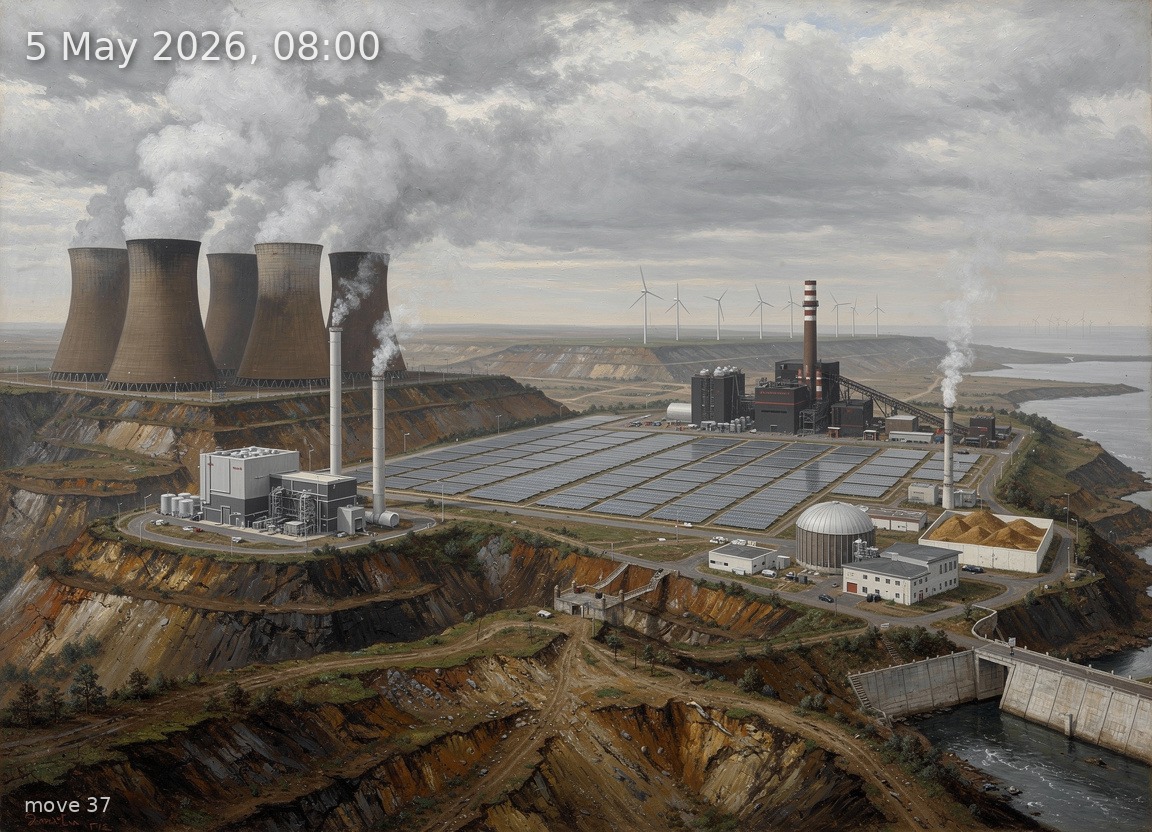
Overcast calm morning: brown coal, solar diffuse, and gas dominate as 24.5 GW net imports fill the supply gap.
Generation mix
Wind onshore 7%
Wind offshore 1%
Solar 32%
Biomass 11%
Hydro 4%
Natural gas 13%
Hard coal 10%
Brown coal 22%
55%
Renewable share
3.1 GW
Wind (on + offshore)
12.3 GW
Solar
38.9 GW
Total generation
24.4 GW
Net import
147.2 EUR/MWh
Day-ahead price
13.0°C / 4 km/h
Temp / Wind speed
Open-Meteo, Kassel (51.3°N 9.5°E) · surface estimate from 100 m wind
100.0% / 0.0 W/m²
Cloud cover / Radiation
320
gCO₂/kWh
Image prompt
Brown coal 8.5 GW dominates the left third of the scene as a cluster of massive hyperbolic cooling towers with thick white-grey steam plumes merging into the overcast sky, surrounded by open-pit mine terraces of exposed lignite earth; natural gas 5.2 GW occupies the left-centre as two compact CCGT power blocks with tall slender exhaust stacks trailing thin heat shimmer; hard coal 3.9 GW appears centre-right as a traditional coal-fired station with rectangular boiler houses, conveyor belts, and a single large chimney emitting pale smoke; solar 12.3 GW fills a broad mid-ground plateau with vast fields of aluminium-framed crystalline silicon PV panels, their surfaces dull and matte under the fully overcast sky reflecting no glint, no sunshine visible; biomass 4.4 GW is rendered as a wood-chip fueled CHP plant with a compact dome silo and modest steam stack near the right side; wind onshore 2.8 GW appears as a sparse row of tall three-blade turbines on a distant ridge, their rotors barely turning in the still air; wind offshore 0.3 GW is suggested by two or three tiny turbines on the far horizon behind a grey sea inlet; hydro 1.5 GW is a concrete run-of-river dam with modest white water spilling over its weir in the right foreground. The sky is a uniform blanket of heavy stratiform cloud, fully overcast at 100%, no blue patches, illuminated by diffuse mid-morning daylight — it is 08:00 in May so daylight is full but flat and shadowless. The atmosphere feels heavy and oppressive, reflecting the high electricity price. Spring vegetation: fresh green grass and young deciduous leaves on scattered birch and beech trees, temperature around 13°C so no frost. High-voltage transmission pylons with bundled conductors recede into the misty distance suggesting the massive imports flowing into the grid. Highly detailed oil painting in the tradition of 19th-century German Romantic landscape painters — Caspar David Friedrich meets industrial sublime — with rich earth tones, visible impasto brushwork, atmospheric aerial perspective, and meticulous engineering accuracy on every turbine nacelle, cooling tower shell, and panel rack. No text, no labels.