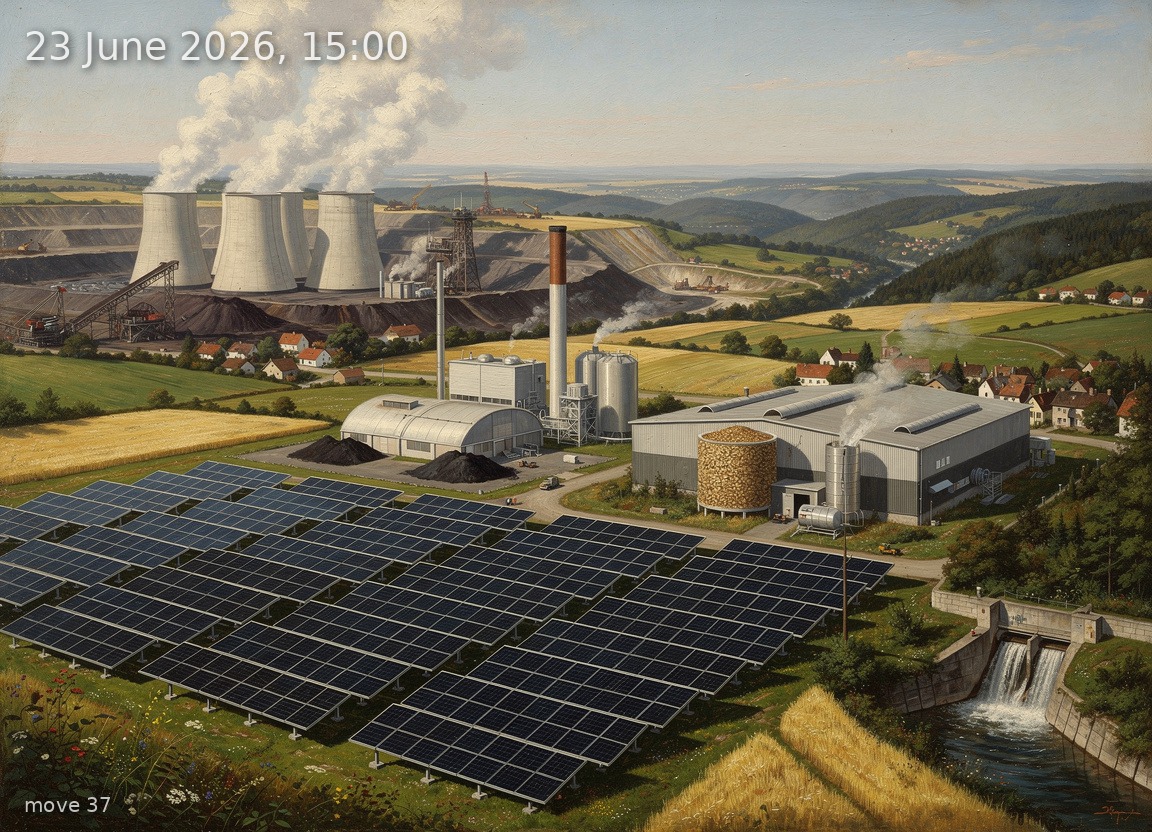
Solar at 44.3 GW drives 70% of generation on a hot, nearly windless June afternoon with 5.9 GW net export.
Generation mix
Wind onshore 1%
Wind offshore 0%
Solar 70%
Biomass 6%
Hydro 3%
Natural gas 5%
Hard coal 5%
Brown coal 10%
80%
Renewable share
1.0 GW
Wind (on + offshore)
44.3 GW
Solar
63.4 GW
Total generation
+5.9 GW
Net export
81.4 EUR/MWh
Day-ahead price
29.5°C / 8 km/h
Temp / Wind speed
Open-Meteo, Kassel (51.3°N 9.5°E) · surface estimate from 100 m wind
31.0% / 559.0 W/m²
Cloud cover / Radiation
146
gCO₂/kWh
Image prompt
Solar 44.3 GW dominates the scene as a vast expanse of crystalline silicon photovoltaic panels stretching across roughly two-thirds of the composition, covering gentle rolling farmland and flat rooftops of villages, their aluminium frames glinting under intense afternoon sun. Brown coal 6.3 GW occupies the left background as a cluster of massive hyperbolic cooling towers with thick white steam plumes rising into the hazy sky, flanked by conveyor belts and open-pit terraces. Hard coal 3.4 GW appears as a smaller power station with a single tall chimney and coal bunkers just left of centre. Natural gas 3.2 GW is rendered as compact CCGT units with slender exhaust stacks emitting faint heat shimmer in the centre-left middle ground. Biomass 3.6 GW shows as a mid-sized industrial hall with a woodchip silo and low steam vent near the centre. Hydro 1.7 GW is a small dam and spillway nestled in a forested valley at the right edge. Wind onshore 0.8 GW appears as two or three distant three-blade turbines on a ridge at the far right, their rotors barely turning. Time is 3 PM midsummer: the sun is high and blazing from the south-southwest, casting short sharp shadows; sky is mostly blue with scattered cumulus clouds covering roughly a third of the dome; the light is white-gold and slightly hazy from the 29.5 °C heat. The atmosphere feels heavy and oppressive — heat ripples over tarmac and panels, a faint yellowish tinge in the lower sky suggesting the elevated 81.4 EUR/MWh price tension. Vegetation is lush midsummer green but dry at the edges, wheat fields golden, wildflowers wilting. Painted in the style of a highly detailed 19th-century German Romantic oil painting — rich saturated colour, visible impasto brushwork, dramatic atmospheric depth receding through layered plains to a hazy horizon — yet every technology is rendered with meticulous engineering accuracy: turbine nacelles, lattice towers, PV cell grid patterns, cooling tower parabolic geometry, CCGT exhaust stacks. No text, no labels.