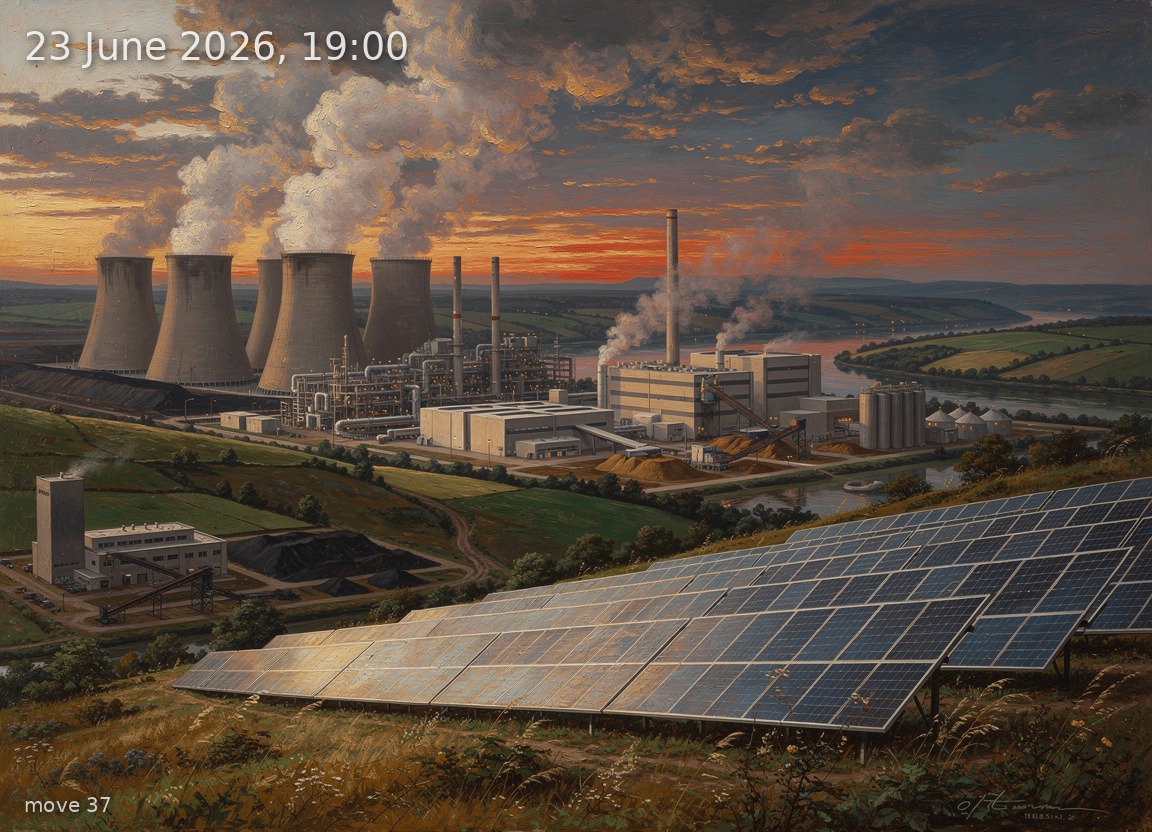
Brown coal and gas dominate as solar fades and weak wind forces heavy imports during a hot summer evening.
Generation mix
Wind onshore 5%
Wind offshore 1%
Solar 24%
Biomass 10%
Hydro 5%
Natural gas 19%
Hard coal 9%
Brown coal 26%
46%
Renewable share
2.5 GW
Wind (on + offshore)
9.3 GW
Solar
38.3 GW
Total generation
21.0 GW
Net import
340.7 EUR/MWh
Day-ahead price
28.5°C / 7 km/h
Temp / Wind speed
Open-Meteo, Kassel (51.3°N 9.5°E) · surface estimate from 100 m wind
40.0% / 166.0 W/m²
Cloud cover / Radiation
375
gCO₂/kWh
Image prompt
Brown coal 10.1 GW dominates the left third of the scene as a massive lignite power complex with four hyperbolic cooling towers exhaling thick white steam plumes into the evening sky; solar 9.3 GW occupies the centre-right as expansive fields of aluminium-framed crystalline silicon PV panels catching the last low-angle golden light; natural gas 7.1 GW appears as two compact CCGT units with tall single exhaust stacks and heat shimmer, positioned centre-left beside the coal complex; biomass 4.0 GW is rendered as a mid-sized industrial plant with a wood-chip conveyor and a single modest smokestack at centre; hard coal 3.5 GW appears as a smaller coal-fired station with a single rectangular cooling tower and coal bunkers in the left background; wind onshore 2.0 GW shows a sparse cluster of three tall three-blade turbines with lattice towers on a distant ridge, their blades barely turning in the still air; hydro 1.9 GW is depicted as a concrete dam with a modest spillway releasing water in the far right valley; wind offshore 0.5 GW appears as two tiny turbines visible on the extreme horizon line. The sky is a dusk scene at 19:00 in late June — rapidly fading warm orange-red glow concentrated on the lower western horizon, transitioning upward through dusty rose into a darkening steel-blue sky above, with scattered clouds at roughly 40 percent coverage catching amber and copper light on their undersides. The atmosphere feels heavy and oppressive, hazy with summer heat at 28.5 degrees, dust and industrial particulate creating a thick, almost tangible quality to the air — reflecting the extreme 340 EUR/MWh price tension. Vegetation is lush midsummer green but parched at the edges, tall grasses golden-dry. The landscape is a broad German river valley with gently rolling terrain. Rendered as a highly detailed oil painting in the tradition of 19th-century German Romantic landscape painters — rich saturated colour palette of amber, ochre, slate-blue and copper, visible confident brushwork, atmospheric depth with aerial perspective softening distant elements, meticulous engineering accuracy on every turbine nacelle, PV cell grid, cooling tower hyperbolic curve, and exhaust stack detail. The painting conveys the monumental industrial sublime. No text, no labels.