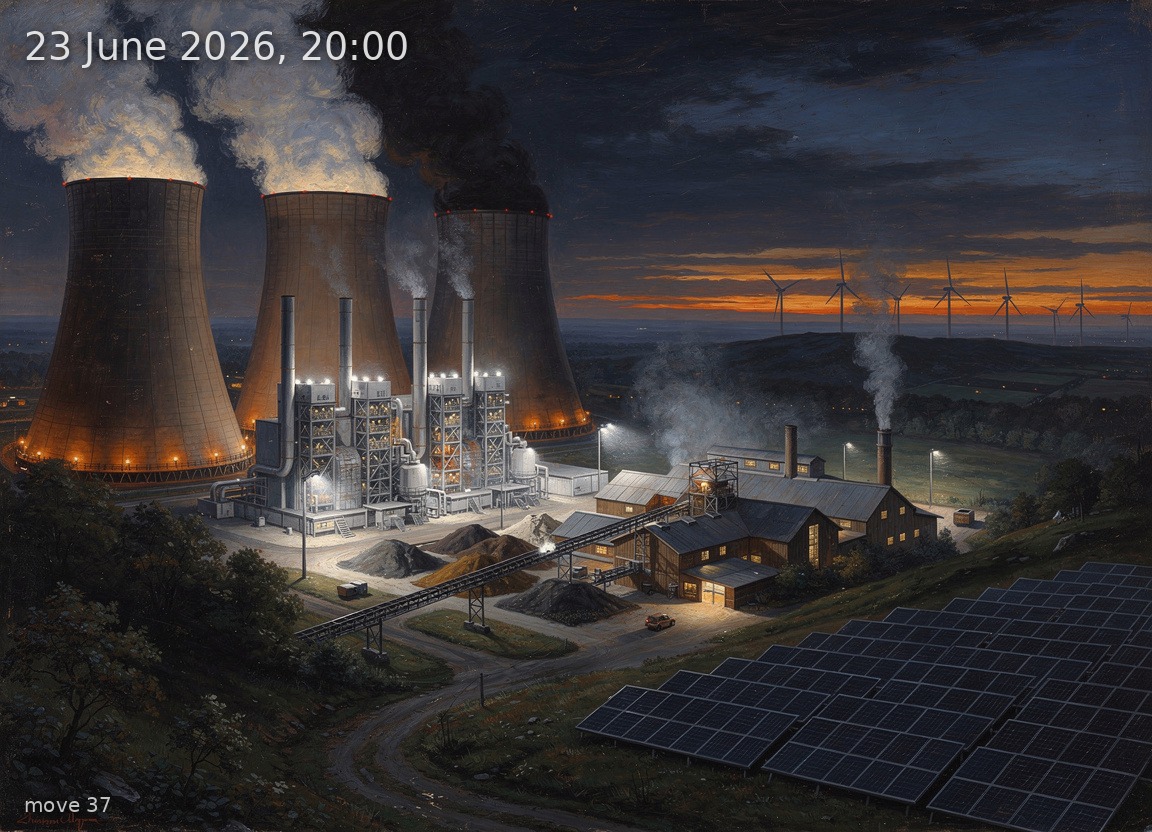
Brown coal and gas dominate a 34 GW supply facing 57.8 GW demand, driving extreme prices amid summer heat and low wind.
Generation mix
Wind onshore 8%
Wind offshore 2%
Solar 9%
Biomass 12%
Hydro 5%
Natural gas 25%
Hard coal 10%
Brown coal 29%
36%
Renewable share
3.2 GW
Wind (on + offshore)
3.0 GW
Solar
34.0 GW
Total generation
23.9 GW
Net import
545.5 EUR/MWh
Day-ahead price
27.7°C / 8 km/h
Temp / Wind speed
Open-Meteo, Kassel (51.3°N 9.5°E) · surface estimate from 100 m wind
5.0% / 130.0 W/m²
Cloud cover / Radiation
439
gCO₂/kWh
Records
#3
The Spike
Image prompt
Brown coal 9.9 GW dominates the left third of the scene as a vast complex of hyperbolic cooling towers with thick white-grey steam plumes rising into a darkening sky, lit from below by orange sodium lamps; natural gas 8.5 GW fills the centre-left as a row of compact CCGT power plants with tall single exhaust stacks emitting thin heat shimmer, their steel structures glowing under industrial floodlights; biomass 4.1 GW appears centre-right as a cluster of smaller wood-clad generation plants with conveyor belts and modest chimneys, warmly lit; hard coal 3.5 GW sits behind the brown coal complex as two additional large stacks with darker smoke; solar 3.0 GW is rendered as a field of aluminium-framed crystalline silicon panels in the far right middle ground, their surfaces now dark and reflecting only the fading sky; wind onshore 2.6 GW appears as a sparse line of three-blade turbines on a distant ridge, rotors barely turning in negligible wind; wind offshore 0.6 GW is suggested by tiny turbine silhouettes on a far horizon line; hydro 1.8 GW appears as a concrete dam structure with spillway in the far right background. The sky is a late-June evening at 20:00 in central Germany—the sun has just set, a thin band of deep amber-orange clings to the western horizon beneath a rapidly darkening blue-black sky, stars not yet visible, the atmosphere heavy and oppressive with summer heat haze at 27.7°C. The landscape is lush green deciduous forest and fields but wilting slightly in the heat. The air feels thick and still. The overall mood is weighty and tense, reflecting the extreme electricity price. Rendered as a highly detailed oil painting in the tradition of 19th-century German Romantic landscape painters—rich impasto brushwork, dramatic chiaroscuro between the glowing industrial facilities and the darkening sky, atmospheric depth with haze layers, meticulous engineering accuracy on all turbine nacelles, cooling tower geometry, PV panel framing, and CCGT stack detailing. No text, no labels.