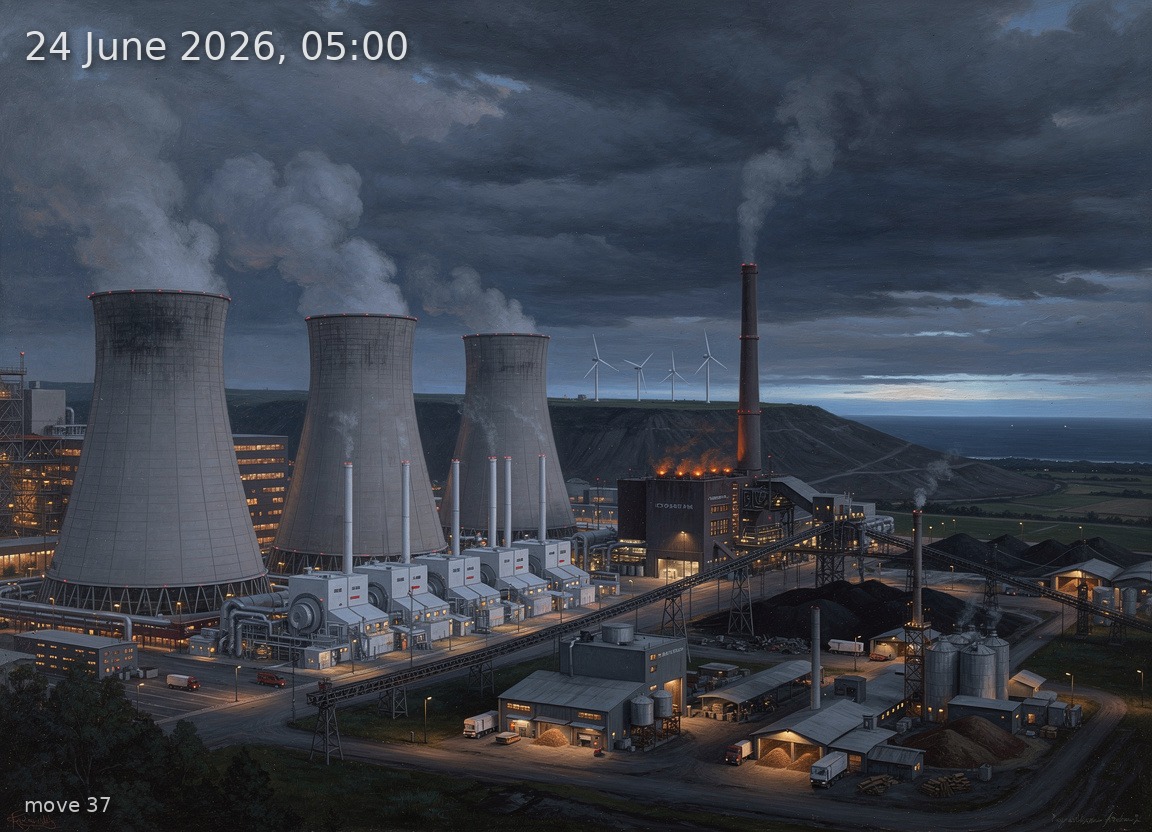
Brown coal, gas, and hard coal dominate as calm winds and pre-dawn darkness force heavy net imports of 19.2 GW.
Generation mix
Wind onshore 7%
Wind offshore 2%
Solar 3%
Biomass 13%
Hydro 6%
Natural gas 23%
Hard coal 12%
Brown coal 33%
32%
Renewable share
2.6 GW
Wind (on + offshore)
0.9 GW
Solar
28.2 GW
Total generation
19.2 GW
Net import
151.6 EUR/MWh
Day-ahead price
16.1°C / 2 km/h
Temp / Wind speed
Open-Meteo, Kassel (51.3°N 9.5°E) · surface estimate from 100 m wind
72.0% / 0.0 W/m²
Cloud cover / Radiation
476
gCO₂/kWh
Image prompt
Brown coal 9.4 GW dominates the left third of the scene as a vast lignite power station complex with four massive hyperbolic cooling towers emitting thick white-grey steam plumes into the heavy sky; natural gas 6.4 GW fills the centre-left as a row of compact CCGT plants with tall single exhaust stacks trailing thin heat shimmer; hard coal 3.4 GW appears centre-right as a dark industrial block with a single large smokestack and coal conveyors; biomass 3.7 GW sits nearby as a cluster of smaller wood-chip-burning facilities with modest chimneys and warm amber-lit loading bays; wind onshore 2.1 GW is rendered as a small group of three-blade turbines on a distant ridge, rotors nearly motionless in the still air; wind offshore 0.5 GW is a barely visible pair of turbines on a far horizon line; hydro 1.7 GW is a concrete dam with spillway nestled in a forested valley at the far right; solar 0.9 GW appears as a small field of aluminium-framed crystalline silicon panels in the foreground, entirely dark and inactive, reflecting no light. Time of day is 05:00 in late June — the sky is deep blue-grey pre-dawn light, no direct sunlight, only the faintest pale band of steel-blue luminescence along the eastern horizon. Cloud cover is heavy at 72%, with thick oppressive low stratus reinforcing the high-price tension. Temperature is mild at 16°C — lush green deciduous trees and summer meadow grasses, slightly dew-covered. Vegetation is full midsummer growth. The atmosphere is heavy, brooding, and industrially dominated. Sodium-orange lights glow from the coal plants and gas facilities. Transmission towers with high-voltage lines stretch across the midground, emphasising interconnection and import dependency. Style: highly detailed oil painting in the tradition of 19th-century German Romantic landscape painters such as Caspar David Friedrich crossed with industrial realism — rich colour palette of deep indigo, warm amber industrial glows, cool grey steam, visible impasto brushwork, atmospheric depth with sfumato haze around distant cooling towers, meticulous engineering accuracy on all turbine nacelles, lattice masts, cooling tower geometries, and exhaust infrastructure. No text, no labels.