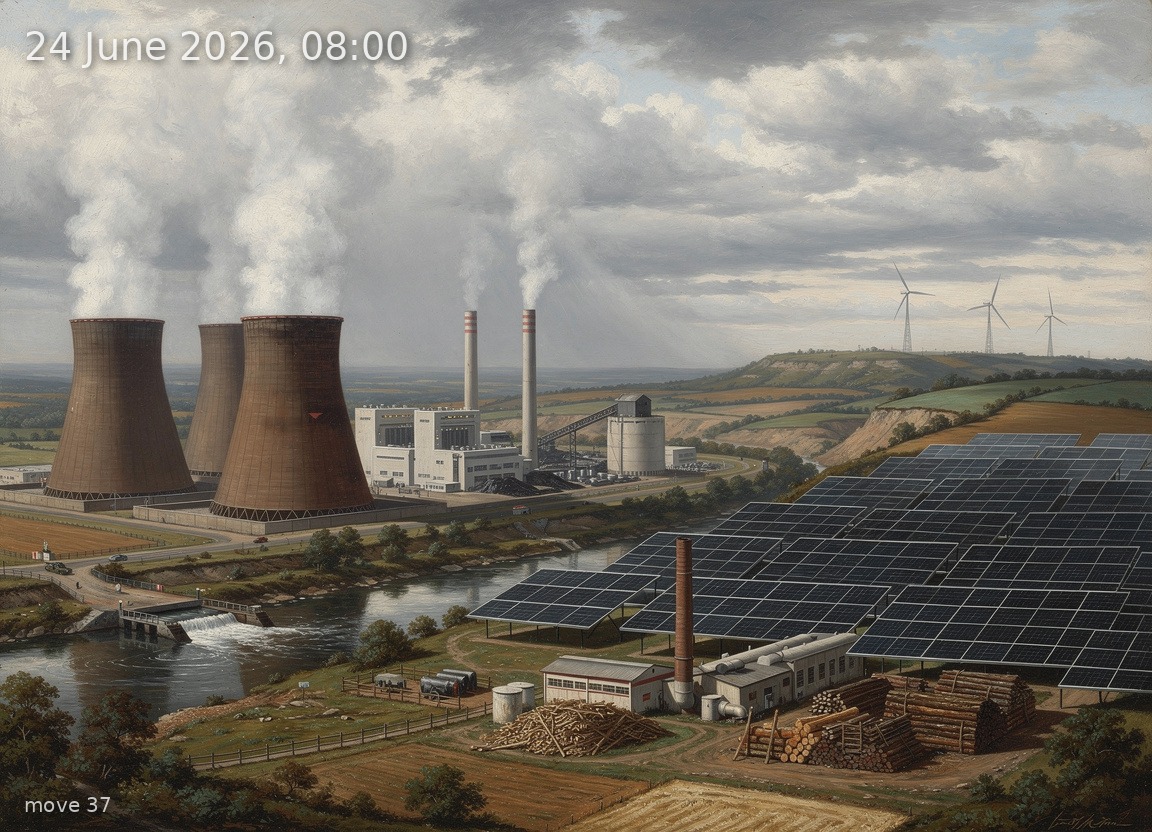
Solar leads at 25.2 GW under overcast skies, but near-zero wind forces heavy coal and gas dispatch.
Generation mix
Wind onshore 1%
Wind offshore 0%
Solar 49%
Biomass 8%
Hydro 3%
Natural gas 13%
Hard coal 7%
Brown coal 18%
62%
Renewable share
0.8 GW
Wind (on + offshore)
25.2 GW
Solar
51.3 GW
Total generation
9.7 GW
Net import
149.3 EUR/MWh
Day-ahead price
18.5°C / 1 km/h
Temp / Wind speed
Open-Meteo, Kassel (51.3°N 9.5°E) · surface estimate from 100 m wind
73.0% / 57.0 W/m²
Cloud cover / Radiation
265
gCO₂/kWh
Image prompt
Brown coal 9.4 GW occupies the left quarter as a cluster of massive hyperbolic cooling towers with thick white-grey steam plumes rising into an overcast sky; natural gas 6.7 GW appears centre-left as three compact CCGT power blocks with tall slim exhaust stacks venting thin heat haze; hard coal 3.5 GW sits behind them as a smaller coal plant with a single large smokestack and conveyor belts of dark fuel; solar 25.2 GW dominates the right half and middle distance as vast fields of aluminium-framed crystalline silicon photovoltaic panels stretching across gently rolling farmland, their surfaces reflecting a diffuse silvery-white light; biomass 4.0 GW appears as a mid-ground wood-chip-fed CHP plant with a modest chimney and timber storage yard; hydro 1.7 GW is a small run-of-river weir and powerhouse along a river in the middle distance; wind onshore 0.6 GW is represented by two or three distant three-blade turbines on a ridge, their rotors barely turning, nearly motionless. The sky is a heavy 73% overcast — layered altostratus and stratocumulus in muted pearl-grey and dull cream tones — with patches of hazy brightness where the June morning sun at 08:00 tries to penetrate. Full daytime illumination but flat and diffuse, no sharp shadows. The atmosphere feels oppressive and thick, hinting at the high electricity price. Temperature is mild at 18.5°C; vegetation is lush midsummer green — tall grass, leafy deciduous trees, wildflowers along field margins. The air is utterly still, no motion in leaves or flags. Rendered as a highly detailed oil painting in the tradition of 19th-century German Romantic landscape painters — rich layered colour, visible confident brushwork, atmospheric aerial perspective with haze softening distant industrial structures — yet every technology is depicted with meticulous engineering accuracy: turbine nacelles with three-blade rotors on lattice or tubular towers, PV panels with visible cell grids and aluminium frames, lignite cooling towers with correct hyperboloid geometry and condensation plumes, CCGT units with heat recovery steam generators. The composition balances pastoral foreground beauty against industrial mid-ground reality. No text, no labels, no people.