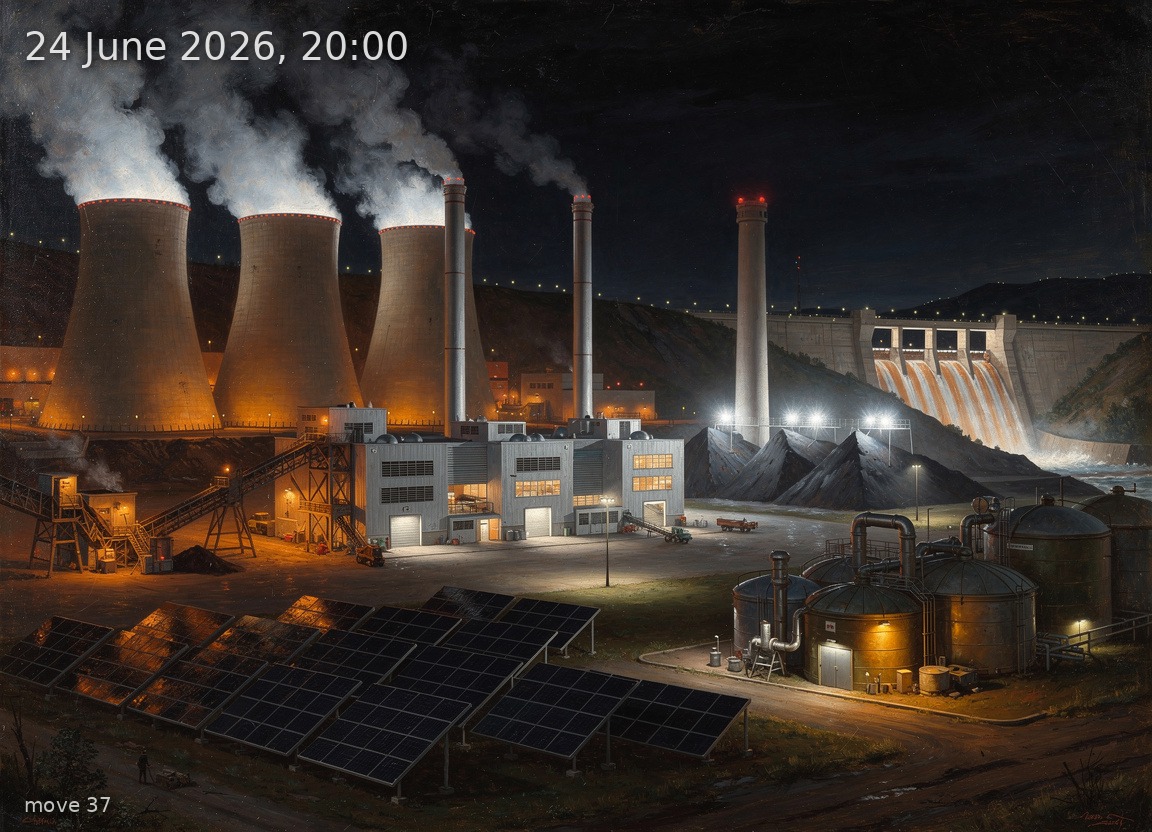
Brown coal, gas, and hard coal dominate as solar fades, heatwave drives 58 GW demand and record prices.
Generation mix
Wind onshore 5%
Wind offshore 1%
Solar 10%
Biomass 13%
Hydro 6%
Natural gas 26%
Hard coal 13%
Brown coal 27%
34%
Renewable share
2.0 GW
Wind (on + offshore)
3.0 GW
Solar
31.6 GW
Total generation
26.4 GW
Net import
665.8 EUR/MWh
Day-ahead price
30.2°C / 8 km/h
Temp / Wind speed
Open-Meteo, Kassel (51.3°N 9.5°E) · surface estimate from 100 m wind
0.0% / 143.0 W/m²
Cloud cover / Radiation
443
gCO₂/kWh
Records
#1
The Spike
#2
Wild Ride
Image prompt
Brown coal 8.5 GW dominates the left third of the scene as a massive complex of four hyperbolic cooling towers releasing thick white steam plumes into a dark sky, with lignite conveyor belts and glowing boiler houses at their base. Natural gas 8.1 GW fills the centre-left as three compact CCGT power stations with tall single exhaust stacks emitting thin heat shimmer, turbine halls lit by sodium-orange industrial lighting. Hard coal 4.1 GW appears centre-right as a smaller coal-fired plant with a single large chimney and coal stockpiles visible under floodlights. Biomass 4.1 GW is rendered as a cluster of industrial biogas facilities with cylindrical digesters and small chimneys, warmly lit from within. Solar 3.0 GW appears as a field of aluminium-framed crystalline silicon panels in the mid-ground, their surfaces dark and reflective under artificial light, catching only faint ambient glow — no sunlight. Hydro 1.8 GW is depicted as a concrete dam with illuminated spillway in the right background. Wind onshore 1.6 GW shows a small row of three-blade turbines on a distant ridge, their rotors barely turning in the still air, red aviation warning lights blinking. Wind offshore 0.4 GW is a faint suggestion of two offshore turbines on a dark horizon line. The sky is completely dark, deep navy-black, no twilight, no sky glow — it is 20:00 in late June but the scene conveys oppressive nighttime heat: the air is thick and hazy, heat distortion rises from every surface. The atmosphere is heavy and suffocating, reflecting the extreme electricity price. Vegetation is lush midsummer green but wilted and parched under the 30-degree heatwave. A river in the foreground reflects the orange industrial glow of the power stations. Zero cloud cover means stars would be visible but are obscured by industrial haze and steam plumes. Rendered as a highly detailed oil painting in the tradition of 19th-century German Romantic landscape painters — rich impasto brushwork, dramatic chiaroscuro between the deep black sky and the orange-lit industrial structures, atmospheric depth achieved through layered haze and diminishing detail. Meticulous engineering accuracy on every turbine nacelle, cooling tower profile, and exhaust stack. The painting conveys the sublime weight of industrial civilization straining against a hot, breathless night. No text, no labels.