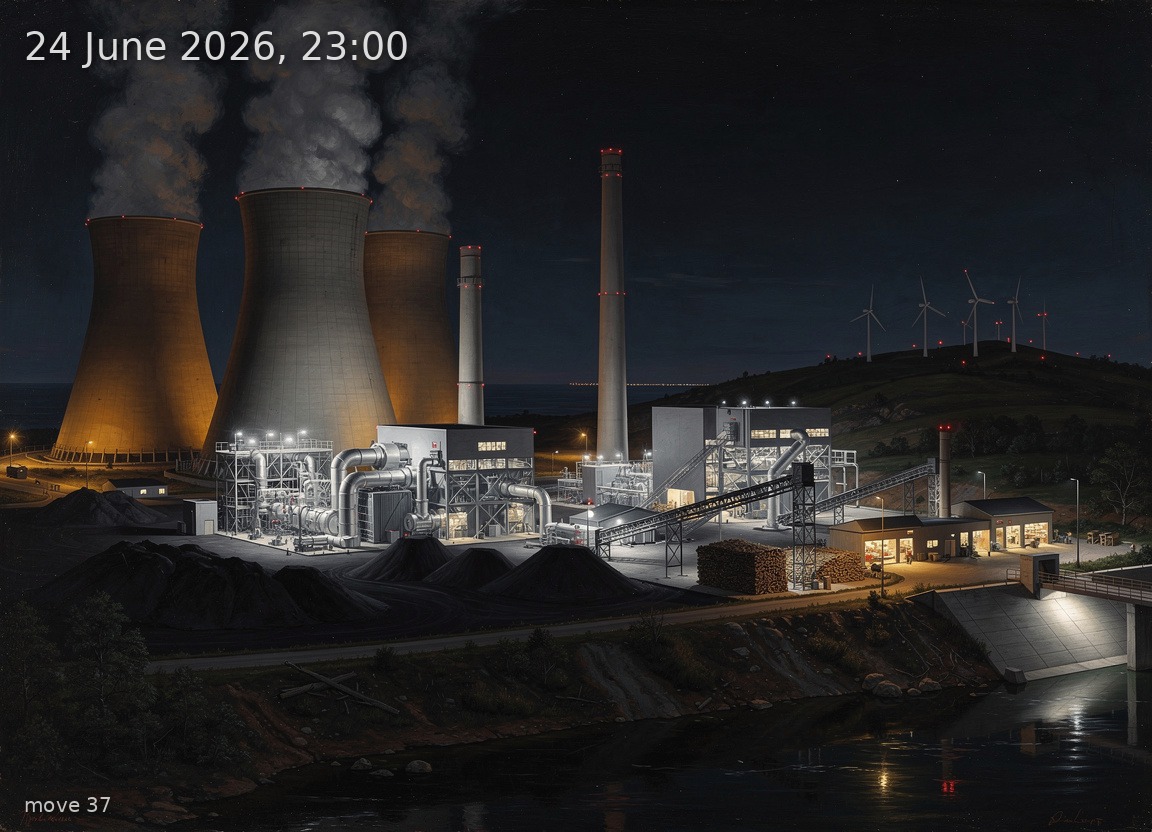
Brown coal, gas, and hard coal dominate overnight generation as low wind and high demand drive significant net imports.
Generation mix
Wind onshore 8%
Wind offshore 2%
Biomass 13%
Hydro 6%
Natural gas 28%
Hard coal 14%
Brown coal 30%
28%
Renewable share
2.8 GW
Wind (on + offshore)
0.0 GW
Solar
30.3 GW
Total generation
19.0 GW
Net import
263.6 EUR/MWh
Day-ahead price
24.2°C / 2 km/h
Temp / Wind speed
Open-Meteo, Kassel (51.3°N 9.5°E) · surface estimate from 100 m wind
0.0% / 0.0 W/m²
Cloud cover / Radiation
487
gCO₂/kWh
Image prompt
Brown coal 9.2 GW dominates the left third of the scene as a cluster of massive hyperbolic cooling towers with heavy white-grey steam plumes rising into a black night sky, lit from below by amber sodium lamps; natural gas 8.3 GW fills the centre-left as two compact CCGT power stations with tall single exhaust stacks emitting thin heat shimmer, their steel structures gleaming under harsh industrial floodlights; hard coal 4.1 GW appears centre-right as a blocky coal-fired station with conveyor belts and a single large smokestack, illuminated by white security lights; biomass 4.0 GW is rendered as a smaller wood-chip-fed generation plant with a modest chimney and stacked fuel piles, warm interior glow visible through open doors; wind onshore 2.3 GW appears as a small group of three-blade turbines on a distant ridge, their red aviation warning lights blinking faintly, rotors nearly motionless in the still air; hydro 1.7 GW is suggested by a concrete dam structure at the far right edge, with water glinting under a single spotlight; wind offshore 0.5 GW is barely visible as a tiny cluster of turbine lights on the far horizon line. The sky is completely black with no twilight or sky glow — deep navy to pure black — a warm midsummer night with stars faintly visible where steam plumes thin out. The atmosphere feels heavy and oppressive, with humid haze clinging to the ground reflecting the high electricity price. Lush green vegetation on surrounding hills suggests midsummer warmth at 24°C. No solar panels anywhere. The landscape is rendered as a highly detailed oil painting in the tradition of 19th-century German Romantic landscape painters — rich saturated colour, visible impasto brushwork, dramatic chiaroscuro between deep shadows and industrial lighting, atmospheric depth with layers of steam and haze receding into darkness. Each technology is painted with meticulous engineering accuracy: turbine nacelles, lattice towers, cooling tower parabolic profiles, CCGT exhaust geometry. The overall mood is a grand nocturnal industrial tableau, a masterwork painting of energy infrastructure laboring through a still, sweltering night. No text, no labels.