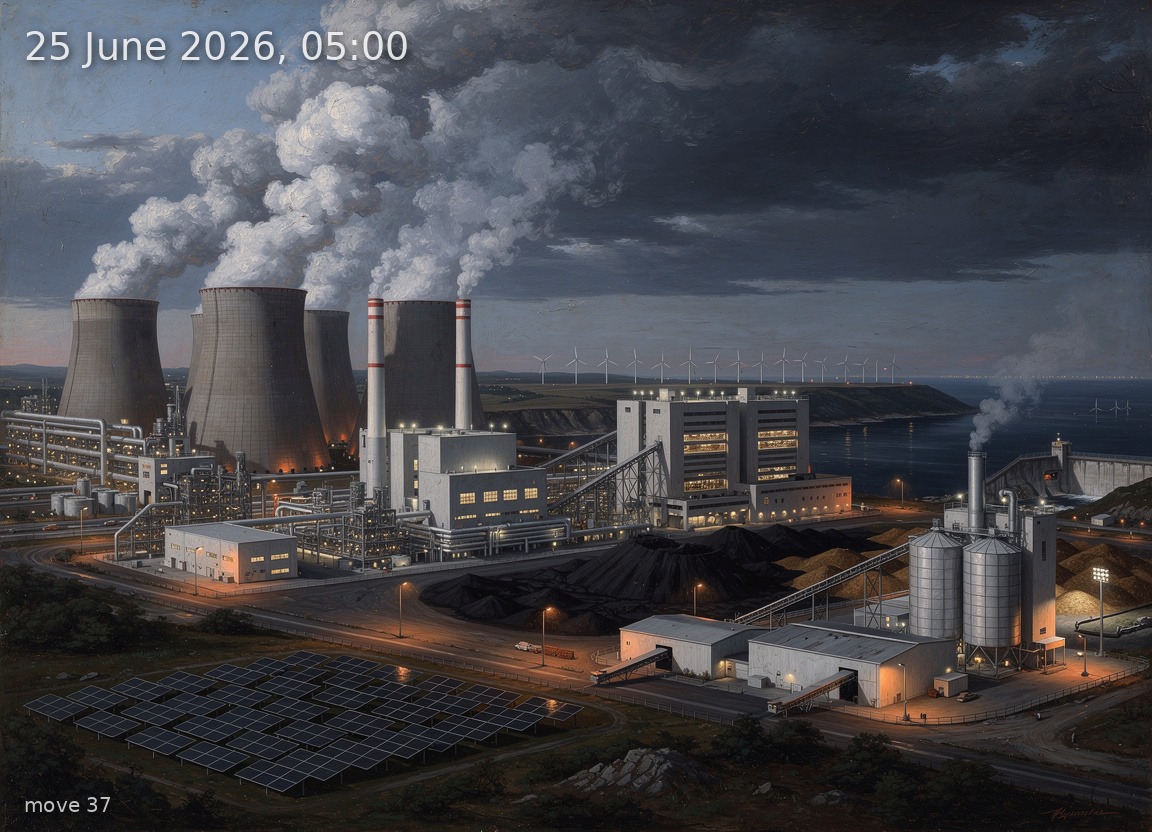
Brown coal and gas dominate pre-dawn generation as near-zero wind and no solar drive heavy net imports.
Generation mix
Wind onshore 9%
Wind offshore 3%
Solar 3%
Biomass 13%
Hydro 6%
Natural gas 20%
Hard coal 14%
Brown coal 32%
34%
Renewable share
3.4 GW
Wind (on + offshore)
0.8 GW
Solar
28.4 GW
Total generation
17.8 GW
Net import
144.6 EUR/MWh
Day-ahead price
18.6°C / 0 km/h
Temp / Wind speed
Open-Meteo, Kassel (51.3°N 9.5°E) · surface estimate from 100 m wind
11.0% / 0.0 W/m²
Cloud cover / Radiation
468
gCO₂/kWh
Image prompt
Brown coal 9.1 GW dominates the left third of the scene as a vast complex of hyperbolic cooling towers emitting thick white-grey steam plumes into the pre-dawn sky; natural gas 5.6 GW fills the centre-left as a cluster of compact CCGT power stations with tall single exhaust stacks venting heat shimmer; hard coal 4.0 GW appears centre-right as a large coal-fired plant with rectangular boiler houses, conveyor belts, and a coal stockpile dimly lit by sodium lamps; biomass 3.7 GW is rendered as a medium-sized industrial facility with wood-chip silos and a modest steam stack at the right-centre; wind onshore 2.5 GW appears as a row of tall three-blade turbines on a distant ridge, rotors completely still in the windless air; hydro 1.7 GW is depicted as a concrete dam with a reservoir reflecting the dark sky in the middle distance; wind offshore 0.9 GW is suggested by a few distant turbines visible on the far horizon over a calm dark sea to the far right; solar 0.8 GW appears as a small field of aluminium-framed crystalline PV panels in the foreground, dark and inactive, reflecting no light. The sky is deep blue-grey with the faintest pale lavender glow along the eastern horizon—pre-dawn at 05:00, no direct sunlight, no warm tones above the horizon line. Stars are still faintly visible overhead. The atmosphere feels heavy, oppressive, and hazy, reflecting the high electricity price—industrial smoke and steam hang low, diffusing the sparse artificial lighting from sodium streetlights and facility floodlights into an amber fog. Vegetation is lush mid-summer green but muted in the near-darkness. The air is perfectly still—no motion in grass, flags, or turbine blades. Highly detailed oil painting in the tradition of 19th-century German Romantic landscape painters such as Caspar David Friedrich and Carl Blechen, with rich colour depth, visible impasto brushwork, dramatic chiaroscuro between the glowing industrial facilities and the vast dark sky, meticulous engineering detail on every turbine nacelle, cooling tower, and exhaust stack, atmospheric perspective fading into smoky distance. No text, no labels.