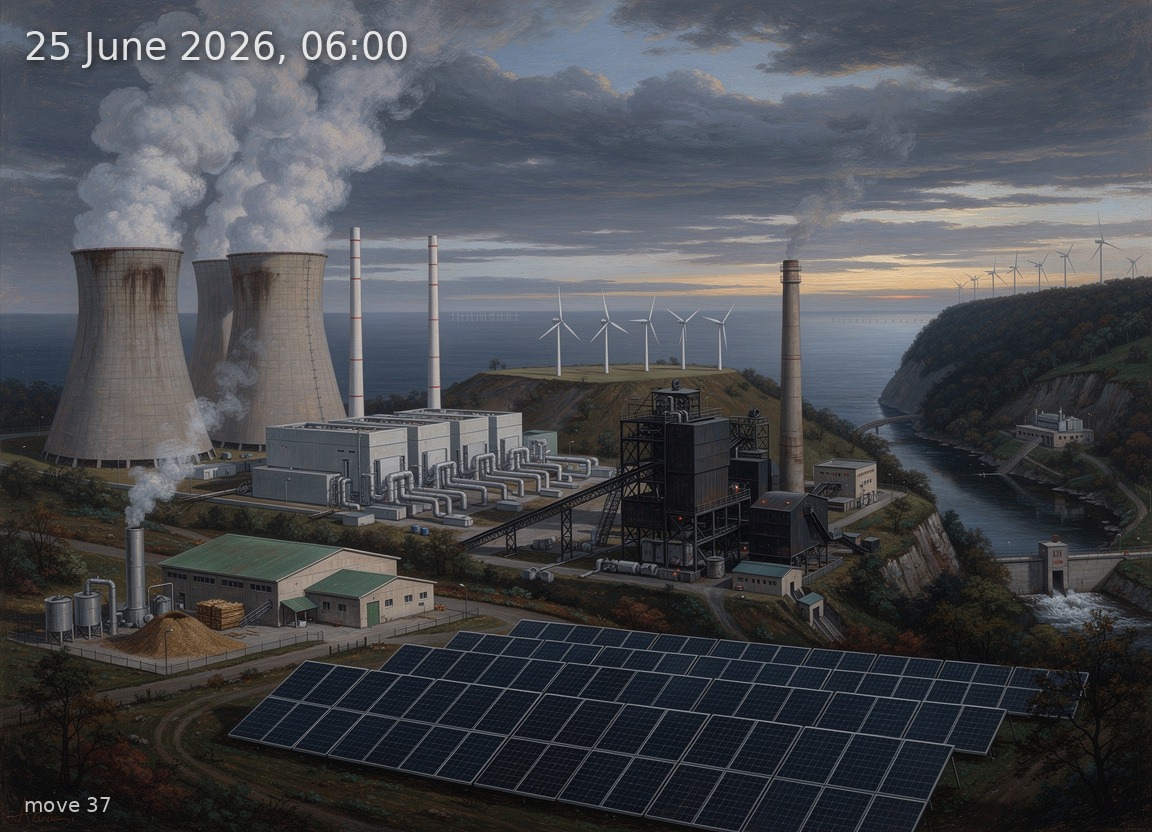
Brown coal and gas dominate as near-zero wind and early dawn solar force heavy net imports at elevated prices.
Generation mix
Wind onshore 7%
Wind offshore 3%
Solar 15%
Biomass 12%
Hydro 5%
Natural gas 18%
Hard coal 13%
Brown coal 28%
42%
Renewable share
3.3 GW
Wind (on + offshore)
4.9 GW
Solar
32.3 GW
Total generation
19.8 GW
Net import
161.3 EUR/MWh
Day-ahead price
18.6°C / 0 km/h
Temp / Wind speed
Open-Meteo, Kassel (51.3°N 9.5°E) · surface estimate from 100 m wind
41.0% / 2.0 W/m²
Cloud cover / Radiation
409
gCO₂/kWh
Image prompt
Brown coal 9.0 GW dominates the left third of the scene as a cluster of massive hyperbolic cooling towers with thick white-grey steam plumes rising into the sky; natural gas 5.8 GW fills the centre-left as a row of compact CCGT power blocks with tall slender exhaust stacks emitting thin heat shimmer; hard coal 4.1 GW appears centre-right as a dark industrial complex with conveyor belts and a single large smokestack; solar 4.9 GW is rendered in the right foreground as rows of aluminium-framed crystalline silicon PV panels angled eastward, catching the first pale grey-blue pre-dawn light; wind onshore 2.4 GW appears as a small group of three-blade turbines on a distant ridge, rotors completely still; wind offshore 0.9 GW is a faint row of turbines on the far horizon; biomass 3.8 GW is a modest wood-chip-fed plant with a green-roofed building and short chimney with pale smoke, placed behind the solar field; hydro 1.6 GW is a small dam and powerhouse nestled in a valley on the far right. The sky is deep blue-grey pre-dawn with the faintest luminous band of pale steel-blue light along the eastern horizon — no direct sun visible, no golden tones, just the very first hint of morning. Clouds cover roughly 40 percent of the sky in broken layers. The atmosphere feels heavy, oppressive, and humid, reflecting high electricity prices. Lush green summer vegetation with trees in full leaf and tall grass; temperature is mild. Sodium-orange industrial lighting still glows at the coal and gas facilities. Painted in the style of a highly detailed 19th-century German Romantic oil painting — rich, layered colour with visible brushwork, deep atmospheric perspective, Caspar David Friedrich-like grandeur combined with meticulous engineering accuracy on every turbine nacelle, cooling tower, and panel frame. No text, no labels.