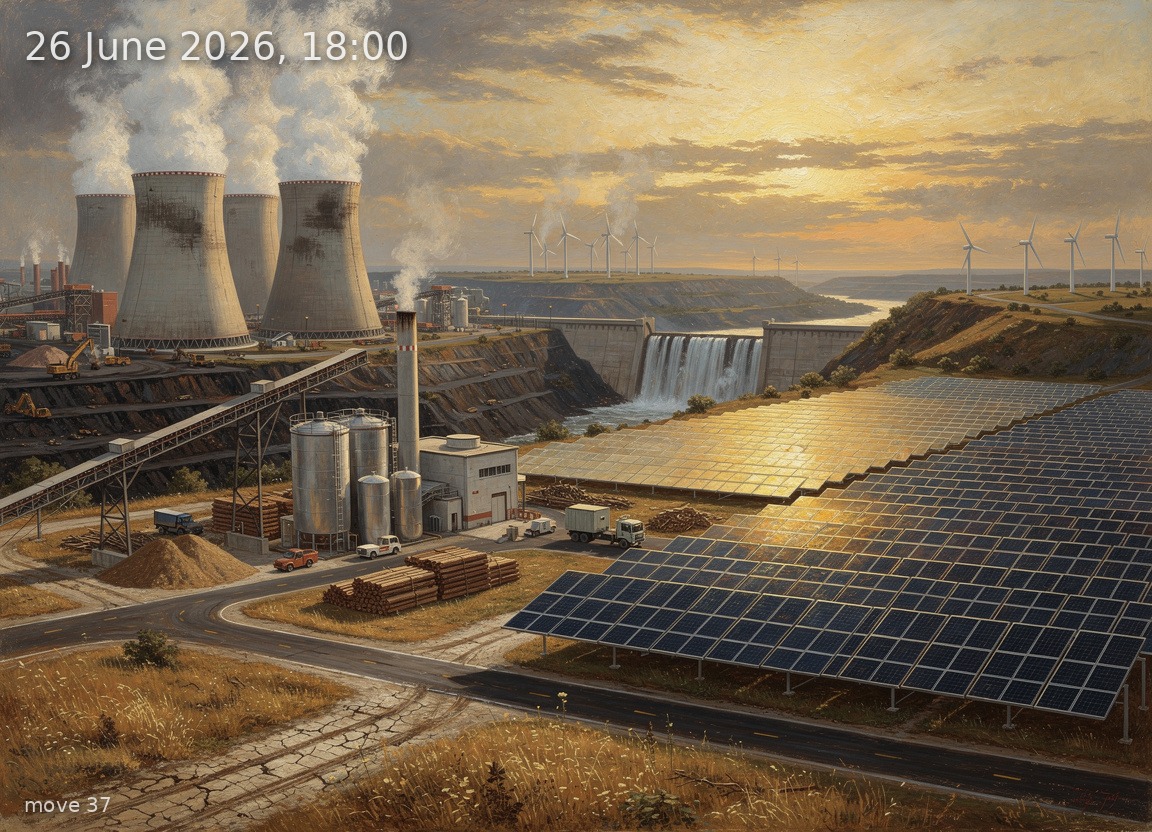
Solar leads at 19.3 GW but extreme heat drives 55.8 GW demand, requiring ~19.4 GW net imports.
Generation mix
Wind onshore 7%
Wind offshore 5%
Solar 53%
Biomass 10%
Hydro 5%
Natural gas 3%
Hard coal 4%
Brown coal 13%
81%
Renewable share
4.6 GW
Wind (on + offshore)
19.3 GW
Solar
36.4 GW
Total generation
19.4 GW
Net import
150.3 EUR/MWh
Day-ahead price
35.6°C / 5 km/h
Temp / Wind speed
Open-Meteo, Kassel (51.3°N 9.5°E) · surface estimate from 100 m wind
0.0% / 423.0 W/m²
Cloud cover / Radiation
146
gCO₂/kWh
Image prompt
Solar 19.3 GW dominates the right half of the scene as vast fields of aluminium-framed crystalline silicon photovoltaic panels stretching across sun-baked farmland, their blue-black surfaces gleaming under intense low-angle golden sunlight; brown coal 4.7 GW occupies the left quarter as a cluster of massive hyperbolic cooling towers with thick white steam plumes rising into the hazy sky, beside conveyor belts and open-pit terraces of dark lignite earth; biomass 3.7 GW appears as a mid-ground combined-heat-and-power plant with squat cylindrical silos and a single exhaust stack beside stacked timber logs; wind onshore 2.6 GW is rendered as a small group of three-blade turbines on a distant ridge, their rotors barely turning in the still air; hydro 1.9 GW shows as a concrete dam with a thin cascade of water in the far background valley; wind offshore 1.9 GW is suggested by tiny turbines visible on a hazy horizon line beyond a river estuary; hard coal 1.3 GW is a single dark industrial block with a rail siding of coal wagons and a narrow smokestack; natural gas 1.0 GW appears as a compact CCGT unit with a single polished exhaust stack emitting a faint heat shimmer. The scene is set at 18:00 dusk in late June: the sun hangs low in the west, casting long amber-orange shadows, the sky is entirely cloudless but oppressively hazy with a whitish-yellow heat pall near the horizon deepening to pale blue overhead. The landscape is parched—dry golden grass, wilting crops, cracked pale soil—conveying extreme 35.6 °C heat. The atmosphere feels heavy and stifling, with visible heat distortion above the solar panels and the asphalt of access roads. Transmission pylons with high-voltage lines run prominently across the mid-ground, symbolising heavy import flows. Style: highly detailed oil painting in the tradition of 19th-century German Romantic landscape painters such as Caspar David Friedrich and Carl Blechen, with rich impasto brushwork, luminous atmospheric depth, dramatic chiaroscuro in the industrial smoke against the golden sky, meticulous engineering detail on every technology element, and a feeling of sublime tension between nature's heat and human industry. No text, no labels.