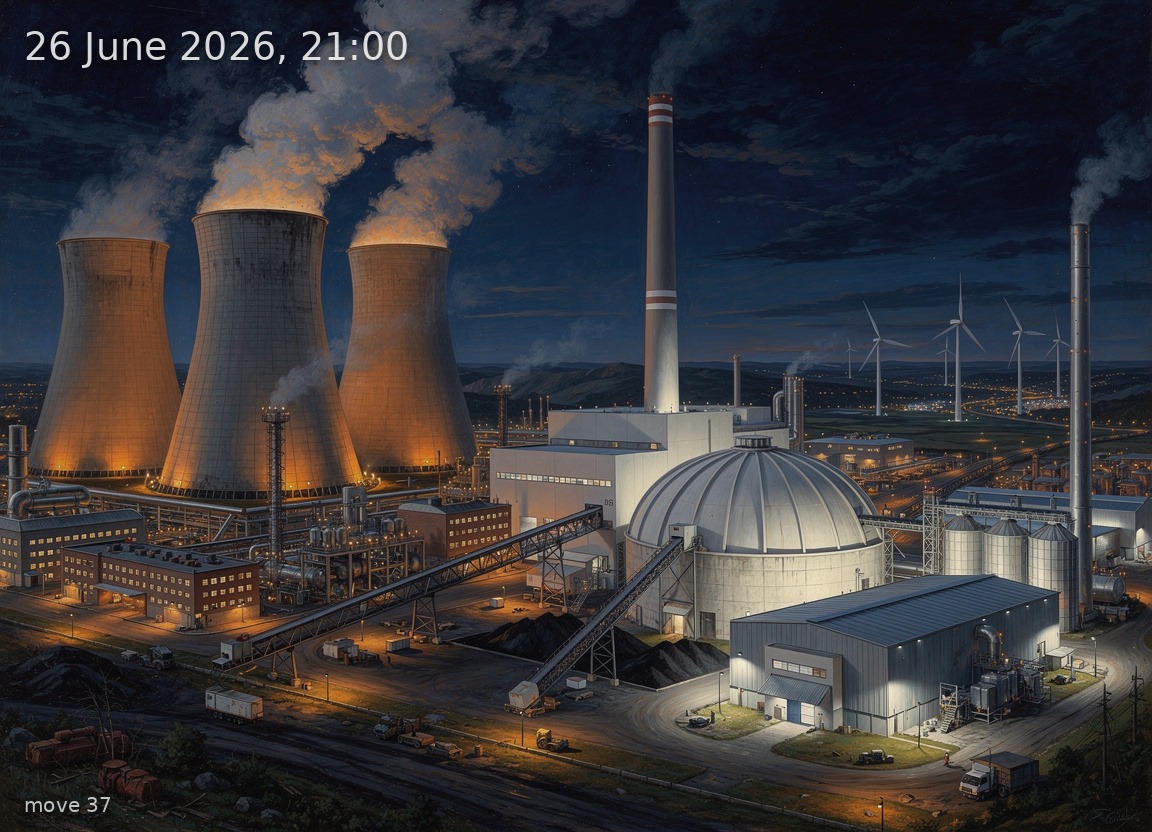
Brown coal and wind lead domestic generation while massive net imports bridge a 24.7 GW gap amid a summer heatwave evening.
Generation mix
Wind onshore 27%
Wind offshore 7%
Solar 1%
Biomass 13%
Hydro 7%
Natural gas 6%
Hard coal 9%
Brown coal 30%
55%
Renewable share
9.3 GW
Wind (on + offshore)
0.3 GW
Solar
27.6 GW
Total generation
24.8 GW
Net import
295.8 EUR/MWh
Day-ahead price
31.1°C / 8 km/h
Temp / Wind speed
Open-Meteo, Kassel (51.3°N 9.5°E) · surface estimate from 100 m wind
3.0% / 40.0 W/m²
Cloud cover / Radiation
341
gCO₂/kWh
Image prompt
Brown coal 8.2 GW dominates the left third of the scene as a vast lignite power station complex with four hyperbolic cooling towers emitting thick pale steam plumes, lit from below by orange sodium floodlights; hard coal 2.5 GW appears as a smaller coal-fired plant just right of centre with a single tall stack and conveyor belts visible under industrial lighting; natural gas 1.7 GW sits as a compact CCGT facility with a slender exhaust stack and modest heat shimmer beside the coal plant; wind onshore 7.3 GW spans the right third as a long row of three-blade turbines on lattice towers along a low ridge, their white nacelles catching faint artificial glow, blades turning slowly in light wind; wind offshore 1.9 GW is suggested on the far-right horizon as a cluster of smaller turbine silhouettes with blinking red aviation lights; biomass 3.7 GW appears as a mid-sized industrial plant with a rounded woodchip storage dome and a single smokestack, located between the coal complex and the wind turbines; hydro 2.0 GW is rendered as a concrete dam structure nestled in a valley in the middle distance with water gleaming faintly under security lights; solar 0.3 GW is represented only as a small dark field of barely visible aluminium-framed panels, unlit and inactive. The sky is completely dark — deep navy to black, no twilight glow, no sunset remnants — it is 21:00 in late June but fully night-dark in this scene, with a few stars barely visible through a nearly cloudless sky. The atmosphere is heavy and oppressive, conveying extreme heat: the air shimmers faintly around industrial structures, dry parched summer grass and wilting linden trees in the foreground suggest 31°C temperatures. High-voltage transmission pylons with glowing insulators stretch from left to right across the middle ground, symbolising massive power flow. Highly detailed oil painting in the tradition of 19th-century German Romantic landscape painters — rich, saturated colour palette of deep indigo, amber industrial glow, and pale steam against darkness — visible confident brushwork, atmospheric depth and chiaroscuro contrast, meticulous engineering accuracy on every turbine nacelle, cooling tower, and exhaust stack. No text, no labels.