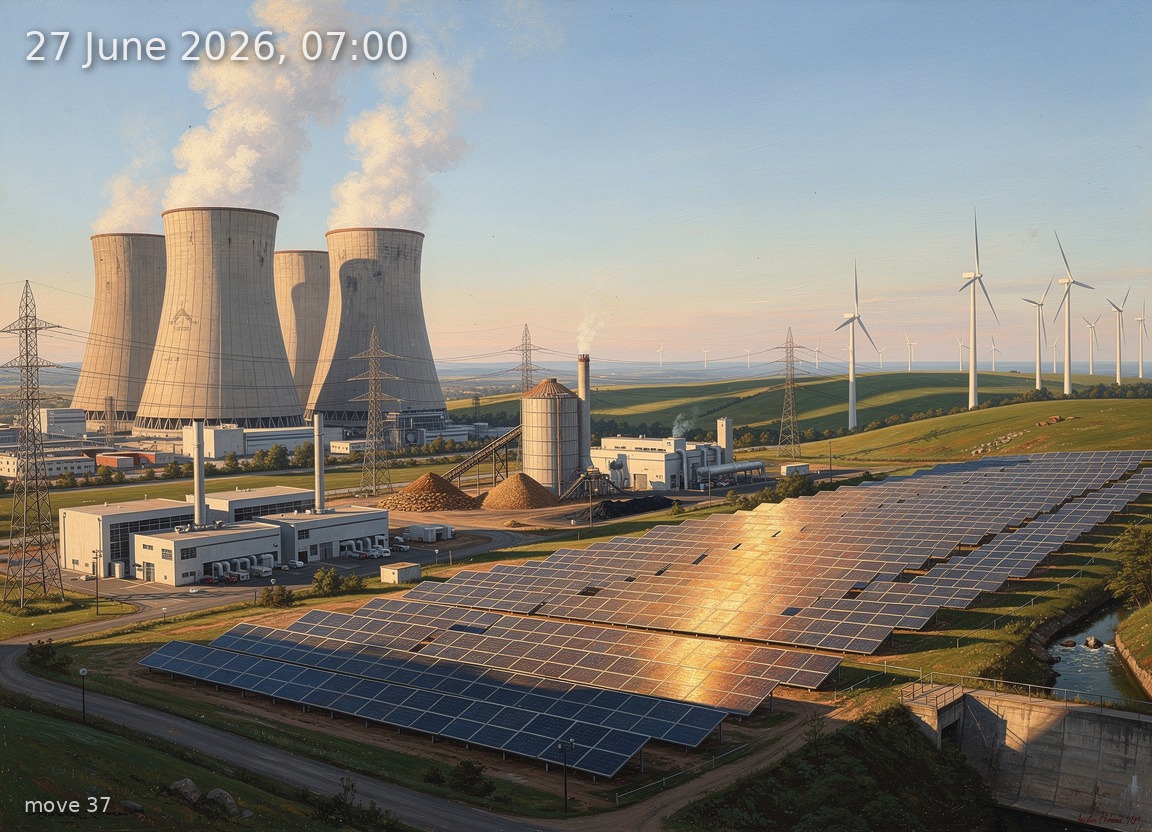
Solar leads at 12.7 GW but brown coal at 8.0 GW and 5 GW net imports fill a morning demand gap.
Generation mix
Wind onshore 15%
Wind offshore 2%
Solar 31%
Biomass 10%
Hydro 5%
Natural gas 9%
Hard coal 8%
Brown coal 20%
63%
Renewable share
7.1 GW
Wind (on + offshore)
12.7 GW
Solar
40.6 GW
Total generation
4.9 GW
Net import
109.3 EUR/MWh
Day-ahead price
21.2°C / 6 km/h
Temp / Wind speed
Open-Meteo, Kassel (51.3°N 9.5°E) · surface estimate from 100 m wind
0.0% / 39.0 W/m²
Cloud cover / Radiation
266
gCO₂/kWh
Image prompt
Brown coal 8.0 GW dominates the left quarter as a cluster of massive hyperbolic cooling towers with thick white steam plumes rising into the sky; solar 12.7 GW fills the centre-right as vast fields of aluminium-framed crystalline silicon panels angled toward the early eastern sun, catching the first direct rays; wind onshore 6.3 GW appears as rows of three-blade turbines on gentle green hills in the right background, blades turning slowly in light breeze; wind offshore 0.8 GW is suggested by a few distant turbines on a hazy horizon line; biomass 4.0 GW is rendered as a medium-sized industrial plant with a wood-chip silo and modest exhaust stack in the centre-left middle ground; natural gas 3.8 GW appears as two compact CCGT units with slim single exhaust stacks beside the coal complex; hard coal 3.2 GW is shown as a smaller conventional power station with a single rectangular cooling tower and conveyor belt; hydro 1.8 GW is a spillway and small dam visible in a valley in the far right. Time of day is early morning dawn-to-daylight transition: the sun is just above the eastern horizon casting long golden-orange rays at a low angle, the sky overhead is pale blue transitioning to deeper blue-grey in the west, with absolutely zero clouds — completely clear sky. The atmosphere feels heavy and oppressive despite the clarity, with a faint brownish industrial haze hanging at ground level suggesting high electricity prices. Summer vegetation: lush green deciduous trees in full leaf, wildflower meadows, ripe wheat fields. Temperature is warm — shimmering heat lines already beginning to form. Style: highly detailed oil painting in the tradition of 19th-century German Romantic landscape painters such as Caspar David Friedrich and Carl Blechen, with rich saturated colour, visible impasto brushwork, atmospheric aerial perspective, and dramatic chiaroscuro from the low morning sun — yet every technological element rendered with meticulous engineering accuracy: turbine nacelles with aviation-warning lights, lattice towers, panel junction boxes, cooling tower reinforced-concrete ribbing, gas turbine air intakes. No text, no labels.