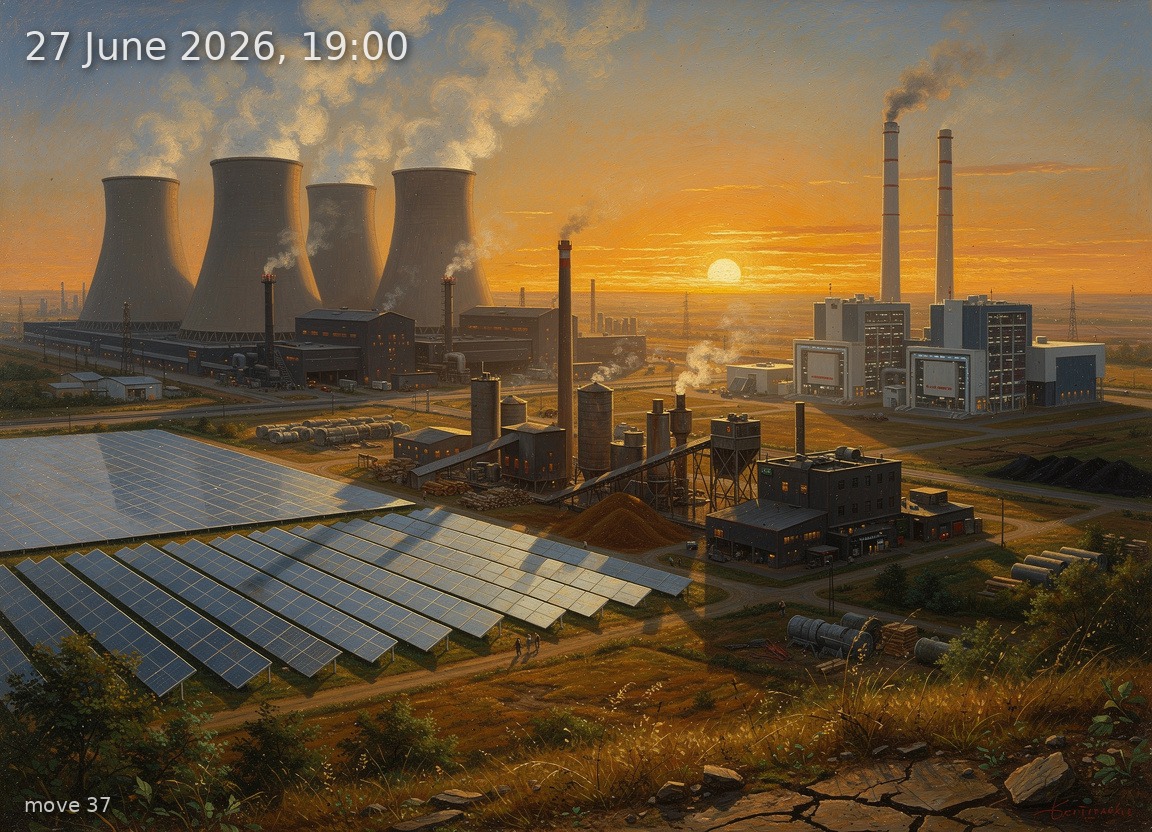
Brown coal and fading solar lead generation as extreme heat drives 50 GW demand and heavy imports.
Generation mix
Wind onshore 8%
Wind offshore 1%
Solar 28%
Biomass 13%
Hydro 5%
Natural gas 12%
Hard coal 8%
Brown coal 25%
55%
Renewable share
2.7 GW
Wind (on + offshore)
8.5 GW
Solar
30.2 GW
Total generation
19.8 GW
Net import
171.8 EUR/MWh
Day-ahead price
34.1°C / 5 km/h
Temp / Wind speed
Open-Meteo, Kassel (51.3°N 9.5°E) · surface estimate from 100 m wind
0.0% / 263.0 W/m²
Cloud cover / Radiation
325
gCO₂/kWh
Image prompt
Brown coal 7.7 GW dominates the left quarter as a massive lignite power station with four hyperbolic cooling towers trailing thick white steam plumes into a hazy sky; solar 8.5 GW fills the centre-left as expansive fields of aluminium-framed crystalline silicon PV panels catching the last angled rays of a low western sun; biomass 3.8 GW appears as a cluster of wood-chip-fed industrial boiler stacks with thin grey exhaust in the centre; natural gas 3.5 GW sits centre-right as two compact CCGT units with slender single exhaust stacks and heat shimmer; hard coal 2.4 GW shows as a smaller coal plant with a single square cooling tower and conveyor belts in the right-centre; wind onshore 2.3 GW is rendered as a small group of three-blade turbines on a distant ridge, rotors barely turning in the still air; hydro 1.6 GW appears as a concrete dam with spillway in the far right background among forested hills; wind offshore 0.4 GW is a faint line of turbines on a hazy horizon. TIME OF DAY: 19:00 Berlin dusk in late June — the sun is very low on the western horizon casting a deep golden-orange glow across the lower sky, with the upper sky transitioning from warm amber to deepening blue. The atmosphere is thick and oppressive, heavy with summer haze and heat shimmer rising from parched golden-brown grass and dry cracked earth, reflecting 34.1°C extreme heat. The air is completely still — no motion in grass or leaves, flags hang limp. The high electricity price is conveyed through a brooding, dense, almost sulfurous quality to the atmosphere. Vegetation is lush summer green but wilted and stressed from heat. Style: highly detailed oil painting in the tradition of 19th-century German Romantic landscape painters such as Caspar David Friedrich and Carl Blechen — rich saturated colour, visible confident brushwork, luminous atmospheric depth, dramatic chiaroscuro from the low dusk light — but with meticulous engineering accuracy in every industrial structure: correct turbine nacelle proportions, lattice tower construction, hyperbolic cooling tower curvature, PV panel grid patterns. The scene reads as a grand panoramic industrial landscape masterwork. No text, no labels.