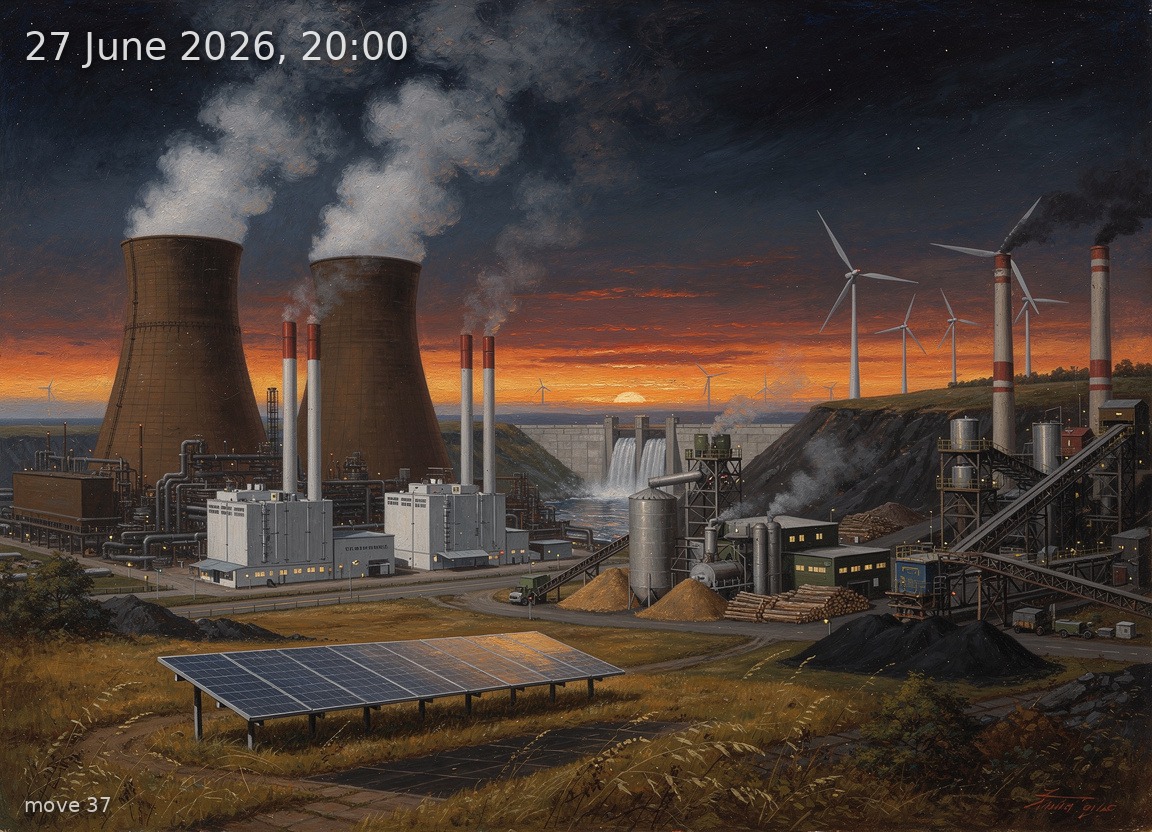
Brown coal and gas dominate as extreme heat drives demand far beyond domestic generation, requiring 22 GW net imports.
Generation mix
Wind onshore 11%
Wind offshore 2%
Solar 10%
Biomass 14%
Hydro 6%
Natural gas 17%
Hard coal 11%
Brown coal 29%
43%
Renewable share
3.5 GW
Wind (on + offshore)
2.7 GW
Solar
27.3 GW
Total generation
22.0 GW
Net import
221.2 EUR/MWh
Day-ahead price
33.5°C / 4 km/h
Temp / Wind speed
Open-Meteo, Kassel (51.3°N 9.5°E) · surface estimate from 100 m wind
20.0% / 135.0 W/m²
Cloud cover / Radiation
403
gCO₂/kWh
Image prompt
Brown coal 7.9 GW dominates the left third of the scene as a massive lignite power station with four hyperbolic cooling towers releasing thick white steam plumes into the darkening sky; natural gas 4.7 GW occupies the left-centre as two compact CCGT plants with slender exhaust stacks venting shimmering heat haze; biomass 3.9 GW appears centre-right as a cluster of industrial wood-chip combustion facilities with stockpiled timber and moderate smoke; hard coal 2.9 GW sits to the right as a traditional coal plant with tall chimneys and conveyor belts; wind onshore 3.0 GW is visible as a small group of three-blade turbines on a distant ridge, their rotors barely turning in the still air; solar 2.7 GW shows as a field of aluminium-framed crystalline silicon panels in the mid-ground catching the last orange light at a low angle; hydro 1.6 GW is a concrete dam structure in the far background with water cascading; wind offshore 0.5 GW is a barely visible pair of turbines on a hazy far horizon. The sky is a late summer dusk at 20:00 in Germany — the sun has just set, leaving a narrow band of deep orange and crimson along the lower western horizon, the upper sky transitioning rapidly to dark navy and indigo, first stars faintly emerging. The atmosphere is heavy, oppressive, hazy with 33.5°C heat — shimmering air distortion over the industrial facilities, parched yellow-brown grass and wilted foliage in the foreground. High-voltage transmission lines with steel lattice pylons stretch across the composition, symbolizing the massive import flows. The overall mood is weighty and tense, reflecting the 221 EUR/MWh price — a thick, sultry atmosphere pressing down on the industrial landscape. Rendered as a highly detailed oil painting in the tradition of 19th-century German Romantic landscape painters — rich impasto brushwork, dramatic chiaroscuro between the glowing industrial fires and the darkening sky, atmospheric depth with haze layers receding to the horizon, meticulous engineering detail on every turbine nacelle, cooling tower ribbing, and panel frame. No text, no labels.