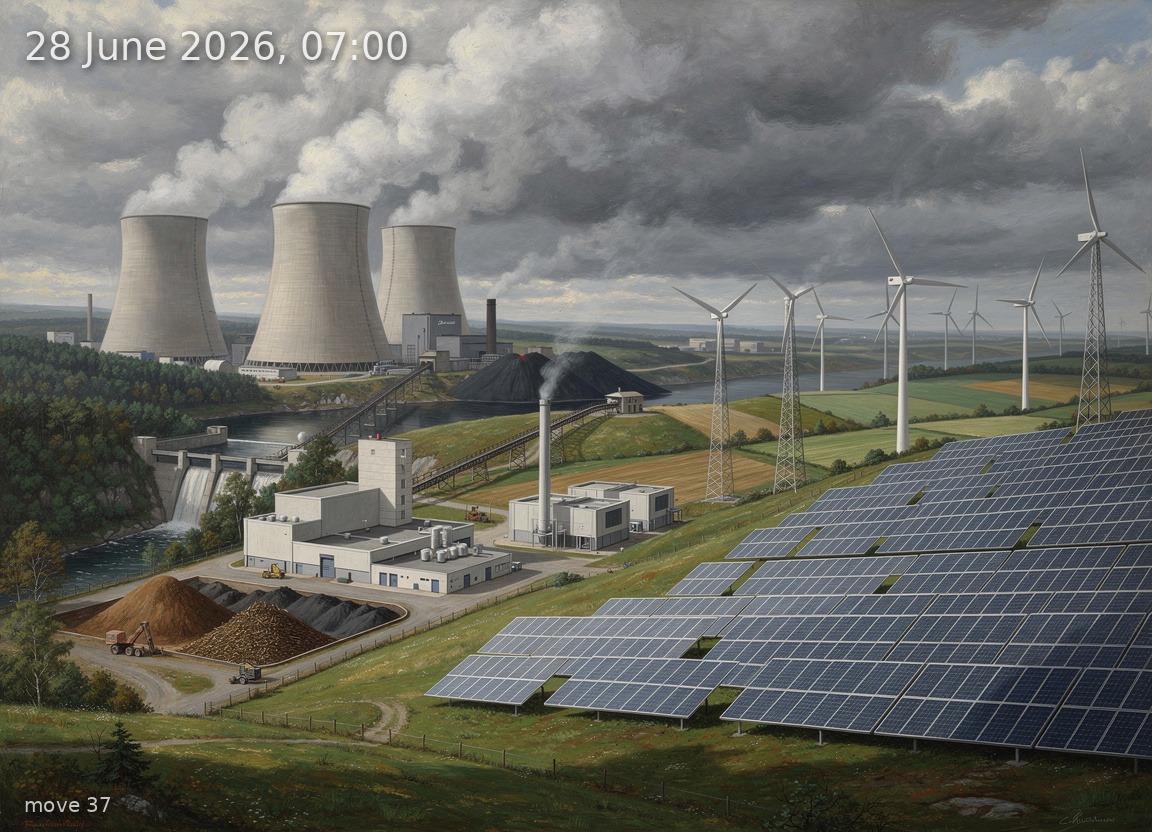
Solar, onshore wind, and brown coal dominate as overcast skies and morning demand drive 5.6 GW net imports.
Generation mix
Wind onshore 23%
Wind offshore 2%
Solar 32%
Biomass 10%
Hydro 4%
Natural gas 6%
Hard coal 4%
Brown coal 19%
70%
Renewable share
9.4 GW
Wind (on + offshore)
12.1 GW
Solar
38.2 GW
Total generation
5.6 GW
Net import
104.4 EUR/MWh
Day-ahead price
22.8°C / 4 km/h
Temp / Wind speed
Open-Meteo, Kassel (51.3°N 9.5°E) · surface estimate from 100 m wind
83.0% / 35.0 W/m²
Cloud cover / Radiation
221
gCO₂/kWh
Image prompt
Solar 12.1 GW occupies the right third of the scene as vast fields of aluminium-framed crystalline silicon PV panels stretching across gentle green hillsides, their surfaces reflecting only pale diffuse light under heavy overcast; brown coal 7.4 GW dominates the left quarter as a cluster of massive hyperbolic cooling towers emitting thick white-grey steam plumes that merge with the low cloud ceiling, with conveyor belts of dark lignite visible at their base; onshore wind 8.7 GW fills the centre-right middle ground as dozens of three-blade turbines on tall lattice and tubular towers scattered across rolling farmland, rotors turning slowly; biomass 3.8 GW appears in the centre-left as a medium-sized industrial plant with a rectangular stack and woodchip storage yard; natural gas 2.3 GW sits near the centre as two compact CCGT units with slim single exhaust stacks emitting faint heat shimmer; hard coal 1.6 GW appears as a smaller coal plant with a single square stack and coal pile behind the brown coal complex; hydro 1.5 GW is rendered as a concrete dam with spillway in the far left background nestled in a forested valley; offshore wind 0.7 GW is barely visible as a few distant turbines on the far horizon line. The sky is early dawn at 07:00 in late June—pale blue-grey pre-dawn light breaking from the east at low angle, no direct sun visible, the heavy 83% cloud cover forming an oppressive low ceiling of layered stratus in slate and pewter tones suggesting the high electricity price. The landscape is lush summer green at 22.8°C with tall grasses, wildflowers, and deciduous trees in full canopy. Air is still, barely any motion in the vegetation due to 3.6 km/h wind. Atmospheric haze softens the distance. Rendered as a highly detailed oil painting in the tradition of 19th-century German Romantic landscape painters—Caspar David Friedrich's atmospheric depth merged with industrial sublime—rich layered colour, visible confident brushwork, dramatic chiaroscuro in the cloud formations, meticulous engineering accuracy in every turbine nacelle, every cooling tower's parabolic curve, every PV panel's grid pattern. No text, no labels.