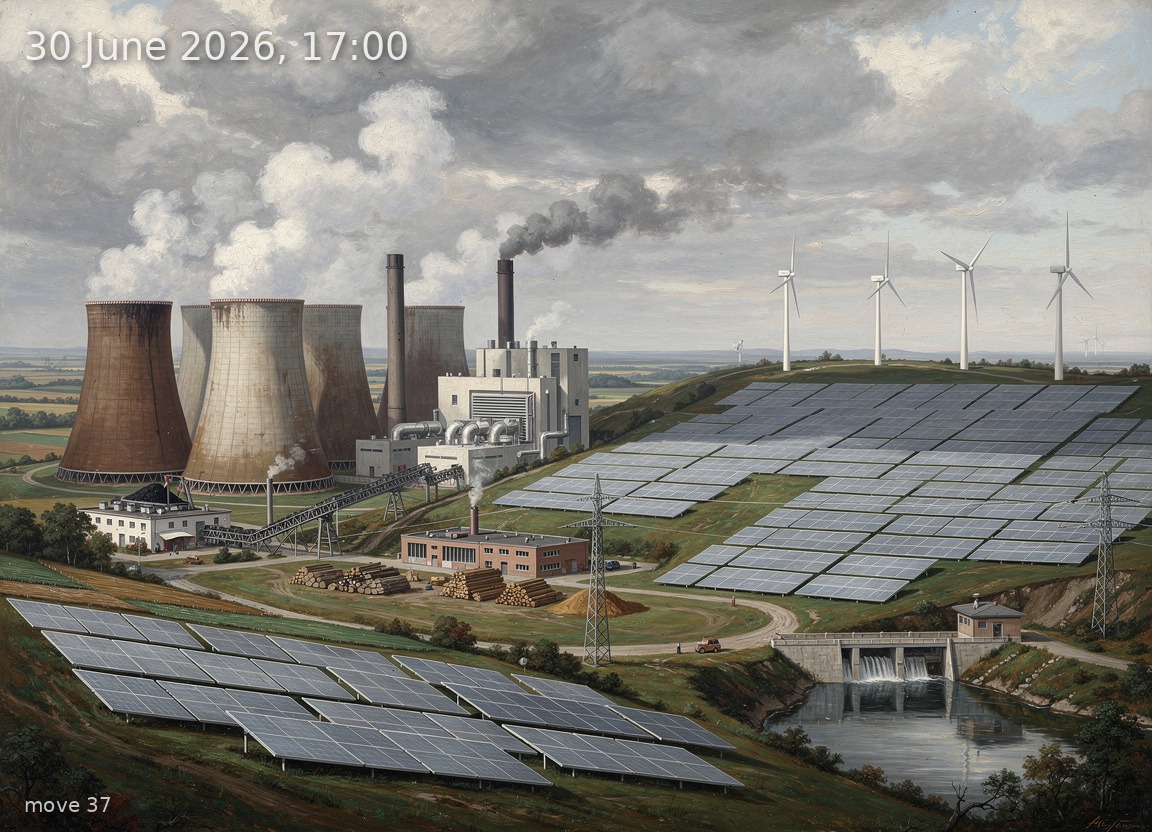
Diffuse solar leads at 20.2 GW under full overcast, with brown coal at 8.0 GW backing a 15.3 GW net import requirement.
Generation mix
Wind onshore 6%
Wind offshore 1%
Solar 46%
Biomass 8%
Hydro 4%
Natural gas 9%
Hard coal 7%
Brown coal 18%
65%
Renewable share
2.8 GW
Wind (on + offshore)
20.2 GW
Solar
43.9 GW
Total generation
15.3 GW
Net import
—
Day-ahead price
25.9°C / 8 km/h
Temp / Wind speed
Open-Meteo, Kassel (51.3°N 9.5°E) · surface estimate from 100 m wind
100.0% / 35.0 W/m²
Cloud cover / Radiation
252
gCO₂/kWh
Image prompt
Solar 20.2 GW dominates the centre and right as vast fields of aluminium-framed crystalline silicon PV panels stretching across gently rolling farmland, their surfaces reflecting a flat white-grey overcast sky; brown coal 8.0 GW occupies the left quarter as a cluster of massive hyperbolic cooling towers emitting thick white steam plumes rising into the heavy clouds; natural gas 4.1 GW appears as two compact CCGT power blocks with tall narrow exhaust stacks and thin heat shimmer behind the cooling towers; hard coal 3.3 GW sits as a single large coal plant with conveyor belts and a blocky boiler house, a dark stack trailing grey smoke, nestled beside the lignite complex; biomass 3.7 GW appears mid-ground as a wood-chip fed combined heat plant with a modest chimney and log piles; hydro 1.8 GW is visible as a small dam and reservoir in a valley fold at far right; wind onshore 2.5 GW shows as a sparse line of five three-blade turbines on a distant ridge, their rotors barely turning in the still air; wind offshore 0.2 GW is suggested by a single tiny turbine silhouette on the far horizon. The sky is entirely overcast at 100% cloud cover, a uniform blanket of warm grey stratus, but the scene is lit by late-afternoon dusk light at 17:00 in late June — a soft amber-orange glow filtering through the cloud layer near the western horizon, casting long gentle shadows eastward across the solar fields. The temperature is 25.9°C: lush dark-green summer foliage on deciduous trees, tall grass, wildflowers in the meadow margins. The atmosphere feels calm and open, reflecting the 0.0 EUR/MWh price — no oppressive weight, just a muted serenity. High-voltage transmission pylons stride across the middle distance carrying cables toward the borders, symbolising the heavy imports. Painted in the style of a highly detailed 19th-century German Romantic oil painting — rich impasto brushwork, luminous atmospheric depth recalling Caspar David Friedrich and Carl Blechen, meticulous engineering accuracy on every turbine nacelle, every panel frame, every cooling tower curve, every lattice tower bolt. No text, no labels.