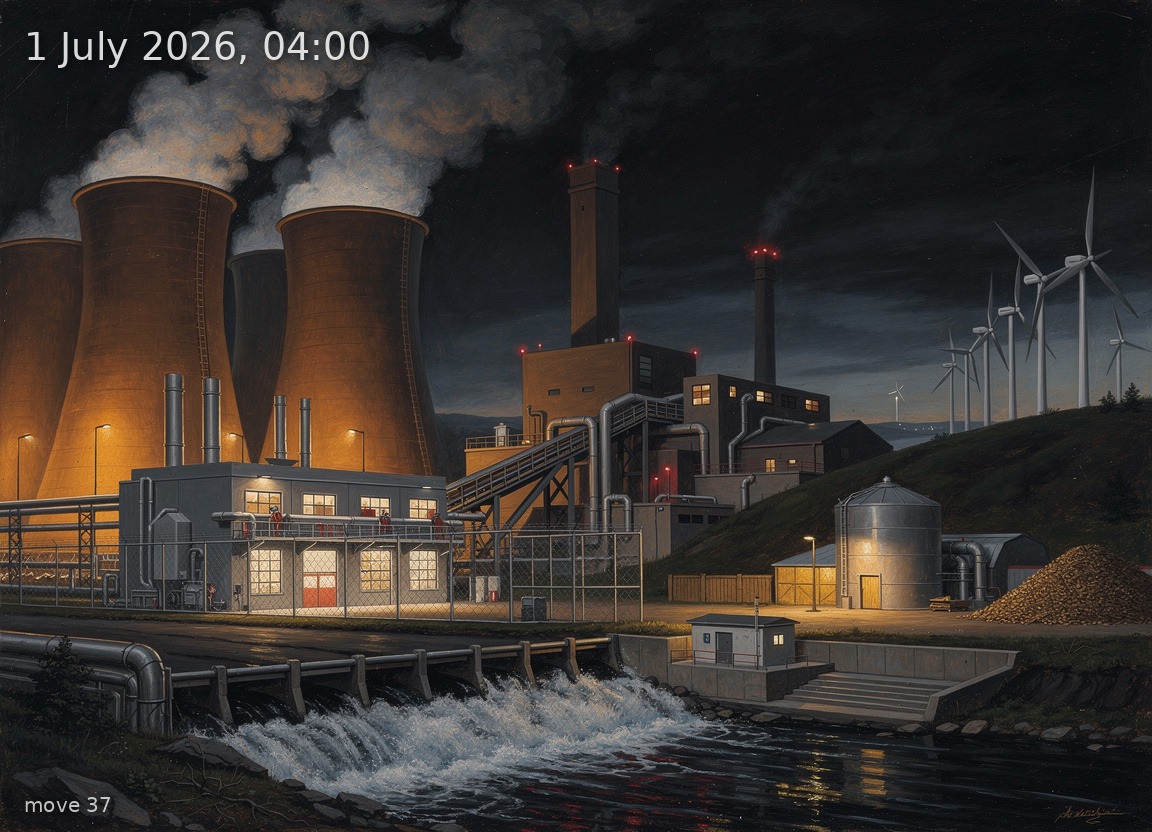
Brown coal, gas, and hard coal dominate overnight generation as low wind and absent solar drive heavy imports.
Generation mix
Wind onshore 12%
Wind offshore 1%
Solar 0%
Biomass 13%
Hydro 6%
Natural gas 22%
Hard coal 14%
Brown coal 32%
33%
Renewable share
3.8 GW
Wind (on + offshore)
0.0 GW
Solar
28.4 GW
Total generation
17.7 GW
Net import
151.0 EUR/MWh
Day-ahead price
17.7°C / 10 km/h
Temp / Wind speed
Open-Meteo, Kassel (51.3°N 9.5°E) · surface estimate from 100 m wind
100.0% / 0.0 W/m²
Cloud cover / Radiation
471
gCO₂/kWh
Image prompt
Brown coal 9.0 GW dominates the left third of the scene as a cluster of massive hyperbolic cooling towers emitting thick white-grey steam plumes into the black sky, lit from below by orange sodium lamps; natural gas 6.1 GW occupies the centre-left as a compact CCGT power station with tall single exhaust stacks and glowing turbine halls behind chain-link fencing; hard coal 4.0 GW appears centre-right as a blocky coal-fired plant with conveyor belts and a tall square chimney, red warning lights blinking at its crown; biomass 3.7 GW is rendered as a medium-sized industrial facility with a rounded silo and woodchip storage yard, warm light spilling from its doors; onshore wind 3.4 GW occupies the far right as a small row of three-blade turbines on a low ridge, their rotors turning slowly, red aviation lights pulsing at each nacelle tip; hydro 1.8 GW appears as a concrete weir and small run-of-river powerhouse nestled beside a dark river in the mid-ground, with foaming white water visible at the outflow; offshore wind 0.4 GW is a single distant turbine barely visible on the far horizon. The sky is completely dark, no twilight, no stars—a heavy 100% overcast blanket of deep charcoal cloud presses low overhead, creating an oppressive atmosphere reflecting the 151 EUR/MWh price. The season is midsummer: lush dark-green deciduous trees frame the foreground, and tall grass is faintly visible in the sodium-orange glow from the industrial facilities. A warm 17.7°C humidity hangs in the air, suggested by faint mist clinging to the river surface. No sunlight, no solar panels anywhere. The entire scene is illuminated only by artificial light—sodium streetlamps casting amber pools, industrial floodlights on the power stations, red aviation beacons, and the soft incandescence from turbine hall windows. Highly detailed oil painting in the tradition of 19th-century German Romantic landscape painters—rich, dark colour palette of deep blues, blacks, warm ambers, and smoky greys; visible confident brushwork; atmospheric depth with layers of industrial haze receding into darkness; meticulous engineering detail on every turbine nacelle, cooling tower, smokestack, and powerhouse. The composition evokes Caspar David Friedrich's sense of sublime scale but applied to a nocturnal industrial panorama. No text, no labels.