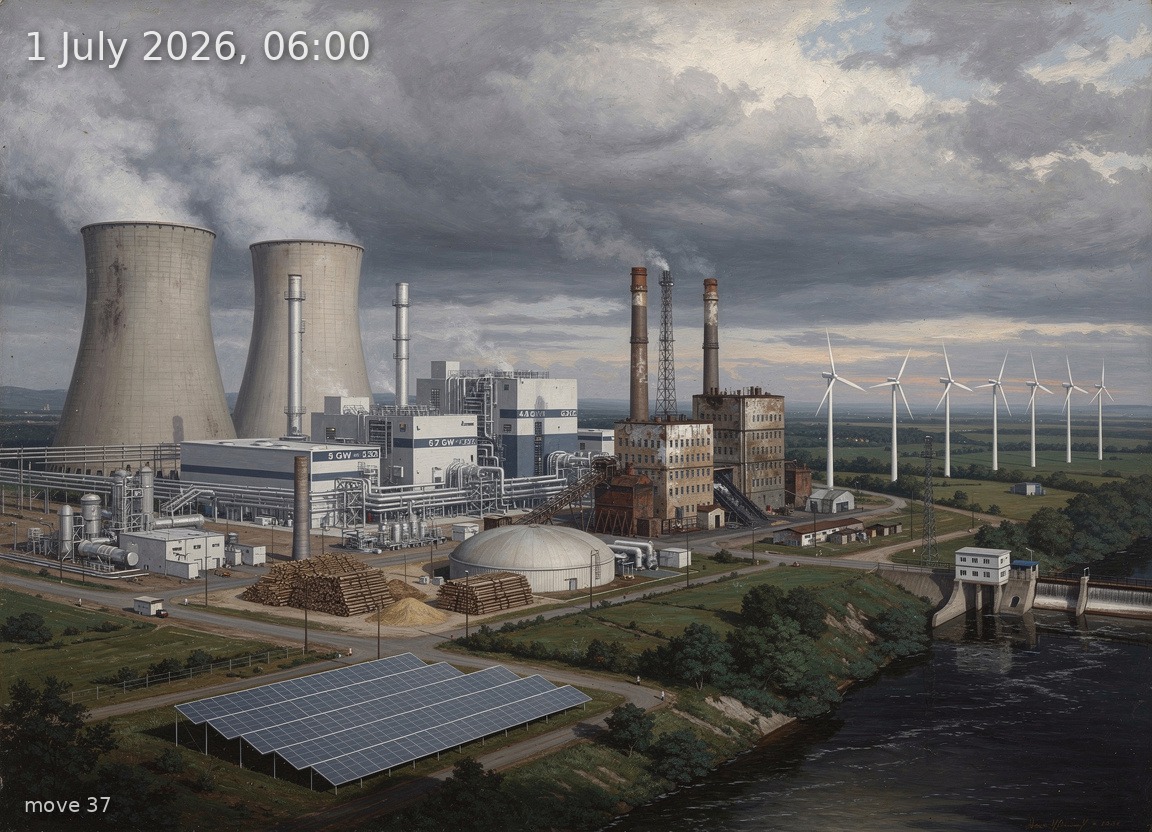
Brown coal, gas, and hard coal dominate as overcast skies and light winds force heavy thermal dispatch and large net imports.
Generation mix
Wind onshore 11%
Wind offshore 1%
Solar 7%
Biomass 12%
Hydro 6%
Natural gas 20%
Hard coal 13%
Brown coal 30%
37%
Renewable share
3.9 GW
Wind (on + offshore)
2.1 GW
Solar
30.9 GW
Total generation
23.4 GW
Net import
196.3 EUR/MWh
Day-ahead price
17.6°C / 10 km/h
Temp / Wind speed
Open-Meteo, Kassel (51.3°N 9.5°E) · surface estimate from 100 m wind
100.0% / 0.0 W/m²
Cloud cover / Radiation
439
gCO₂/kWh
Image prompt
Brown coal 9.2 GW dominates the left third of the scene as a massive lignite power complex with four hyperbolic cooling towers emitting thick white-grey steam plumes into the heavy sky; natural gas 6.2 GW fills the centre-left as a cluster of modern CCGT plants with tall slender exhaust stacks releasing thin heat shimmer; hard coal 4.0 GW appears centre-right as a pair of older industrial boiler houses with square chimneys and coal conveyors; biomass 3.7 GW is rendered as a compact wood-chip-fired plant with a rounded storage dome and a single modest stack at centre; wind onshore 3.5 GW occupies the right middle-ground as a sparse line of eight three-blade turbines on lattice and tubular towers, rotors turning slowly in light breeze; solar 2.1 GW appears as a small field of aluminium-framed crystalline silicon panels in the right foreground, their surfaces dull and reflectionless under the overcast; hydro 1.8 GW is a concrete run-of-river weir with a modest powerhouse visible at far right beside a dark river; wind offshore 0.4 GW is barely suggested as two distant turbines on the far horizon. The sky is entirely blanketed in dense, low stratus clouds with no break — a uniform ceiling of oppressive grey pressing down on the landscape, lending a heavy, costly atmosphere. The time is early dawn at 06:00 in July: a pale, cold pre-dawn light seeps through from the east in muted blue-grey tones, no direct sunlight whatsoever, the horizon faintly lighter but still deeply overcast. The landscape is lush midsummer German lowland — deep green deciduous trees, tall grass, wildflowers — but all colours are muted and subdued under the flat light. The cooling tower plumes merge with the low cloud base. Power lines on steel lattice pylons recede into the misty distance, suggesting interconnector flows. Painted in the style of a highly detailed 19th-century German Romantic oil painting — rich impasto brushwork, atmospheric depth and haze, dramatic tonal contrast between the dark industrial foreground and the pale grey sky — but with meticulous engineering accuracy on every turbine nacelle, cooling tower shell, PV panel frame, and gas turbine exhaust stack. No text, no labels.