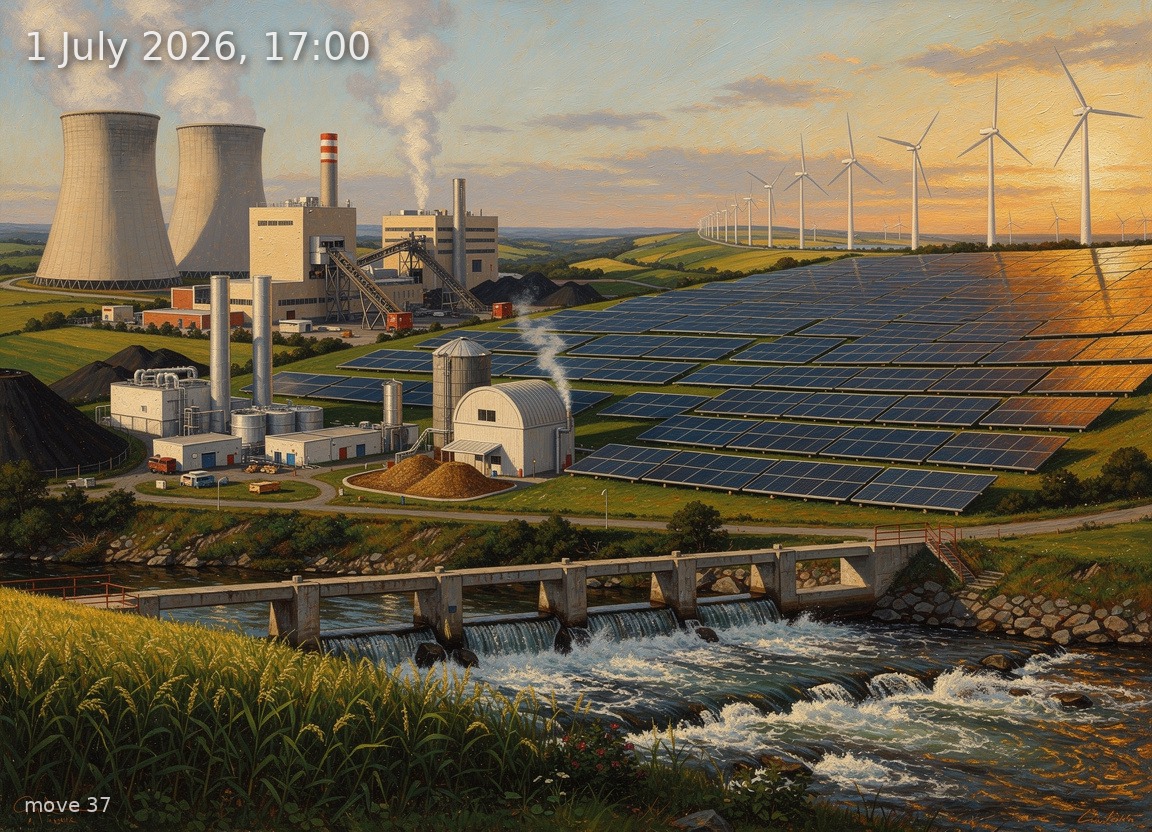
Solar leads at 22.4 GW with coal and gas backstopping the evening ramp as net imports cover an 8.8 GW shortfall.
Generation mix
Wind onshore 14%
Wind offshore 1%
Solar 45%
Biomass 7%
Hydro 4%
Natural gas 8%
Hard coal 8%
Brown coal 12%
72%
Renewable share
7.4 GW
Wind (on + offshore)
22.4 GW
Solar
49.5 GW
Total generation
8.8 GW
Net import
101.4 EUR/MWh
Day-ahead price
25.1°C / 16 km/h
Temp / Wind speed
Open-Meteo, Kassel (51.3°N 9.5°E) · surface estimate from 100 m wind
26.0% / 487.0 W/m²
Cloud cover / Radiation
200
gCO₂/kWh
Image prompt
Solar 22.4 GW dominates the right half and middle distance as vast fields of aluminium-framed crystalline silicon photovoltaic panels stretching across rolling green summer farmland, catching intense late-afternoon light; brown coal 6.1 GW occupies the far left as three massive hyperbolic concrete cooling towers with thick white-grey steam plumes rising into the sky; hard coal 3.9 GW appears just left of centre as a large coal-fired power station with tall rectangular stacks and conveyor belts feeding dark fuel; natural gas 4.1 GW sits centre-left as a compact combined-cycle gas turbine plant with slim cylindrical exhaust stacks and a modest heat shimmer; wind onshore 7.0 GW fills the distant right horizon as a line of modern three-blade turbines on lattice-free tubular towers turning slowly in moderate wind; wind offshore 0.4 GW is suggested by two small turbines barely visible on the far horizon; biomass 3.7 GW appears as a mid-sized wood-chip power plant with a rounded silo and a single low stack near the centre; hydro 2.0 GW is a concrete run-of-river weir with churning white water in the foreground stream. The sky is a dusk scene at 17:00 in July — the sun is lowering toward the western horizon, casting long warm golden-orange light across the landscape, the upper sky still vivid blue with only 26% cloud cover rendered as thin cirrus wisps. The atmosphere carries a slightly heavy, hazy quality reflecting the high electricity price. Lush midsummer vegetation — tall green wheat, full-canopy deciduous trees — corresponds to 25°C warmth. Style: highly detailed oil painting in the tradition of 19th-century German Romantic landscape masters such as Caspar David Friedrich and Carl Blechen, with rich saturated colour, visible impasto brushwork, luminous atmospheric depth, dramatic chiaroscuro from the low sun, and meticulous engineering accuracy on every turbine nacelle, panel frame, and cooling tower. No text, no labels, no people.