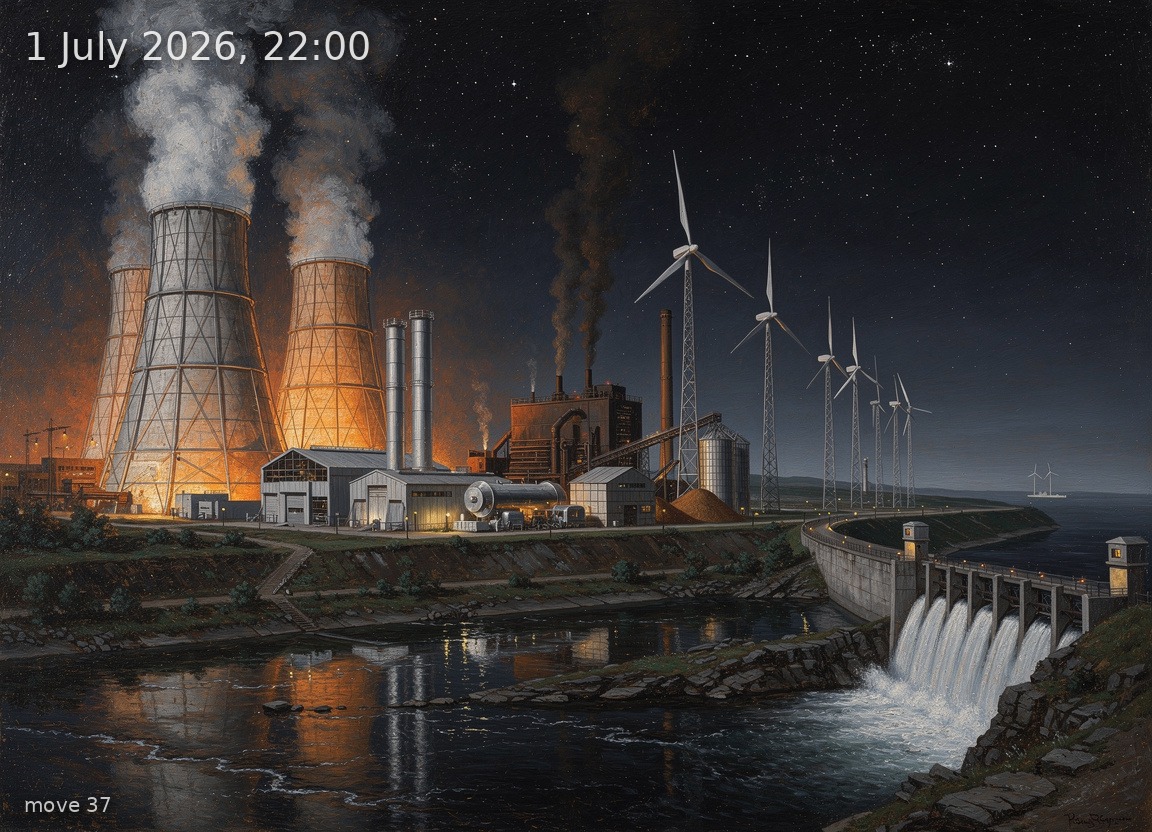
Brown coal, gas, and hard coal dominate nighttime generation as Germany imports roughly 25 GW to meet demand.
Generation mix
Wind onshore 12%
Wind offshore 1%
Solar 0%
Biomass 15%
Hydro 7%
Natural gas 21%
Hard coal 14%
Brown coal 30%
35%
Renewable share
3.8 GW
Wind (on + offshore)
0.0 GW
Solar
28.8 GW
Total generation
24.9 GW
Net import
199.5 EUR/MWh
Day-ahead price
20.2°C / 16 km/h
Temp / Wind speed
Open-Meteo, Kassel (51.3°N 9.5°E) · surface estimate from 100 m wind
0.0% / 2.0 W/m²
Cloud cover / Radiation
455
gCO₂/kWh
Image prompt
Brown coal 8.6 GW dominates the left third of the scene as a vast complex of hyperbolic cooling towers emitting thick white-grey steam plumes, lit from below by orange sodium vapor lights; natural gas 6.1 GW fills the centre-left as a cluster of modern CCGT power plants with tall slender exhaust stacks glowing with internal combustion light; hard coal 4.1 GW appears centre-right as a blocky traditional coal plant with conveyor belts and a single large chimney trailing dark smoke; biomass 4.2 GW sits beside it as a medium-scale industrial facility with cylindrical wood-chip silos and a modest stack; wind onshore 3.5 GW occupies the right portion as a row of three-blade turbines on lattice towers, their rotors turning gently in moderate wind; hydro 2.1 GW appears at the far right as a concrete dam with water cascading into a lit spillway; wind offshore 0.3 GW is barely suggested as a single distant turbine silhouette. The sky is completely dark, deep navy-black, no twilight, no sky glow, a clear summer night with stars visible overhead and zero clouds, the Milky Way faintly visible. The atmosphere is heavy and oppressive despite the clear sky, conveying the high electricity price — a humid summer haze clings to the industrial facilities, diffusing the artificial lights into warm halos. Temperature is mild at 20°C: lush green deciduous trees and tall summer grass surround the facilities, their leaves barely visible in the industrial glow. Foreground shows a meandering German river reflecting the orange and white lights of the power plants. The entire scene is rendered as a highly detailed oil painting in the tradition of 19th-century German Romantic landscape painters such as Caspar David Friedrich and Carl Blechen — rich impasto brushwork, dramatic chiaroscuro between the artificial lights and the dark sky, atmospheric depth with haze layers receding into the distance. Each technology is rendered with meticulous engineering accuracy: turbine nacelles with three-blade rotors, aluminium cooling tower frameworks, CCGT exhaust details. The painting evokes industrial sublimity — humanity's infrastructure glowing beneath an indifferent cosmos. No text, no labels.