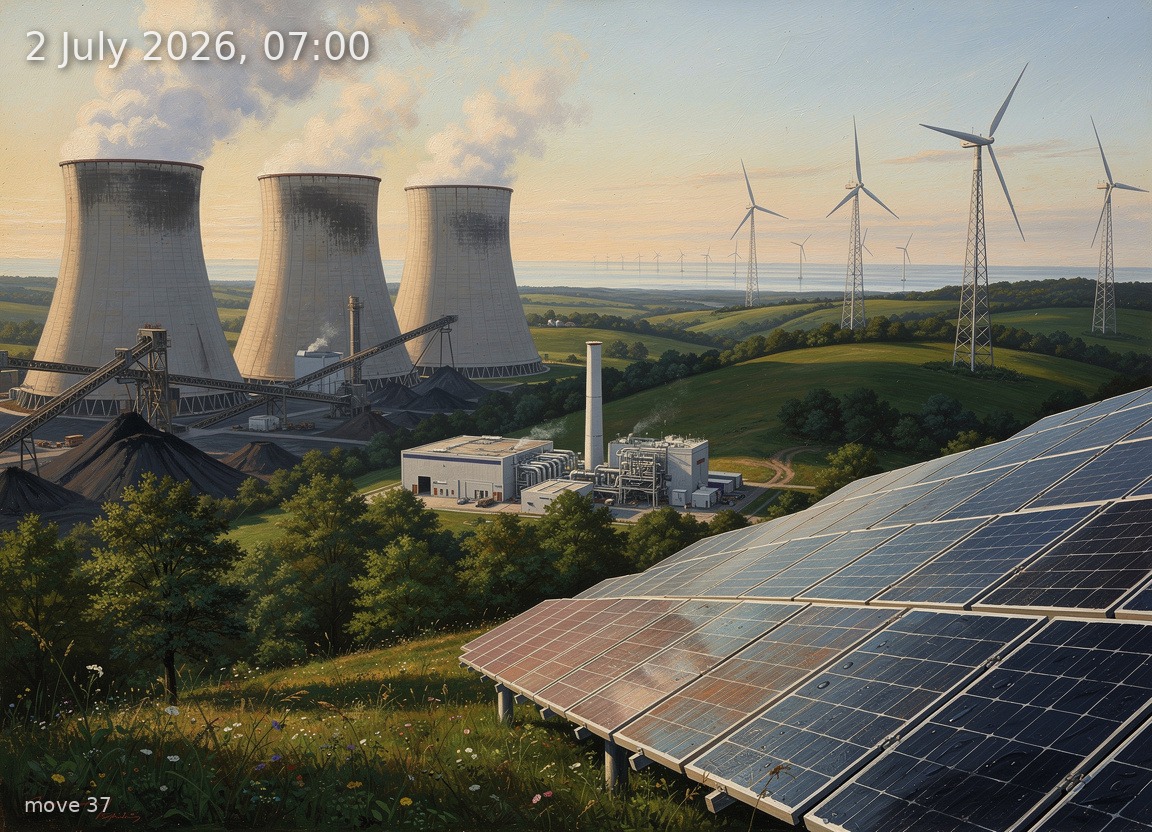
Solar, wind, and brown coal lead generation as Germany imports roughly 11 GW during morning load ramp-up.
Generation mix
Wind onshore 14%
Wind offshore 12%
Solar 27%
Biomass 8%
Hydro 3%
Natural gas 9%
Hard coal 8%
Brown coal 17%
66%
Renewable share
12.5 GW
Wind (on + offshore)
12.4 GW
Solar
46.3 GW
Total generation
11.1 GW
Net import
112.9 EUR/MWh
Day-ahead price
13.3°C / 10 km/h
Temp / Wind speed
Open-Meteo, Kassel (51.3°N 9.5°E) · surface estimate from 100 m wind
0.0% / 44.0 W/m²
Cloud cover / Radiation
246
gCO₂/kWh
Image prompt
Solar 12.4 GW fills the right foreground as vast fields of aluminium-framed crystalline silicon PV panels catching the first low-angle rays of a clear dawn sky; wind onshore 6.7 GW rises across rolling green hills in the centre-right as clusters of tall three-blade turbines on lattice towers slowly turning in light wind; wind offshore 5.8 GW appears on the distant horizon as a row of turbines standing in a pale sea; brown coal 8.0 GW dominates the left third with three massive hyperbolic cooling towers exhaling thick white steam plumes against the brightening sky, alongside conveyor belts of dark lignite; natural gas 4.4 GW appears centre-left as two compact CCGT units with slim exhaust stacks releasing thin heat shimmer; hard coal 3.6 GW sits behind the gas plant as a smaller coal-fired station with a single rectangular stack and coal bunker; biomass 3.9 GW occupies the near left as a timber-clad facility with a modest chimney and stacked wood-chip piles; hydro 1.6 GW is visible in the far centre-background as a small concrete dam with water spilling over a weir into a green valley stream. The sky is a graduated wash of deep blue-grey at the zenith transitioning to pale gold and soft peach at the eastern horizon, completely clear with zero clouds, the sun not yet fully risen but its first light casting long amber shadows across the landscape. The air feels heavy and slightly oppressive despite the clarity, suggesting high electricity cost. Lush July vegetation — dense green deciduous trees, tall grass, wildflowers — at 13°C morning coolness with dew on the panels. Highly detailed oil painting in the tradition of 19th-century German Romantic landscape painters such as Caspar David Friedrich and Carl Blechen, rich saturated colour, visible confident brushwork, atmospheric aerial perspective with haze softening distant cooling towers, meticulous engineering accuracy on every technology element — three-blade rotor profiles, nacelle housings, PV cell grid patterns, cooling tower parabolic curves, CCGT exhaust geometry. The scene reads as a grand industrial pastoral, monumental yet precise. No text, no labels.