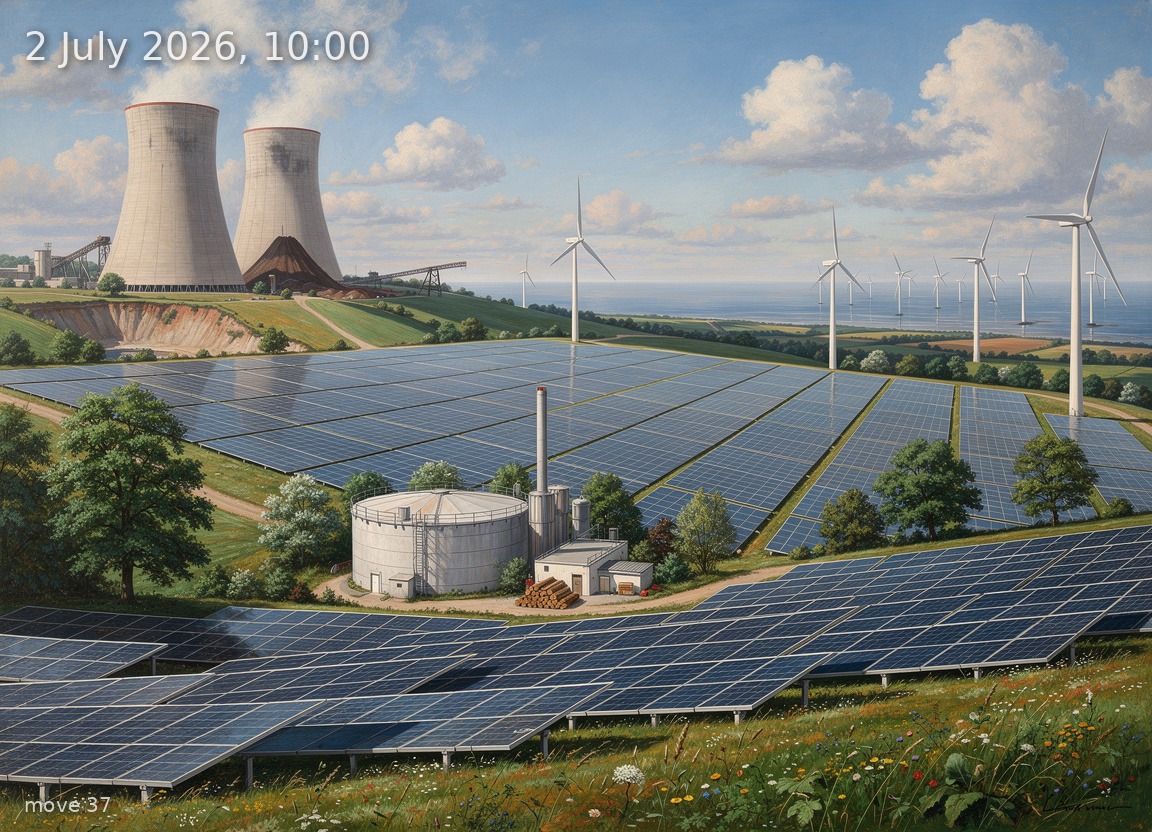
Solar at 41 GW and wind at 18 GW drive 90% renewable generation, pushing 9.4 GW of net exports.
Generation mix
Wind onshore 18%
Wind offshore 7%
Solar 57%
Biomass 5%
Hydro 3%
Natural gas 3%
Hard coal 2%
Brown coal 6%
90%
Renewable share
17.7 GW
Wind (on + offshore)
41.2 GW
Solar
72.1 GW
Total generation
+9.4 GW
Net export
5.5 EUR/MWh
Day-ahead price
20.1°C / 11 km/h
Temp / Wind speed
Open-Meteo, Kassel (51.3°N 9.5°E) · surface estimate from 100 m wind
33.0% / 413.0 W/m²
Cloud cover / Radiation
72
gCO₂/kWh
Image prompt
Solar 41.2 GW dominates the scene as a vast expanse of crystalline silicon photovoltaic panels stretching across rolling central German farmland, occupying well over half the canvas, their aluminium frames glinting under bright mid-morning summer sunlight filtering through scattered cumulus clouds covering roughly a third of a luminous blue sky. Wind onshore 13.0 GW appears as dozens of tall three-blade turbines with white nacelles and lattice-free tubular towers marching across green hillsides in the middle distance, blades turning gently in moderate breeze. Wind offshore 4.7 GW is visible as a cluster of larger turbines on the far horizon where land meets a suggestion of the North Sea coast, half-veiled in atmospheric haze. Brown coal 4.0 GW sits in the left background as a pair of massive hyperbolic concrete cooling towers emitting modest white steam plumes beside a lignite conveyor and open-pit mine edge. Biomass 3.9 GW appears as a mid-sized industrial facility with a cylindrical digester tank, a small stack, and stacked timber nearby, nestled among trees at mid-ground. Hydro 2.1 GW is rendered as a concrete run-of-river weir with water cascading through turbine outlets along a tree-lined river cutting through the foreground meadow. Natural gas 2.0 GW is depicted as a compact combined-cycle gas turbine plant with a single tall exhaust stack and a smaller heat recovery unit, positioned beside the river. Hard coal 1.3 GW is the smallest industrial element, a single unit with a rectangular boiler house and a modest chimney with thin grey exhaust, nearly hidden behind summer-green linden and oak trees. The vegetation is lush midsummer — tall grass, wildflowers, full canopy deciduous trees — temperature around 20°C. The atmosphere is calm and open, reflecting the very low electricity price: expansive sky, gentle light, no oppressive tones. Style: highly detailed oil painting in the tradition of 19th-century German Romantic landscape painting — rich, layered colour, visible confident brushwork, atmospheric aerial perspective with haze softening distant elements — yet every technological detail rendered with meticulous engineering accuracy: turbine blade profiles, PV cell grid patterns, cooling tower parabolic curvature, CCGT exhaust geometry. No text, no labels.