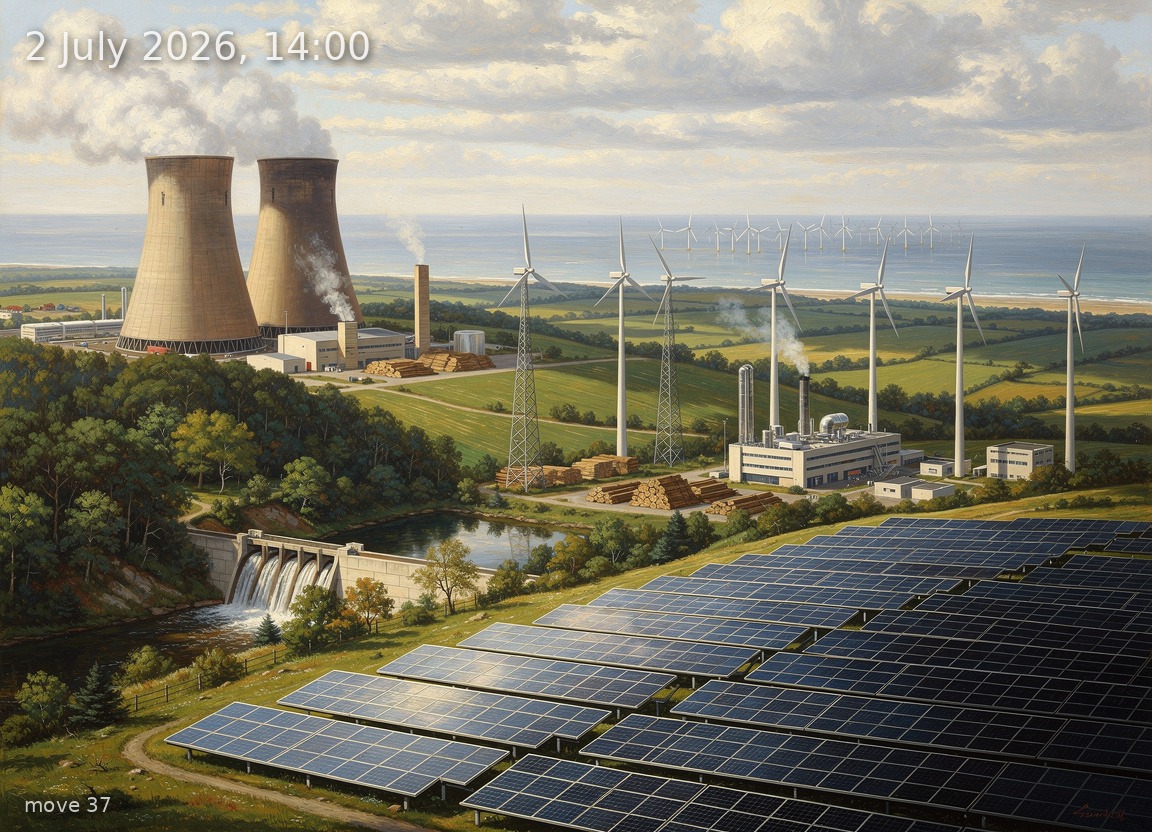
Solar (39.2 GW) and wind (24.4 GW) drive 92% renewables, pushing prices negative amid 16.4 GW net export.
Generation mix
Wind onshore 29%
Wind offshore 3%
Solar 52%
Biomass 5%
Hydro 3%
Natural gas 2%
Hard coal 1%
Brown coal 4%
92%
Renewable share
24.4 GW
Wind (on + offshore)
39.2 GW
Solar
74.9 GW
Total generation
+16.4 GW
Net export
-3.0 EUR/MWh
Day-ahead price
26.3°C / 19 km/h
Temp / Wind speed
Open-Meteo, Kassel (51.3°N 9.5°E) · surface estimate from 100 m wind
83.0% / 596.0 W/m²
Cloud cover / Radiation
55
gCO₂/kWh
Image prompt
Solar 39.2 GW dominates the scene as vast fields of aluminium-framed crystalline silicon photovoltaic panels stretching across the entire foreground and right half of the composition, their blue-black surfaces catching diffuse light beneath a mostly overcast sky with occasional bright breaks; wind onshore 22.0 GW fills the mid-ground and left-centre as dozens of tall three-blade turbines on lattice and tubular towers, rotors visibly spinning in moderate wind, spread across rolling green summer hills; wind offshore 2.4 GW appears as a small cluster of turbines on the far horizon above a faint coastal strip; brown coal 3.0 GW occupies the far left as two large hyperbolic cooling towers emitting lazy white steam plumes; biomass 3.6 GW sits beside them as a modest wood-chip facility with a single rectangular stack and stored timber; hydro 2.0 GW is represented by a concrete dam and spillway set into a wooded valley in the left mid-ground; natural gas 1.6 GW appears as a compact CCGT plant with a single polished exhaust stack and minimal emissions near the coal complex; hard coal 1.1 GW shows as a smaller conventional plant with a square chimney and thin grey plume. The time is 14:00 on a warm summer day: full bright daylight but filtered through 83% cloud cover, creating a luminous silvery-white overcast with scattered dramatic sunbeams breaking through gaps in high cumulus, casting dappled golden light across the solar fields. The vegetation is lush midsummer green — tall grass, wildflowers, deciduous trees in full canopy. The atmosphere is calm and open, reflecting the negative electricity price. Highly detailed oil painting in the tradition of 19th-century German Romantic landscape painters such as Caspar David Friedrich and Carl Blechen — rich saturated colour, visible confident brushwork, atmospheric aerial perspective with hazy blue distances — but with meticulous engineering accuracy on every turbine nacelle, every PV panel frame, every cooling tower's hyperbolic concrete curve. The composition balances industrial sublime with pastoral serenity. No text, no labels.