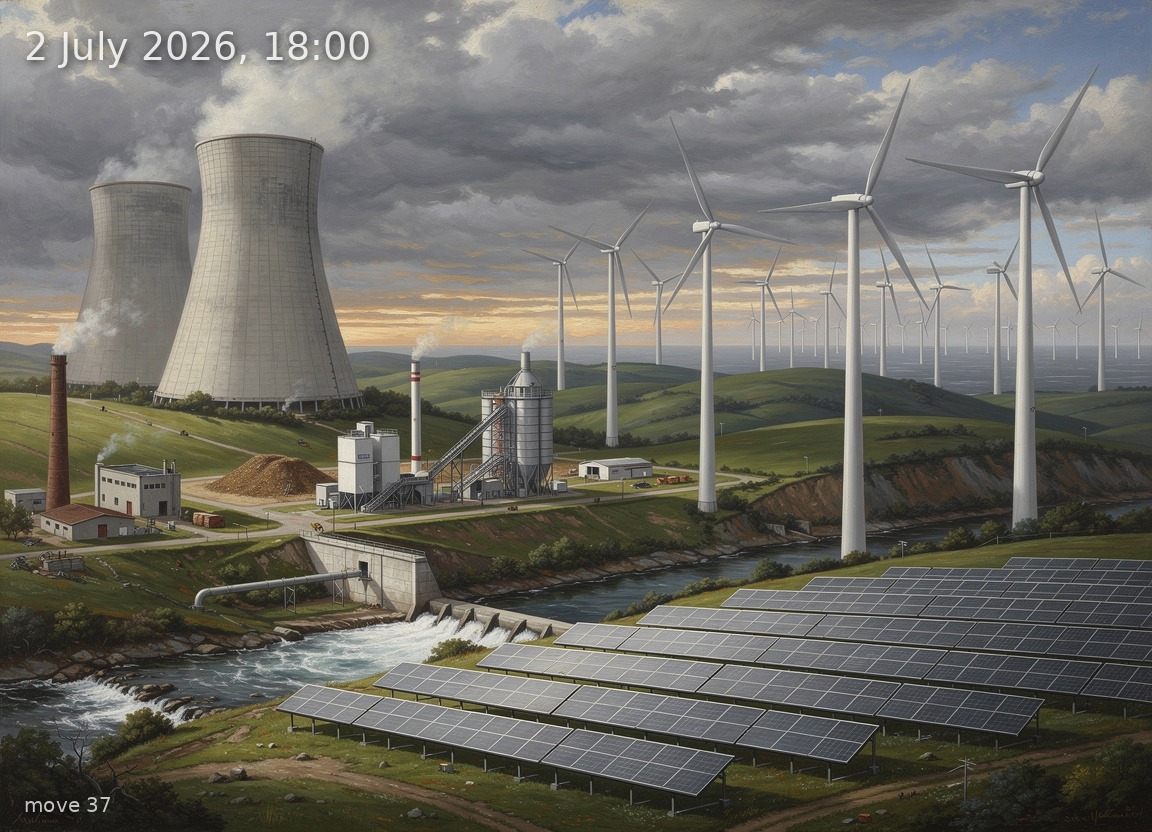
Strong onshore wind at 31.4 GW leads a 91% renewable mix under heavy overcast, enabling 3.6 GW net export.
Generation mix
Wind onshore 51%
Wind offshore 9%
Solar 23%
Biomass 6%
Hydro 3%
Natural gas 3%
Hard coal 2%
Brown coal 4%
91%
Renewable share
36.7 GW
Wind (on + offshore)
14.4 GW
Solar
62.0 GW
Total generation
+3.6 GW
Net export
46.8 EUR/MWh
Day-ahead price
23.0°C / 21 km/h
Temp / Wind speed
Open-Meteo, Kassel (51.3°N 9.5°E) · surface estimate from 100 m wind
97.0% / 59.0 W/m²
Cloud cover / Radiation
61
gCO₂/kWh
Image prompt
Wind onshore 31.4 GW dominates the scene as vast ranks of three-blade turbines with white tubular towers and detailed nacelles stretching across rolling green hills from the centre to the far right, their rotors spinning briskly in strong wind; wind offshore 5.3 GW appears as a distant line of larger turbines standing in a slate-grey North Sea visible on the far horizon at right; solar 14.4 GW occupies the centre-left foreground as expansive fields of aluminium-framed crystalline silicon PV panels angled on metal racks, their glass surfaces reflecting only dull grey sky — no direct sunlight; biomass 3.6 GW is rendered as a mid-ground industrial facility with a wood-chip silo and a low exhaust stack trailing thin white vapour; brown coal 2.6 GW appears at the far left as a pair of hyperbolic concrete cooling towers with modest steam plumes rising into the overcast; hydro 2.0 GW is a concrete run-of-river dam with churning white water in the left mid-ground valley; natural gas 1.7 GW sits as a compact combined-cycle gas turbine plant with a single tall exhaust stack and a small cooling unit, placed between the cooling towers and the dam; hard coal 1.1 GW is a smaller coal plant with a single rectangular boiler house and a brick smokestack emitting faint grey exhaust at the far left edge. The sky is 97% overcast with a dense, layered grey cloud ceiling; it is 18:00 in early July so the light is dusk-transitional — a muted warm amber glow seeps through the clouds near the western horizon while the upper sky darkens to blue-grey. The landscape is lush midsummer green with tall grasses and deciduous trees in full canopy, swaying in the 20 km/h wind. The atmosphere is slightly heavy but not oppressive, reflecting a moderate electricity price. Style: highly detailed oil painting in the tradition of 19th-century German Romantic landscape painters — rich layered colour, visible confident brushwork, atmospheric depth with haze between foreground and distant sea, meticulous engineering accuracy on every turbine nacelle, PV cell pattern, and cooling tower concrete texture. No text, no labels.