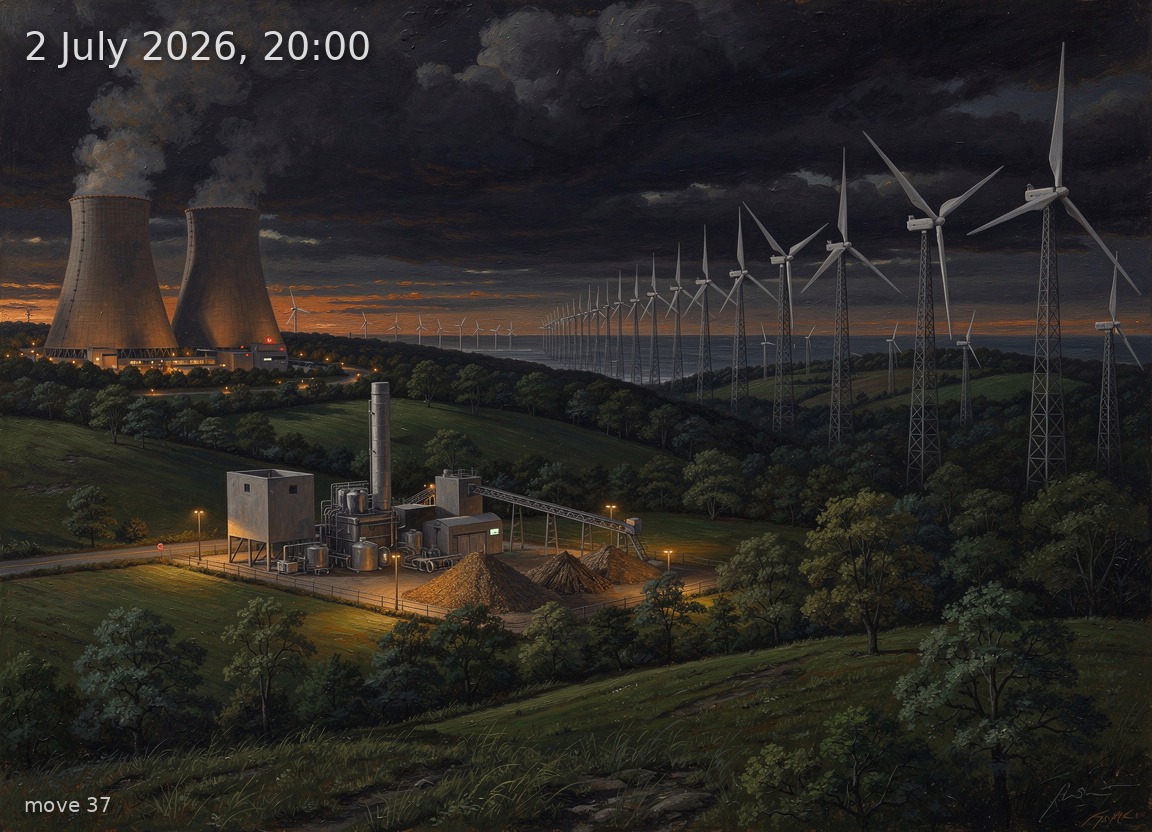
Strong onshore wind leads generation at 30.2 GW, but 6.6 GW net imports are needed to meet evening demand under overcast skies.
Generation mix
Wind onshore 59%
Wind offshore 11%
Solar 4%
Biomass 7%
Hydro 4%
Natural gas 4%
Hard coal 4%
Brown coal 6%
86%
Renewable share
35.9 GW
Wind (on + offshore)
2.2 GW
Solar
50.9 GW
Total generation
6.6 GW
Net import
107.3 EUR/MWh
Day-ahead price
19.4°C / 19 km/h
Temp / Wind speed
Open-Meteo, Kassel (51.3°N 9.5°E) · surface estimate from 100 m wind
100.0% / 3.0 W/m²
Cloud cover / Radiation
97
gCO₂/kWh
Image prompt
Wind onshore 30.2 GW dominates the scene as vast ranks of three-blade turbines on lattice towers stretching across rolling green hills from the right side through the centre, their rotors spinning briskly in moderate wind; wind offshore 5.7 GW appears in the far background as a cluster of larger turbines standing in a dark grey sea visible through a gap in the terrain. Brown coal 3.0 GW occupies the far left as two massive hyperbolic cooling towers with pale steam plumes rising into the night sky, lit from below by sodium-orange industrial lighting. Biomass 3.7 GW sits in the left-centre as a mid-sized industrial plant with a tall rectangular stack and a woodchip storage yard, warmly lit by floodlights. Natural gas 2.2 GW appears as a compact CCGT facility with a single gleaming exhaust stack and visible heat shimmer, tucked between the biomass plant and the turbine field. Hard coal 1.9 GW is rendered as a smaller power station with a conveyor belt and a single square cooling tower, dimly lit beside the brown coal complex. Hydro 1.9 GW is depicted as a concrete dam structure with spillway at the lower-left edge of the composition, water reflecting artificial lights. Solar 2.2 GW is represented only by a few barely visible aluminium-framed panels on a nearby rooftop, dark and inactive. The sky is completely dark, deep navy to black, 100% overcast with no stars and no twilight glow—it is 20:00 in summer but the heavy cloud blanket eliminates any residual light. The atmosphere feels heavy and oppressive, reflecting the high electricity price: low thick clouds press down, tinged faintly orange by industrial light pollution from the coal plants. The landscape is lush mid-summer German countryside—full green deciduous trees, tall grass—at a mild 19°C, with leaves rustling in the wind. Sodium streetlights line a small road in the foreground, casting amber pools of light. Highly detailed oil painting in the tradition of 19th-century German Romantic landscape painters such as Caspar David Friedrich and Carl Blechen—rich dark palette of navy, amber, steel grey, and moss green, with visible impasto brushwork, atmospheric depth and chiaroscuro contrast between the glowing industrial facilities and the surrounding darkness. Meticulous engineering accuracy in turbine nacelles, cooling tower geometry, and plant infrastructure. No text, no labels.