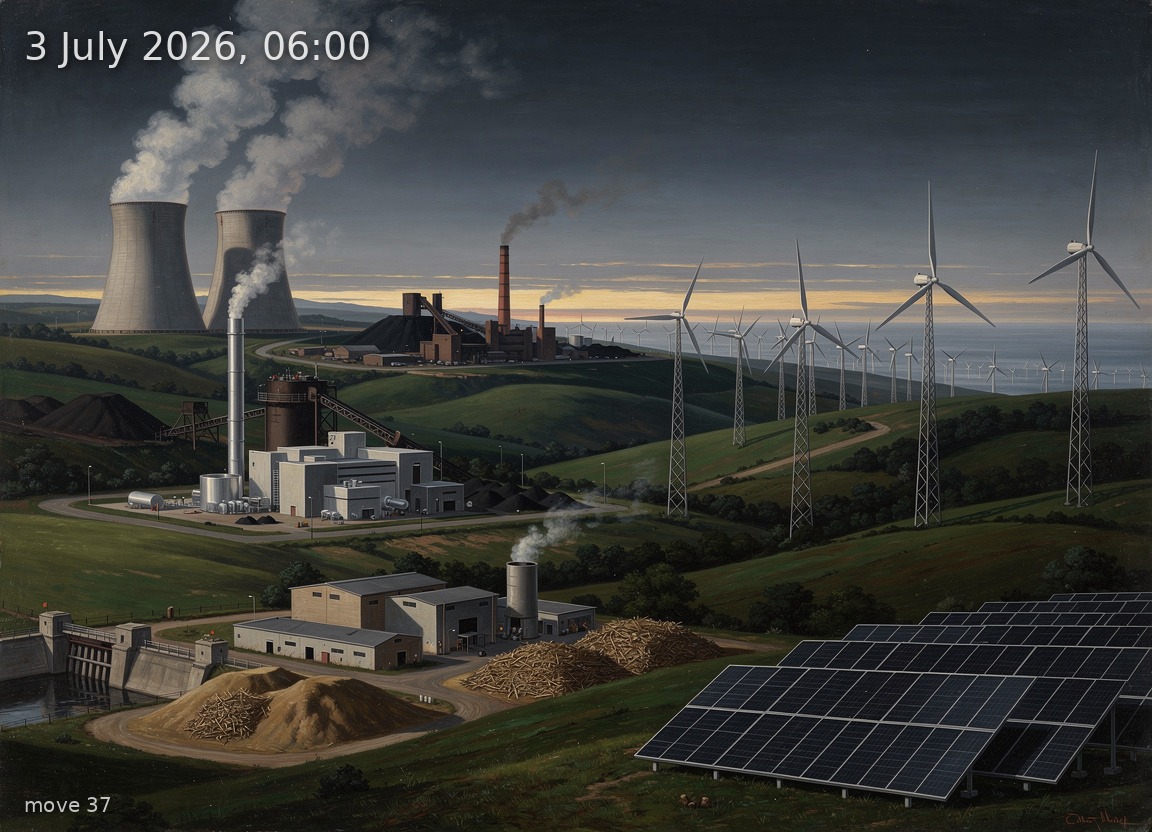
Wind provides 62% of generation at dawn; thermal plants and net imports of 2.9 GW cover the remaining demand.
Generation mix
Wind onshore 51%
Wind offshore 11%
Solar 8%
Biomass 7%
Hydro 3%
Natural gas 5%
Hard coal 6%
Brown coal 7%
81%
Renewable share
31.2 GW
Wind (on + offshore)
4.2 GW
Solar
50.3 GW
Total generation
2.9 GW
Net import
99.5 EUR/MWh
Day-ahead price
11.4°C / 4 km/h
Temp / Wind speed
Open-Meteo, Kassel (51.3°N 9.5°E) · surface estimate from 100 m wind
0.0% / 3.0 W/m²
Cloud cover / Radiation
132
gCO₂/kWh
Image prompt
Wind onshore 25.6 GW dominates the scene as vast ranks of three-blade turbines on lattice towers stretching across rolling green hills from the centre to the far right, their rotors barely turning in light air; wind offshore 5.7 GW appears as a distant line of larger turbines on the far horizon above a sliver of grey sea at the right edge. Solar 4.2 GW is rendered as a modest field of aluminium-framed crystalline silicon panels in the lower right foreground, their surfaces reflecting only the faintest pre-dawn light, no direct sunshine. Brown coal 3.6 GW occupies the left background as a pair of massive hyperbolic cooling towers emitting thick pale steam plumes rising into the still air. Hard coal 3.0 GW sits adjacent as a dark industrial complex with conveyor belts, coal stockpiles, and a tall brick chimney trailing thin smoke. Natural gas 2.8 GW appears as a compact modern CCGT plant in the left-centre middle ground with a single gleaming exhaust stack and a smaller vapour plume. Biomass 3.8 GW is depicted as a cluster of squat industrial buildings with a wood-chip storage yard and a low broad chimney with faint whitish exhaust, placed in the centre-left foreground. Hydro 1.6 GW is shown as a small concrete dam and powerhouse nestled in a wooded valley in the far left. The sky is deep blue-grey pre-dawn light, completely clear with zero clouds, the eastern horizon showing the faintest band of pale gold where the sun has not yet risen, the upper sky still nearly dark. The atmosphere feels heavy and oppressive despite the clear sky, reflecting high electricity prices — a slight haze clings to the valley floors. Vegetation is lush midsummer green, temperature around 11°C suggested by dew on grass and a cool stillness. Highly detailed oil painting in the tradition of 19th-century German Romantic landscape painters — Caspar David Friedrich's atmospheric depth combined with meticulous industrial-engineering accuracy, rich saturated colour, visible confident brushwork, dramatic chiaroscuro between the dark land and the pale emerging dawn. No text, no labels.