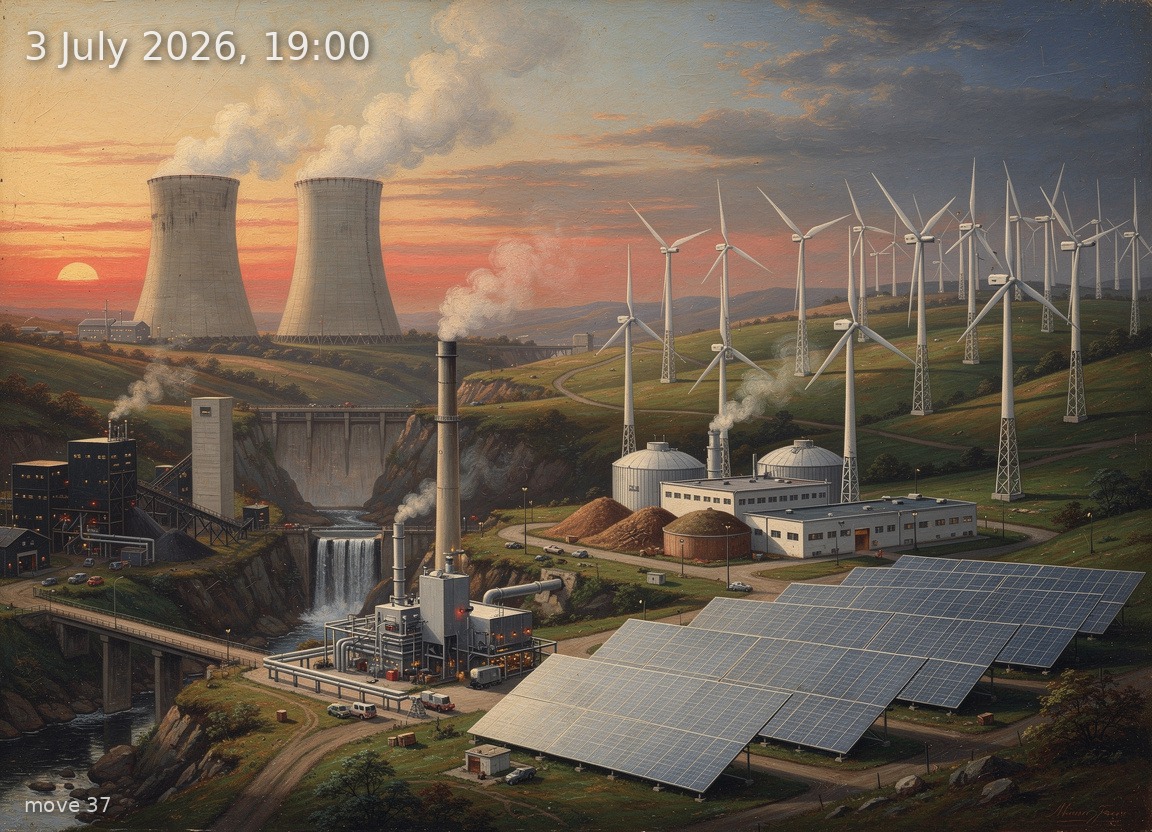
Strong onshore wind leads at 27.6 GW with fading solar at 9.4 GW; modest thermal fill and slight net imports balance evening demand.
Generation mix
Wind onshore 50%
Wind offshore 9%
Solar 17%
Biomass 7%
Hydro 3%
Natural gas 4%
Hard coal 4%
Brown coal 7%
86%
Renewable share
32.4 GW
Wind (on + offshore)
9.4 GW
Solar
55.6 GW
Total generation
1.2 GW
Net import
102.6 EUR/MWh
Day-ahead price
20.9°C / 17 km/h
Temp / Wind speed
Open-Meteo, Kassel (51.3°N 9.5°E) · surface estimate from 100 m wind
45.0% / 183.0 W/m²
Cloud cover / Radiation
102
gCO₂/kWh
Image prompt
Wind onshore 27.6 GW dominates the right two-thirds of the scene as dozens of three-blade turbines with white lattice towers and detailed nacelles marching across rolling green hills; solar 9.4 GW appears in the centre-right foreground as expansive fields of aluminium-framed crystalline silicon panels catching the last amber light; wind offshore 4.8 GW is visible on the far-right horizon as a cluster of turbines standing in a faintly visible sea; biomass 4.1 GW is rendered centre-left as a mid-sized industrial plant with a tall stack and wood-chip storage silos; brown coal 3.7 GW occupies the left background as two hyperbolic cooling towers releasing thick white steam plumes; hard coal 2.2 GW appears as a smaller power station with conveyor belts and a single rectangular cooling tower to the far left; natural gas 2.1 GW sits centre-left as a compact CCGT facility with a slim exhaust stack and clean metallic casing; hydro 1.7 GW is a concrete dam with a narrow waterfall visible in the distant centre-left valley. Lighting: dusk at 19:00 in July — the sun is very low on the western horizon, casting a warm orange-red glow along the lower sky, the upper sky transitioning from pale gold to deepening blue, long shadows stretching eastward across the landscape. The atmosphere is slightly hazy and heavy, reflecting elevated energy prices — a subtle oppressive warmth in the humid summer air. Vegetation is lush midsummer green, tall grasses swaying in moderate 16.6 km/h wind, scattered cumulus clouds covering roughly 45% of the sky lit from below in peach and amber tones. Painted in the style of a highly detailed 19th-century German Romantic oil painting — rich saturated colour, visible impasto brushwork, meticulous atmospheric depth and chiaroscuro — yet every turbine nacelle, every PV panel frame, every cooling tower profile is rendered with precise engineering accuracy. No text, no labels.