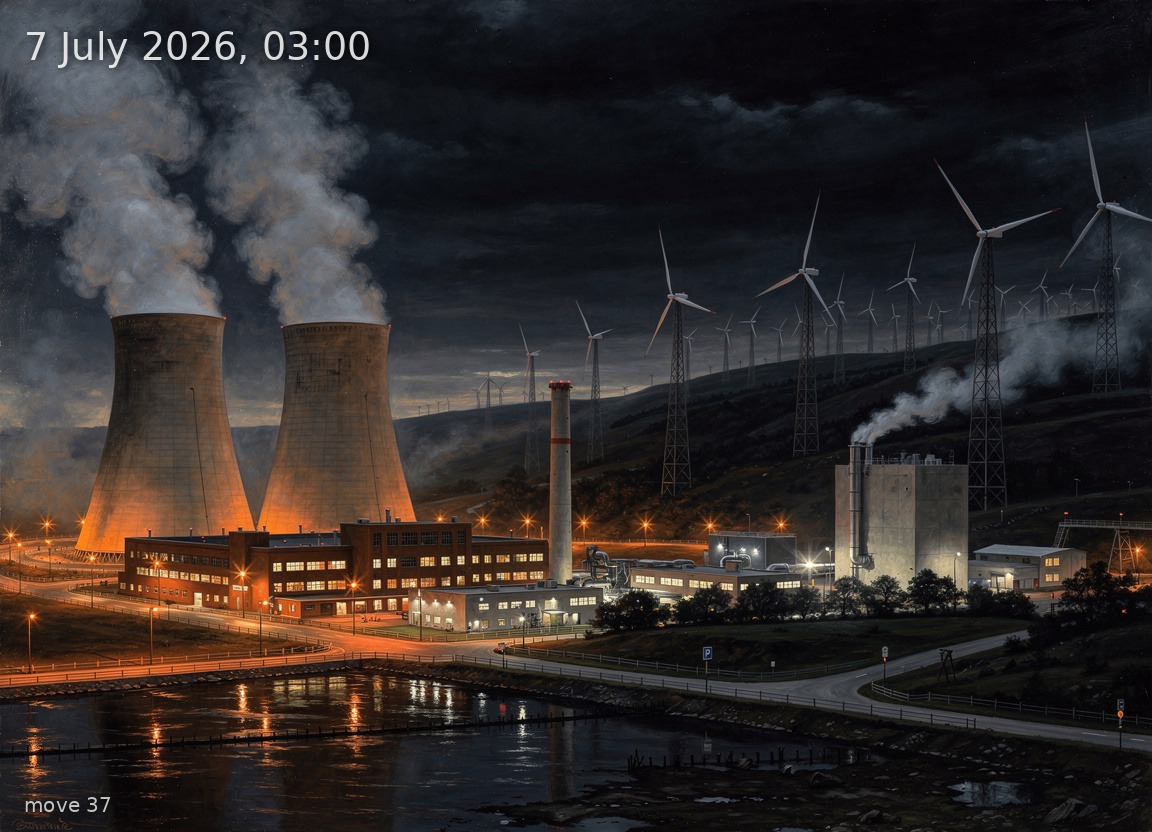
Strong overnight wind (27.1 GW) leads generation at 3 AM, with brown coal (7.4 GW) providing thermal baseload amid elevated prices.
Generation mix
Wind onshore 51%
Wind offshore 11%
Biomass 9%
Hydro 3%
Natural gas 7%
Hard coal 3%
Brown coal 17%
74%
Renewable share
27.1 GW
Wind (on + offshore)
0.0 GW
Solar
44.0 GW
Total generation
0.4 GW
Net import
101.0 EUR/MWh
Day-ahead price
18.4°C / 19 km/h
Temp / Wind speed
Open-Meteo, Kassel (51.3°N 9.5°E) · surface estimate from 100 m wind
100.0% / 0.0 W/m²
Cloud cover / Radiation
192
gCO₂/kWh
Image prompt
Wind onshore 22.3 GW dominates the right two-thirds of the scene as vast ranks of three-blade turbines on lattice towers stretching across dark rolling hills, rotors spinning briskly in strong wind; brown coal 7.4 GW occupies the left quarter as a massive lignite power station with three hyperbolic cooling towers emitting thick white steam plumes lit from below by sodium-orange industrial lights; wind offshore 4.8 GW appears in the far background as a line of turbines standing in a barely visible dark sea on the horizon; natural gas 3.2 GW is rendered as a compact CCGT plant with twin exhaust stacks and a smaller vapour plume, positioned between the coal station and the wind farm; biomass 3.8 GW appears as a mid-sized industrial facility with a tall single chimney and stacked timber logs nearby, illuminated by warm floodlights; hydro 1.4 GW is suggested by a small concrete dam with spillway gleaming under a single lamp in the mid-ground; hard coal 1.1 GW is a smaller conventional plant with a single square cooling tower tucked behind the gas plant. Time is 3 AM — the sky is completely black, no twilight, no sky glow, deep navy-black heavens with 100% cloud cover hiding all stars. The atmosphere is heavy and oppressive, humid summer air pressing down, reflecting the high electricity price. Warm orange-sodium streetlights and industrial floodlights provide the only illumination, casting long reflections on wet surfaces. Lush dark-green summer vegetation — full deciduous canopies, tall grasses — barely visible in the artificial light. Style: highly detailed oil painting in the tradition of 19th-century German Romantic landscape painters such as Caspar David Friedrich and Carl Blechen, but depicting an industrial nocturne — rich deep colour palette of blacks, dark blues, burnt oranges, and warm yellows, visible impasto brushwork, atmospheric depth with haze around the cooling tower plumes, meticulous engineering detail on turbine nacelles, three-blade rotors, aluminium-framed structures, and concrete cooling towers. No text, no labels.