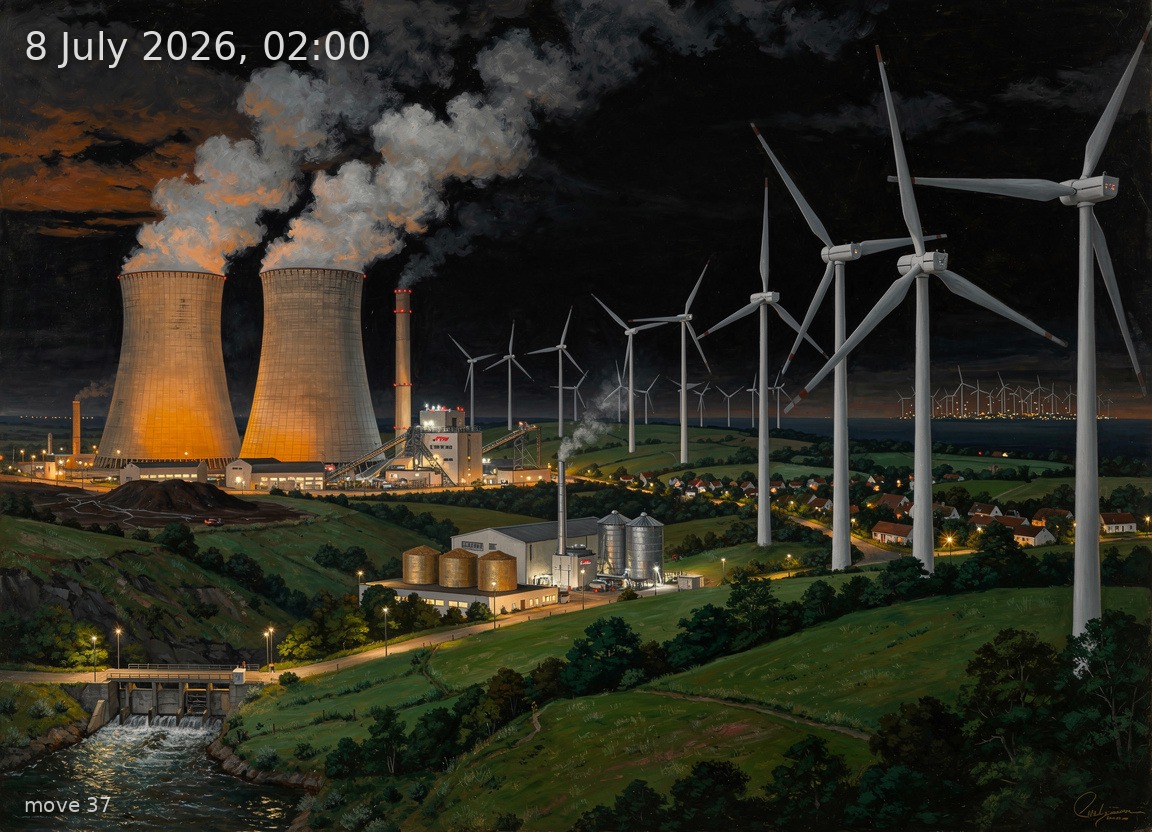
Strong overnight wind (27.2 GW) leads generation at 71% renewables, with brown coal (7.4 GW) maintaining significant baseload at 2 AM.
Generation mix
Wind onshore 49%
Wind offshore 11%
Biomass 9%
Hydro 3%
Natural gas 6%
Hard coal 6%
Brown coal 16%
71%
Renewable share
27.2 GW
Wind (on + offshore)
0.0 GW
Solar
45.2 GW
Total generation
+1.3 GW
Net export
111.8 EUR/MWh
Day-ahead price
18.2°C / 16 km/h
Temp / Wind speed
Open-Meteo, Kassel (51.3°N 9.5°E) · surface estimate from 100 m wind
100.0% / 0.0 W/m²
Cloud cover / Radiation
210
gCO₂/kWh
Image prompt
Wind onshore 22.0 GW dominates the right two-thirds of the scene as dozens of tall three-blade turbines with white tubular towers and nacelles stretching across rolling central German hills, rotors spinning visibly in moderate wind; wind offshore 5.2 GW appears as a distant cluster of larger turbines on a dark horizon line far right. Brown coal 7.4 GW occupies the left foreground as a massive lignite power station with three hyperbolic concrete cooling towers emitting thick white-grey steam plumes rising into the black sky, lit from below by sodium-orange industrial lighting. Hard coal 2.7 GW sits as a smaller coal-fired plant with a single tall chimney and conveyor belts just left of centre. Natural gas 2.8 GW appears as a compact CCGT facility with a single slender exhaust stack and a small visible heat shimmer, nestled between the coal plant and the turbines. Biomass 3.9 GW is rendered as a mid-sized industrial facility with wood-chip silos and a modest smokestack in the mid-ground. Hydro 1.2 GW is a small dam structure with spillway visible in a valley at lower left. No solar panels anywhere — it is deep night. The sky is completely black with no twilight, no sky glow, heavy 100% overcast clouds faintly visible only where industrial light catches their undersides in sickly orange. The atmosphere is oppressive and heavy, humid July warmth suggested by haze around the cooling tower plumes. Lush green summer vegetation on the hills is visible only under artificial light pools. Sodium streetlights dot a small village between the turbines. The entire scene is rendered as a highly detailed oil painting in the tradition of 19th-century German Romantic landscape painters — rich saturated colour, visible confident brushwork, deep atmospheric perspective — yet every piece of energy infrastructure is depicted with meticulous engineering accuracy: lattice towers, three-blade rotors with correct pitch, aluminium-clad nacelles, hyperbolic cooling tower geometry with ribbed concrete texture, CCGT exhaust stacks. No text, no labels.