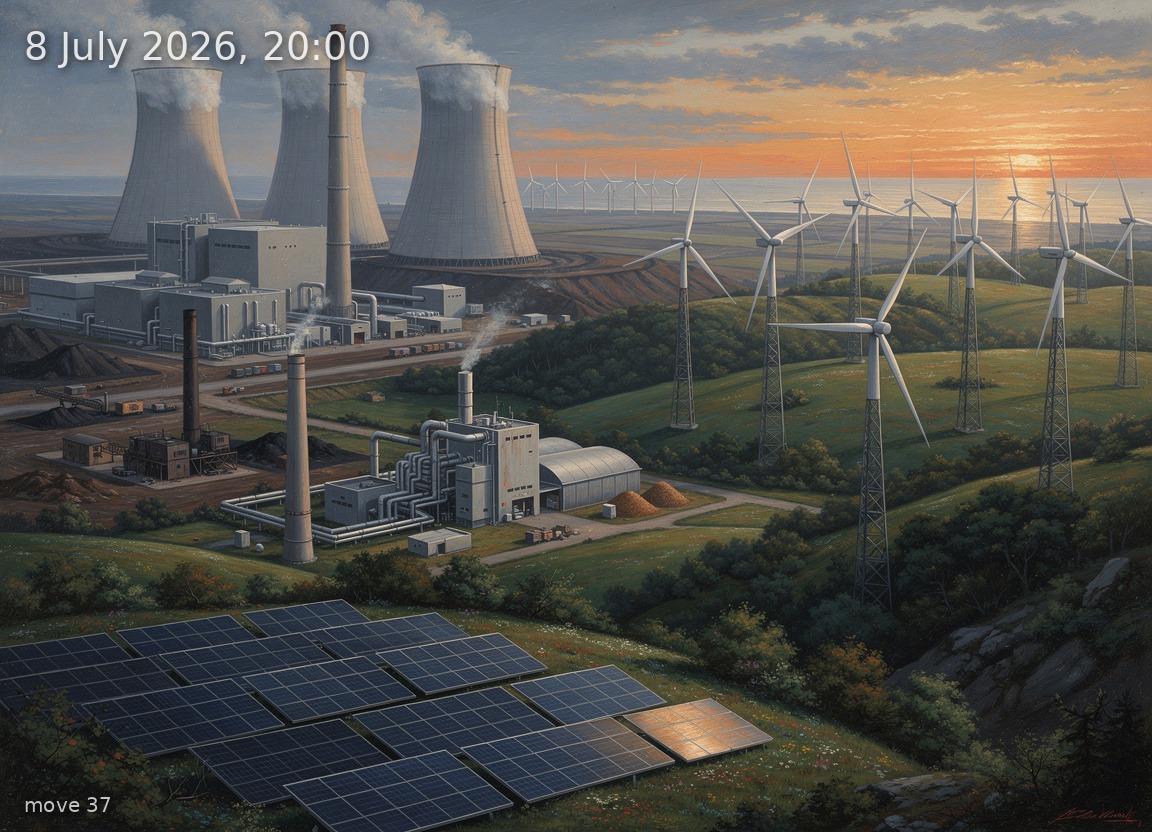
Strong onshore wind leads generation but 10.8 GW net imports are needed to meet elevated evening demand at 150.8 EUR/MWh.
Generation mix
Wind onshore 40%
Wind offshore 6%
Solar 6%
Biomass 9%
Hydro 3%
Natural gas 9%
Hard coal 7%
Brown coal 20%
64%
Renewable share
20.9 GW
Wind (on + offshore)
2.7 GW
Solar
45.3 GW
Total generation
10.8 GW
Net import
150.8 EUR/MWh
Day-ahead price
20.8°C / 15 km/h
Temp / Wind speed
Open-Meteo, Kassel (51.3°N 9.5°E) · surface estimate from 100 m wind
5.0% / 111.0 W/m²
Cloud cover / Radiation
259
gCO₂/kWh
Image prompt
Wind onshore 18.0 GW dominates the right two-thirds of the scene as dozens of three-blade turbines on lattice and tubular towers arrayed across rolling green hills, rotors visibly turning in moderate wind; brown coal 8.9 GW occupies the left background as a massive lignite power station with four hyperbolic cooling towers emitting thick white-grey steam plumes; natural gas 4.2 GW appears as a compact CCGT facility with twin exhaust stacks and a slim vapour trail, positioned centre-left; hard coal 3.2 GW is rendered as a smaller coal plant with a single tall chimney and coal conveyors beside it, left of centre; biomass 4.2 GW is depicted as a wood-chip-fed CHP plant with a squat boiler building and modest smokestack near the centre; wind offshore 2.9 GW is visible far in the distance as a cluster of turbines on a hazy horizon line suggesting the North Sea; solar 2.7 GW appears as a modest field of aluminium-framed crystalline silicon panels in the foreground catching the very last faint amber light reflecting off their surfaces; hydro 1.3 GW is a small dam and spillway tucked into a valley in the far right background. TIME OF DAY: 20:00 in early July Berlin — the sky is deep twilight transitioning to night, a narrow band of burnt orange along the western horizon fading rapidly into deep indigo and near-black overhead; the first stars are barely visible; the industrial facilities glow with warm sodium lighting, windows illuminated amber; cooling tower steam catches the last orange horizon glow from below but is grey-blue above. ATMOSPHERE: the air feels heavy and oppressive, hinting at the high electricity price — a brooding, humid summer evening with a faintly hazy quality despite clear skies (5% cloud cover), warm 21°C air suggested by lush green summer vegetation, wildflowers in meadows. Summer foliage is dense and full. STYLE: highly detailed oil painting in the tradition of Caspar David Friedrich and Carl Blechen — rich, deep colour palette of indigo, amber, and slate grey, visible impasto brushwork, atmospheric aerial perspective with luminous depth, meticulous engineering accuracy on every turbine nacelle, cooling tower curvature, and panel frame, feeling like a monumental Romantic masterwork of the industrial landscape. No text, no labels.