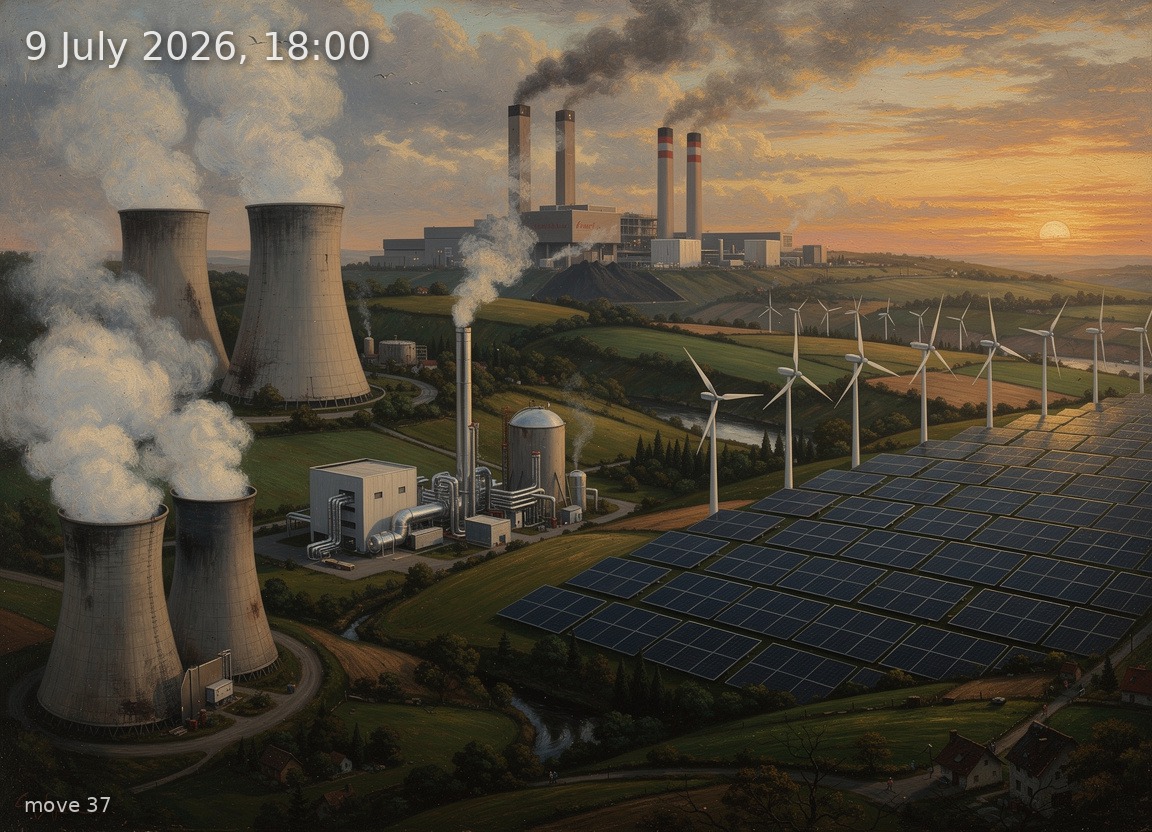
Solar leads at 19.7 GW but fading evening output and high demand drive coal, gas, and net imports.
Generation mix
Wind onshore 13%
Wind offshore 3%
Solar 44%
Biomass 9%
Hydro 3%
Natural gas 5%
Hard coal 7%
Brown coal 16%
71%
Renewable share
6.8 GW
Wind (on + offshore)
19.7 GW
Solar
44.5 GW
Total generation
13.0 GW
Net import
130.4 EUR/MWh
Day-ahead price
20.2°C / 11 km/h
Temp / Wind speed
Open-Meteo, Kassel (51.3°N 9.5°E) · surface estimate from 100 m wind
63.0% / 92.0 W/m²
Cloud cover / Radiation
213
gCO₂/kWh
Image prompt
Solar 19.7 GW dominates the right half of the scene as vast fields of aluminium-framed crystalline silicon PV panels stretching across gentle green hillsides, their surfaces catching the last warm light; brown coal 7.3 GW occupies the left foreground as a cluster of massive hyperbolic cooling towers emitting thick white-grey steam plumes rising into the sky; wind onshore 5.6 GW appears as a line of modern three-blade turbines on ridgelines in the middle distance, blades turning slowly in light breeze; hard coal 3.1 GW is rendered as a coal-fired power station with tall rectangular stacks and thin dark exhaust behind the cooling towers; natural gas 2.4 GW sits as a compact CCGT plant with a single polished exhaust stack and clean heat shimmer to the left of centre; biomass 3.8 GW appears as a mid-sized industrial facility with a rounded silo and short chimney releasing pale vapour in the centre-left; hydro 1.4 GW is a small concrete dam and reservoir visible in a valley in the far middle distance; wind offshore 1.2 GW is faintly visible as a row of turbines on the far horizon line over a distant sea glimpse. The sky is a dusk scene at 18:00 in July — the sun is low in the west, casting a warm orange-gold glow along the lower horizon, with the upper sky transitioning from pale blue to deeper blue-grey, partly veiled by broken cumulus clouds covering roughly two-thirds of the sky, some edges lit golden by the low sun. The atmosphere feels heavy and somewhat oppressive, with haze thickening in the valleys. Vegetation is lush midsummer green — tall grasses, full deciduous trees, wildflowers. Temperature is mild and warm. Style: highly detailed oil painting in the tradition of 19th-century German Romantic landscape painters such as Caspar David Friedrich and Carl Blechen — rich saturated colour, visible textured brushwork, dramatic atmospheric depth and chiaroscuro, meticulous engineering detail on every turbine nacelle, every PV cell grid-line, every cooling tower's parabolic curvature, every exhaust stack's riveted steel. The scene is a grand panoramic industrial landscape masterwork. No text, no labels.