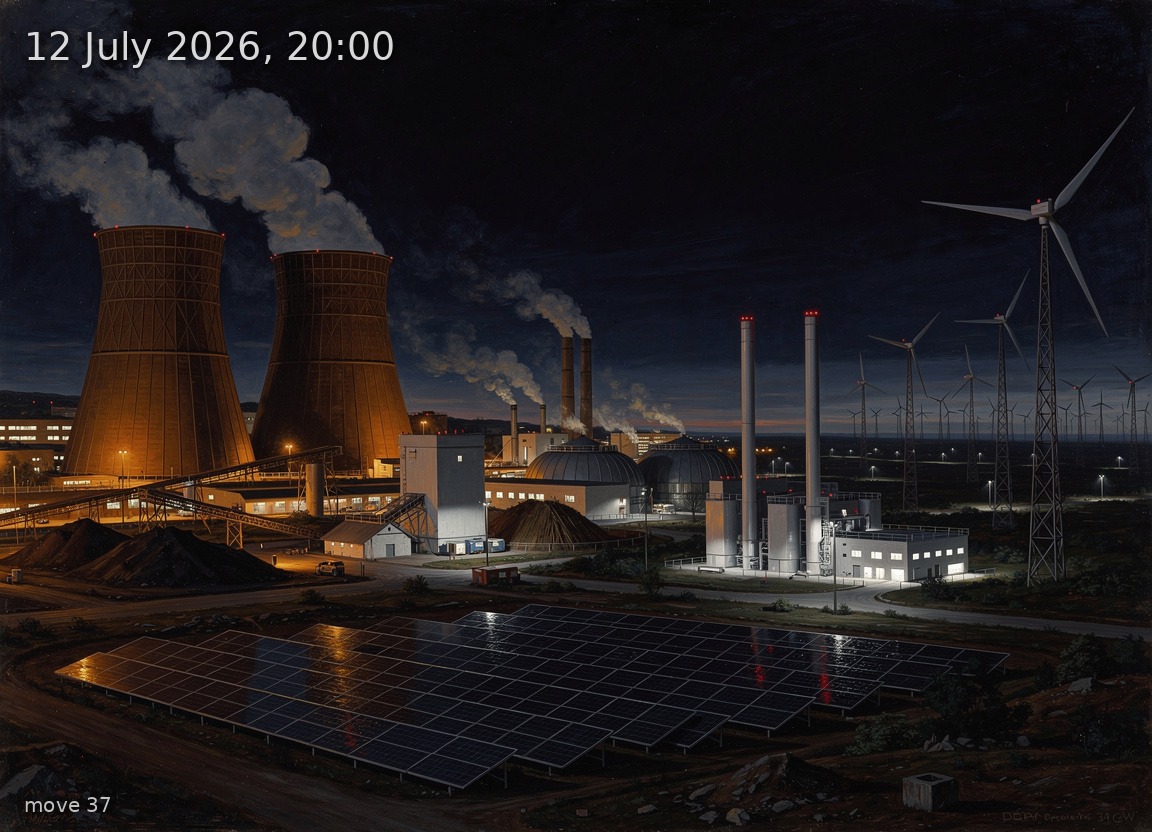
Wind and brown coal anchor domestic supply while 17.9 GW net imports cover evening peak demand on a hot July night.
Generation mix
Wind onshore 29%
Wind offshore 10%
Solar 9%
Biomass 13%
Hydro 4%
Natural gas 8%
Hard coal 6%
Brown coal 22%
64%
Renewable share
12.0 GW
Wind (on + offshore)
2.8 GW
Solar
31.1 GW
Total generation
17.9 GW
Net import
140.9 EUR/MWh
Day-ahead price
27.3°C / 13 km/h
Temp / Wind speed
Open-Meteo, Kassel (51.3°N 9.5°E) · surface estimate from 100 m wind
1.0% / 151.0 W/m²
Cloud cover / Radiation
263
gCO₂/kWh
Image prompt
Brown coal 6.9 GW dominates the left quarter as a sprawling lignite complex with three massive hyperbolic cooling towers emitting thick white steam plumes into a dark evening sky, lit from below by orange sodium lamps and glowing conveyor belts carrying raw lignite. Wind onshore 8.9 GW fills the right third of the scene as a deep array of tall three-blade turbines on lattice towers, their rotors turning moderately in the breeze, red aviation warning lights blinking on nacelles against the black sky. Wind offshore 3.1 GW appears as a distant line of larger turbines on the far right horizon, silhouetted with flashing red beacons. Biomass 4.0 GW sits center-left as a cluster of medium-scale industrial facilities with cylindrical digesters, wood-chip storage domes, and low exhaust stacks releasing pale vapor, warmly lit by facility lighting. Solar 2.8 GW appears as a modest field of aluminium-framed crystalline silicon panels in the center-foreground, barely catching the last traces of fading indirect light, mostly dark and reflective. Natural gas 2.6 GW is rendered as two compact CCGT units with tall single exhaust stacks and lit control buildings center-right. Hard coal 1.7 GW appears as a smaller coal plant with a single square cooling tower and coal bunker to the left of center. Hydro 1.2 GW is suggested by a small dam and powerhouse nestled in a valley in the distant background. The sky is completely dark — deep navy to black — it is 20:00 in July, fully night with no twilight glow remaining, only the faintest deep blue memory near the western horizon. The atmosphere is heavy and oppressive, reflecting the 140.9 EUR/MWh price — humid summer heat at 27.3°C with lush green deciduous trees in full summer foliage visible near the foreground, leaves barely stirring in light wind. All artificial lighting — amber sodium streetlights, white LED facility lights, red warning beacons — creates dramatic pools of illumination against the dark landscape. Style: highly detailed oil painting in the tradition of 19th-century German Romantic landscape painters such as Caspar David Friedrich and Carl Blechen — rich deep blues, warm ambers, visible confident brushwork, atmospheric depth and chiaroscuro, meticulous engineering detail on every turbine nacelle, cooling tower ribbing, and panel frame — a grand industrial nocturne. No text, no labels.