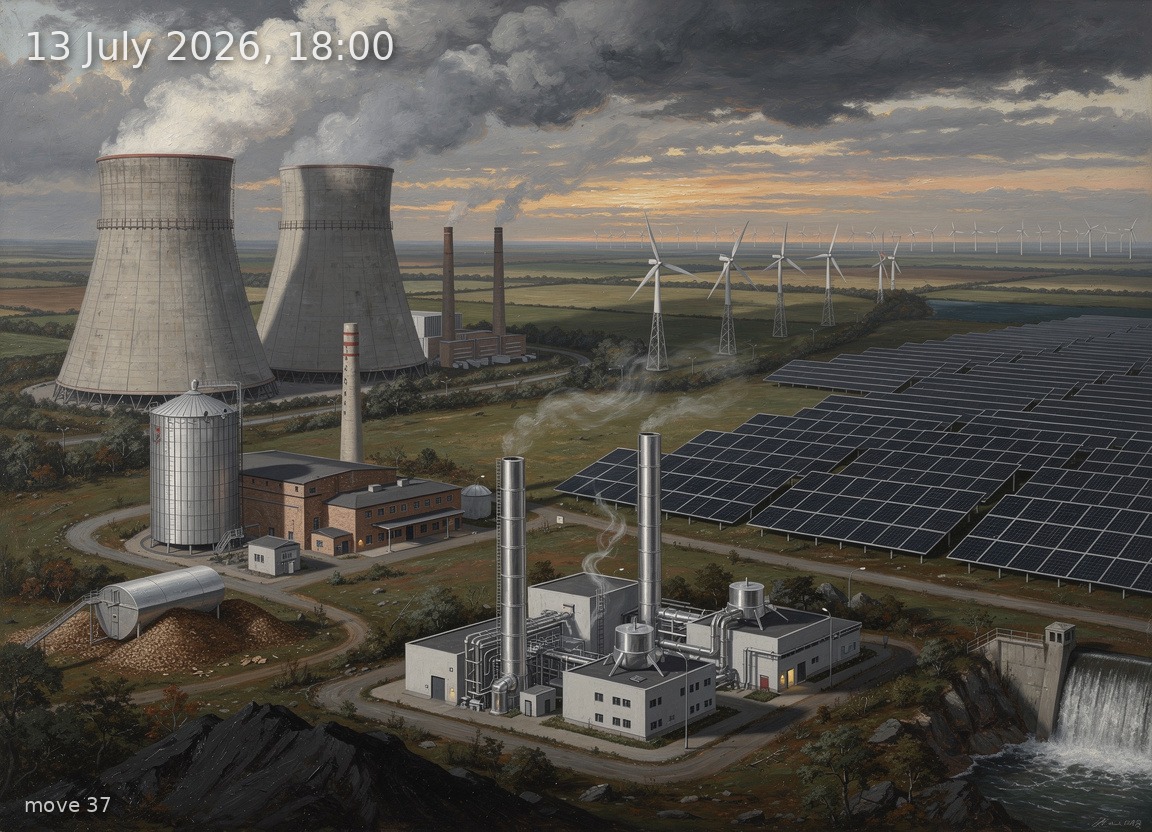
Solar leads at 16.8 GW but 15 GW net imports needed as heat-driven demand reaches 57.4 GW.
Generation mix
Wind onshore 14%
Wind offshore 6%
Solar 40%
Biomass 9%
Hydro 3%
Natural gas 7%
Hard coal 5%
Brown coal 17%
71%
Renewable share
8.4 GW
Wind (on + offshore)
16.8 GW
Solar
42.4 GW
Total generation
15.0 GW
Net import
140.0 EUR/MWh
Day-ahead price
30.4°C / 9 km/h
Temp / Wind speed
Open-Meteo, Kassel (51.3°N 9.5°E) · surface estimate from 100 m wind
93.0% / 363.0 W/m²
Cloud cover / Radiation
212
gCO₂/kWh
Image prompt
Solar 16.8 GW dominates the upper-right quadrant as vast fields of aluminium-framed crystalline silicon PV panels stretching across flat farmland; brown coal 7.2 GW occupies the left foreground as three massive hyperbolic cooling towers with heavy white-grey steam plumes rising into overcast sky; wind onshore 6.0 GW appears as a mid-ground line of roughly a dozen three-blade turbines on lattice towers with blades turning slowly in light wind; biomass 3.7 GW is rendered as a compact wood-chip power station with a cylindrical silo and single low smokestack in the centre-left; natural gas 2.9 GW sits centre as a modern CCGT plant with sleek exhaust stacks and a thin heat shimmer; wind offshore 2.4 GW visible in the far background as a row of sea-based turbines on monopile foundations at the horizon; hard coal 2.2 GW appears as a smaller conventional power station with two rectangular chimneys near the brown coal complex; hydro 1.2 GW is a small dam spillway visible at the far right edge. Time is 18:00 Berlin dusk in July: the sky is heavy and overcast at 93% cloud cover, but the lower western horizon shows a muted orange-amber glow of late sun filtering through a thick humid haze. The atmosphere is oppressive and hazy, conveying extreme summer heat at 30 degrees — parched yellowing grass, shimmering heat distortion above roads and rooftops, wilting linden trees. The high electricity price is expressed through a brooding, heavy, close atmosphere with dense warm tones. Style: highly detailed oil painting in the tradition of 19th-century German Romantic landscape painters such as Caspar David Friedrich and Carl Blechen — rich impasto brushwork, deep atmospheric perspective, dramatic chiaroscuro between the glowing horizon and the dark cloud mass above, meticulous engineering detail on every turbine nacelle, cooling tower reinforcement rib, and PV panel frame. No text, no labels.