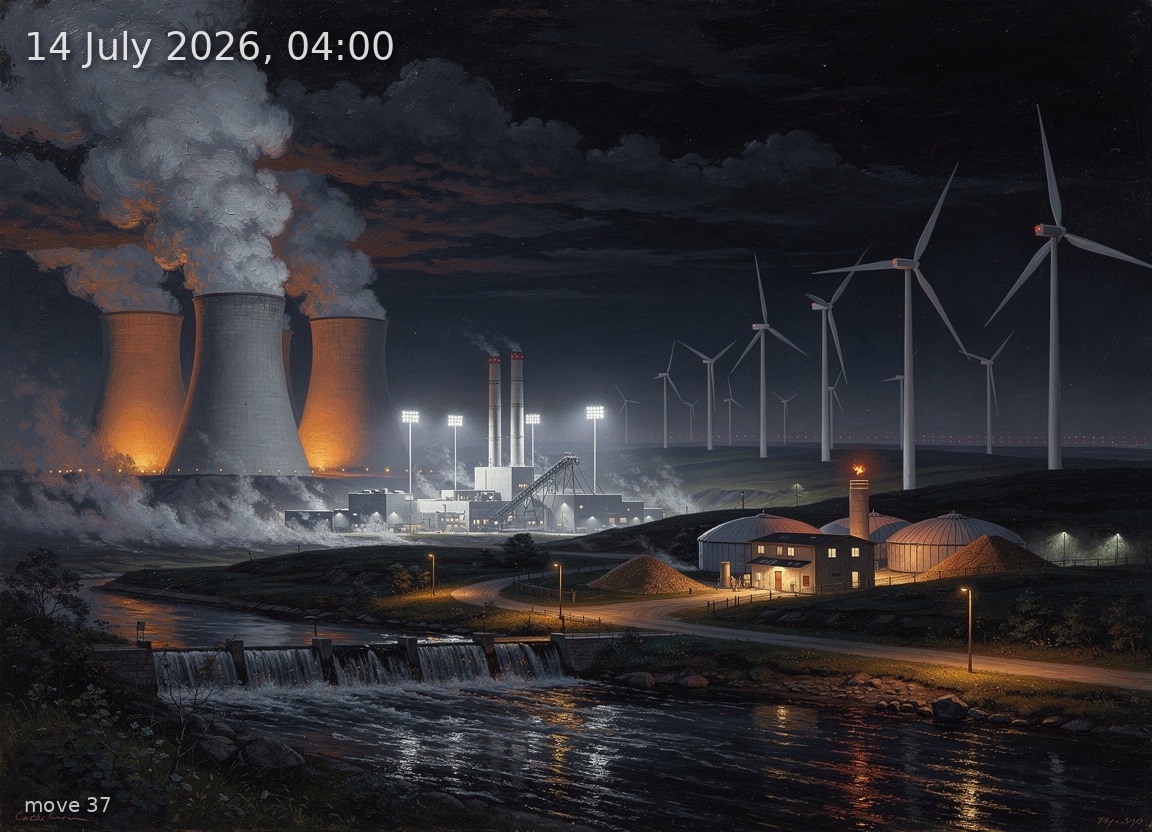
Wind and brown coal anchor overnight generation while 9 GW net imports cover the consumption gap at elevated prices.
Generation mix
Wind onshore 34%
Wind offshore 5%
Solar 0%
Biomass 10%
Hydro 3%
Natural gas 14%
Hard coal 11%
Brown coal 23%
52%
Renewable share
13.7 GW
Wind (on + offshore)
0.0 GW
Solar
35.5 GW
Total generation
9.0 GW
Net import
127.7 EUR/MWh
Day-ahead price
17.5°C / 7 km/h
Temp / Wind speed
Open-Meteo, Kassel (51.3°N 9.5°E) · surface estimate from 100 m wind
68.0% / 0.0 W/m²
Cloud cover / Radiation
342
gCO₂/kWh
Image prompt
Wind onshore 12.1 GW dominates the right half of the composition as dozens of tall three-blade turbines with white tubular towers and visible nacelles stretching across a dark rolling landscape, blades turning gently in moderate wind. Brown coal 8.2 GW occupies the left quarter as a massive lignite power station with four hyperbolic cooling towers emitting thick white-grey steam plumes lit from below by sodium-orange industrial lighting. Natural gas 4.9 GW appears centre-left as two compact CCGT plants with slender exhaust stacks releasing thin heat shimmer, their facades illuminated by harsh white floodlights. Hard coal 4.0 GW sits behind the gas plants as a blocky power station with a single large smokestack and coal conveyor silhouetted against faint industrial glow. Biomass 3.6 GW appears in the centre-right middle ground as a modest facility with wood-chip storage domes and a short stack with a warm amber glow at its tip. Hydro 1.1 GW is a small run-of-river weir in the foreground with dark water reflecting artificial lights. Wind offshore 1.7 GW is suggested in the far background right as tiny red aviation warning lights dotting the black horizon line over an implied sea. Time is 4:00 AM in July: the sky is completely dark, deep navy-black with no twilight glow, no moon visible, thick cloud cover at 68% obscuring any stars. The atmosphere feels heavy and oppressive, with humid summer air carrying the steam plumes low, pressing them toward the earth — reflecting high electricity prices. Temperature is a warm 17.5°C: lush midsummer vegetation visible in foreground, dark green deciduous trees and tall grass faintly lit by facility lights. Sodium-orange streetlights line a small road in the lower foreground. Style: highly detailed oil painting in the tradition of 19th-century German Romantic landscape painting — rich impasto brushwork, atmospheric chiaroscuro, deep tonal contrasts between the glowing industrial facilities and the vast dark sky. Meticulous engineering detail on each turbine nacelle, cooling tower curvature, CCGT stack geometry. The scene evokes Caspar David Friedrich's sublime darkness merged with industrial realism. No text, no labels.