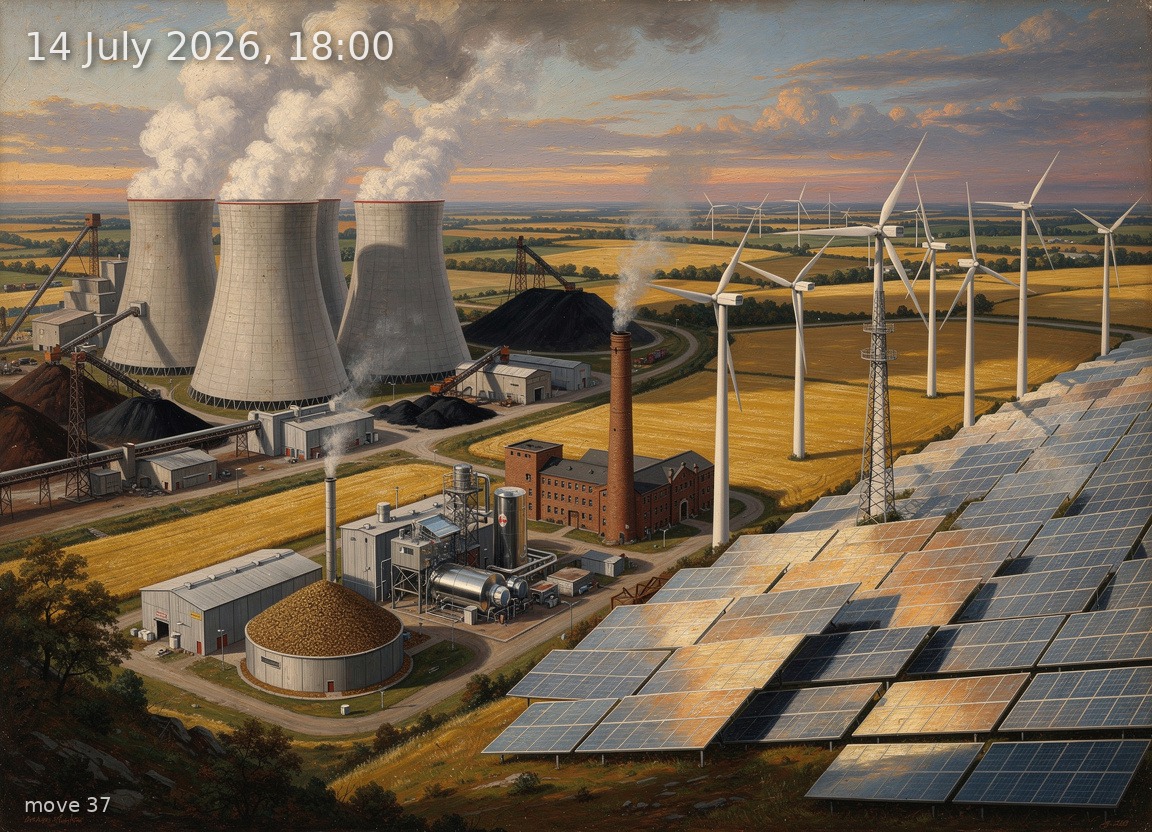
Solar and wind lead at 27.7 GW combined, but 12.8 GW net imports are needed to meet hot-evening peak demand.
Generation mix
Wind onshore 22%
Wind offshore 5%
Solar 35%
Biomass 8%
Hydro 3%
Natural gas 5%
Hard coal 6%
Brown coal 15%
73%
Renewable share
12.3 GW
Wind (on + offshore)
15.4 GW
Solar
44.6 GW
Total generation
12.8 GW
Net import
138.3 EUR/MWh
Day-ahead price
27.5°C / 10 km/h
Temp / Wind speed
Open-Meteo, Kassel (51.3°N 9.5°E) · surface estimate from 100 m wind
9.0% / 349.0 W/m²
Cloud cover / Radiation
196
gCO₂/kWh
Image prompt
Solar 15.4 GW dominates the right half of the scene as vast fields of aluminium-framed crystalline silicon photovoltaic panels stretching across golden summer farmland, angled to catch the low western sun. Wind onshore 9.9 GW fills the centre-right as dozens of three-blade turbines on lattice and tubular towers, rotors turning slowly in light breeze. Brown coal 6.6 GW occupies the left quarter as a cluster of massive hyperbolic cooling towers with thick white-grey steam plumes rising into the sky, adjacent to conveyor belts and lignite bunkers. Biomass 3.7 GW appears as a medium-sized industrial plant with a wood-chip storage dome and a single smokestack emitting thin pale exhaust, positioned centre-left. Hard coal 2.9 GW shows as a traditional coal power station with a tall brick chimney and coal yard, slightly behind the brown coal complex. Natural gas 2.5 GW is rendered as a compact combined-cycle gas turbine facility with a single polished exhaust stack and visible heat-recovery steam generator, nestled between the coal and biomass plants. Wind offshore 2.4 GW is visible on the far horizon as a line of turbines standing in a hazy sea glimpsed through a gap in the landscape. Hydro 1.3 GW appears as a small dam with cascading water in the far middle distance. The lighting is dusk at 18:00 in July: the sun is still above the horizon but low in the west, casting long warm orange-golden light across the entire landscape, with shadows stretching eastward. The sky is nearly cloudless at 9% cover, a gradient from deep blue overhead to warm amber-peach near the horizon. The atmosphere feels heavy and oppressive—a thick summer haze shimmers above the fields, reflecting the 27.5°C heat and the high electricity price. Lush green deciduous trees and ripe wheat fields mark midsummer. Painted in the style of a highly detailed 19th-century German Romantic oil painting with rich saturated colour, visible impasto brushwork, dramatic atmospheric depth, and meticulous engineering accuracy for every technology depicted. No text, no labels.