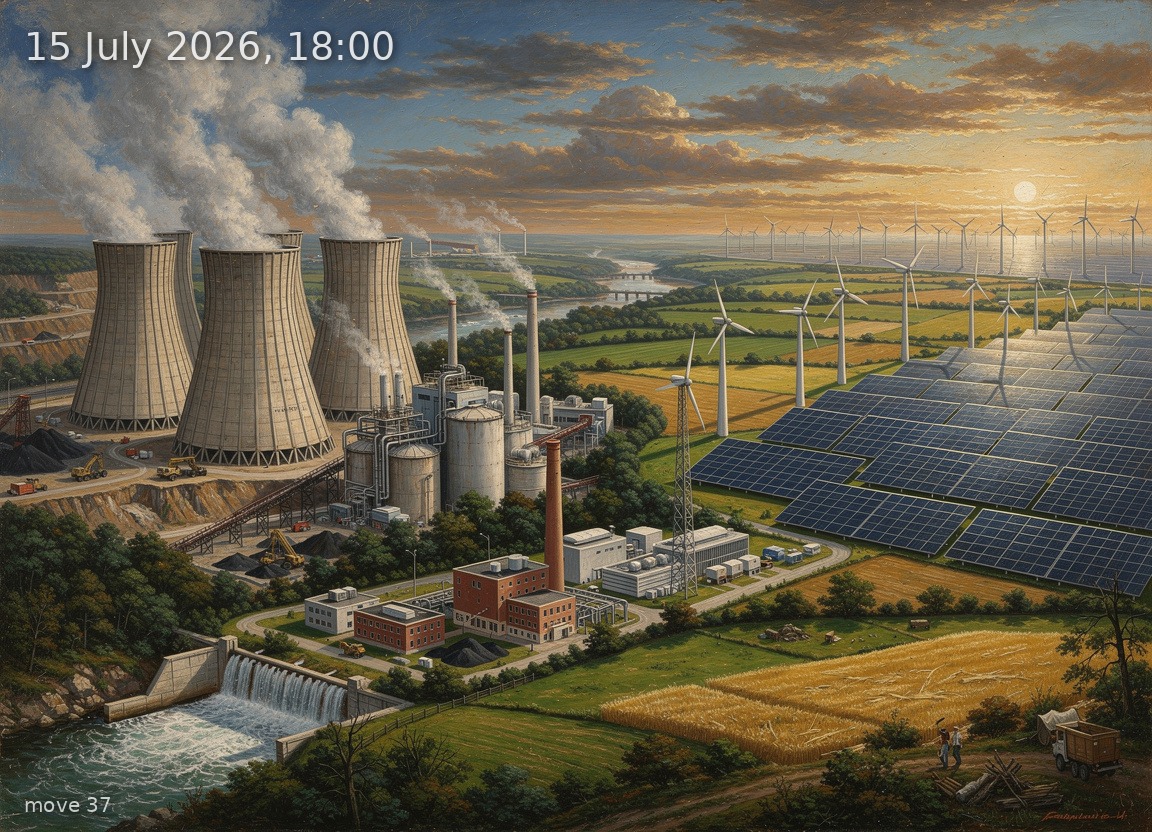
Solar leads at 16.2 GW with strong wind and heavy brown coal as summer evening demand exceeds domestic generation.
Generation mix
Wind onshore 17%
Wind offshore 5%
Solar 35%
Biomass 8%
Hydro 3%
Natural gas 7%
Hard coal 7%
Brown coal 18%
68%
Renewable share
10.2 GW
Wind (on + offshore)
16.2 GW
Solar
46.3 GW
Total generation
11.6 GW
Net import
145.6 EUR/MWh
Day-ahead price
26.9°C / 15 km/h
Temp / Wind speed
Open-Meteo, Kassel (51.3°N 9.5°E) · surface estimate from 100 m wind
30.0% / 309.0 W/m²
Cloud cover / Radiation
236
gCO₂/kWh
Image prompt
Solar 16.2 GW dominates the right third of the scene as vast fields of aluminium-framed crystalline silicon photovoltaic panels stretching across gentle rolling hills, angled toward a low western sun; brown coal 8.5 GW occupies the left quarter as a cluster of massive hyperbolic cooling towers emitting thick white-grey steam plumes against the sky, with conveyor belts and open-pit mine terraces visible at their base; wind onshore 7.7 GW fills the centre-right as dozens of tall three-blade turbines on lattice and tubular towers, rotors turning moderately in 14.8 km/h breeze, scattered across green summer farmland; biomass 3.7 GW appears as mid-sized industrial plants with cylindrical silos and single chimneys releasing thin grey exhaust, nestled among trees in the centre-left; natural gas 3.3 GW is rendered as compact CCGT units with paired exhaust stacks and rectangular turbine halls, positioned near the coal complex; hard coal 3.1 GW shows as a traditional power station with a single tall rectangular chimney and coal stockpiles; wind offshore 2.4 GW is visible in the far background as a line of turbines on the hazy horizon suggesting the distant North Sea coast; hydro 1.4 GW appears as a small concrete dam with cascading water in the far left valley. Time is 18:00 in July: the sun is descending in the west, casting long warm golden-orange light across the landscape, sky transitioning from deep blue overhead to amber and copper near the horizon, with 30% scattered cumulus clouds lit dramatically from below in peach and rose tones. The atmosphere feels heavy and oppressive despite the beauty — a faint haze and a subtle weight to the air suggesting high prices and strained supply. Temperature is 26.9°C: lush dark-green summer foliage on deciduous trees, ripened wheat fields, heat shimmer rising from the solar panels. Highly detailed oil painting in the tradition of 19th-century German Romantic landscape painters — rich saturated colour palette, visible impasto brushwork, atmospheric aerial perspective with luminous depth, meticulous engineering detail on every turbine nacelle, every cooling tower's concrete ribbing, every PV panel's grid lines. The scene reads as a grand panoramic industrial landscape masterwork. No text, no labels.