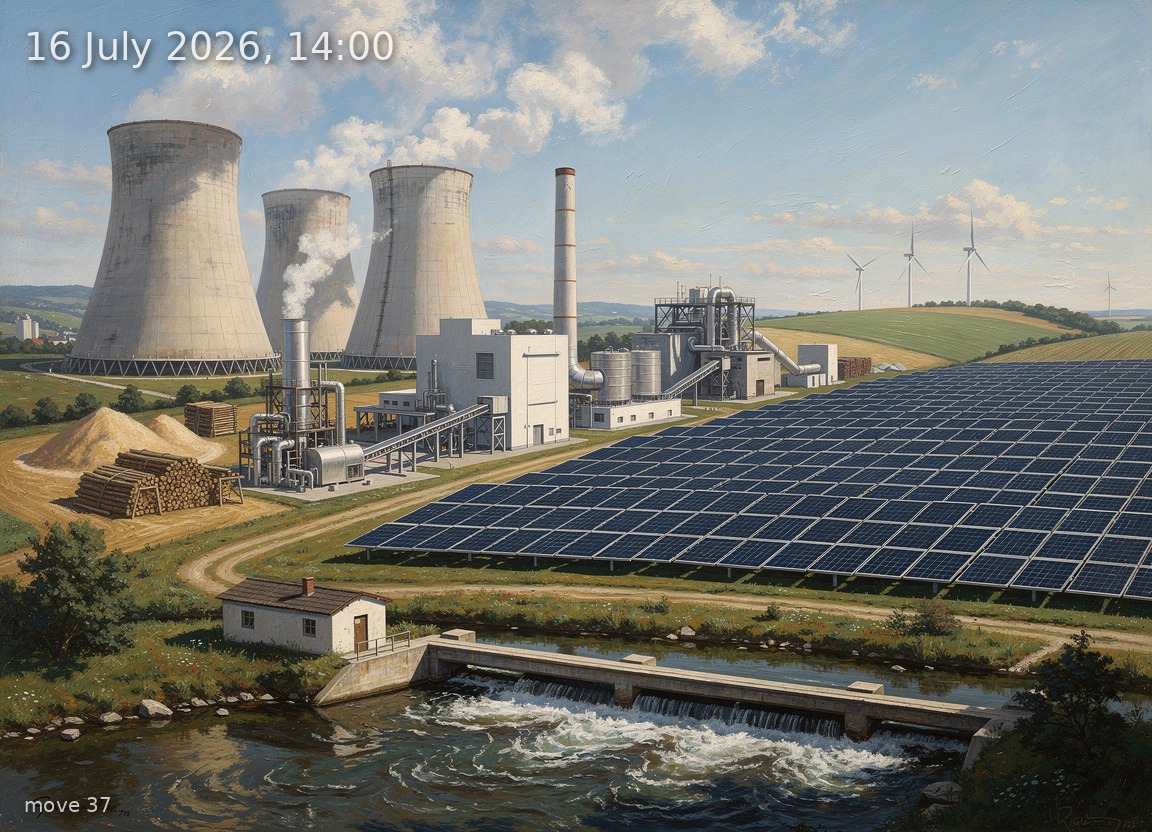
Solar at 46 GW dominates a hot, windless July afternoon; brown coal persists at 8 GW as Germany exports ~9.5 GW.
Generation mix
Wind onshore 2%
Wind offshore 0%
Solar 70%
Biomass 5%
Hydro 2%
Natural gas 4%
Hard coal 4%
Brown coal 12%
79%
Renewable share
1.3 GW
Wind (on + offshore)
46.0 GW
Solar
65.9 GW
Total generation
+9.4 GW
Net export
96.5 EUR/MWh
Day-ahead price
28.6°C / 4 km/h
Temp / Wind speed
Open-Meteo, Kassel (51.3°N 9.5°E) · surface estimate from 100 m wind
32.0% / 622.0 W/m²
Cloud cover / Radiation
153
gCO₂/kWh
Image prompt
Solar 46.0 GW dominates the scene as an enormous expanse of crystalline silicon photovoltaic panels covering gently rolling agricultural fields across the entire right two-thirds and centre of the composition, their aluminium frames glinting under intense July sunshine. Brown coal 8.0 GW occupies the left portion as a cluster of massive hyperbolic cooling towers emitting thick white steam plumes that drift into a hazy sky. Biomass 3.5 GW appears as a medium-sized wood-chip-fed power station with a squat smokestack and timber storage yard in the middle-left ground. Natural gas 2.9 GW is rendered as a compact modern CCGT plant with a single tall exhaust stack and heat-recovery unit, situated just right of the lignite complex. Hard coal 2.8 GW appears as a smaller traditional coal plant with conveyor belts and a rectangular chimney releasing faint grey exhaust, tucked behind the gas plant. Hydro 1.5 GW is visible as a concrete run-of-river weir and small powerhouse on a river winding through the foreground. Wind onshore 1.1 GW is represented by just two or three distant three-blade turbines on a far ridge, their rotors nearly motionless in the calm air. Wind offshore 0.2 GW is a single tiny turbine silhouette barely visible on the far horizon. The sky is mostly clear with scattered cumulus clouds at 32% coverage, blazing hot July afternoon light at 14:00 — high sun, sharp shadows, the air shimmering with heat haze at 28.6°C. Vegetation is lush dark-green summer growth — wheat fields turning golden, mature deciduous trees in full canopy. Despite the bright sun, the atmosphere feels heavy and oppressive, a warm yellowish cast suggesting high prices and thermal stress. Rendered as a highly detailed oil painting in the tradition of 19th-century German Romantic landscape painters such as Caspar David Friedrich and Carl Blechen — rich saturated colour, visible impasto brushwork, dramatic atmospheric depth and luminous sky treatment — but with meticulous engineering accuracy for every technology depicted: correct turbine nacelles, PV cell patterns, cooling tower geometry, industrial piping. No text, no labels.