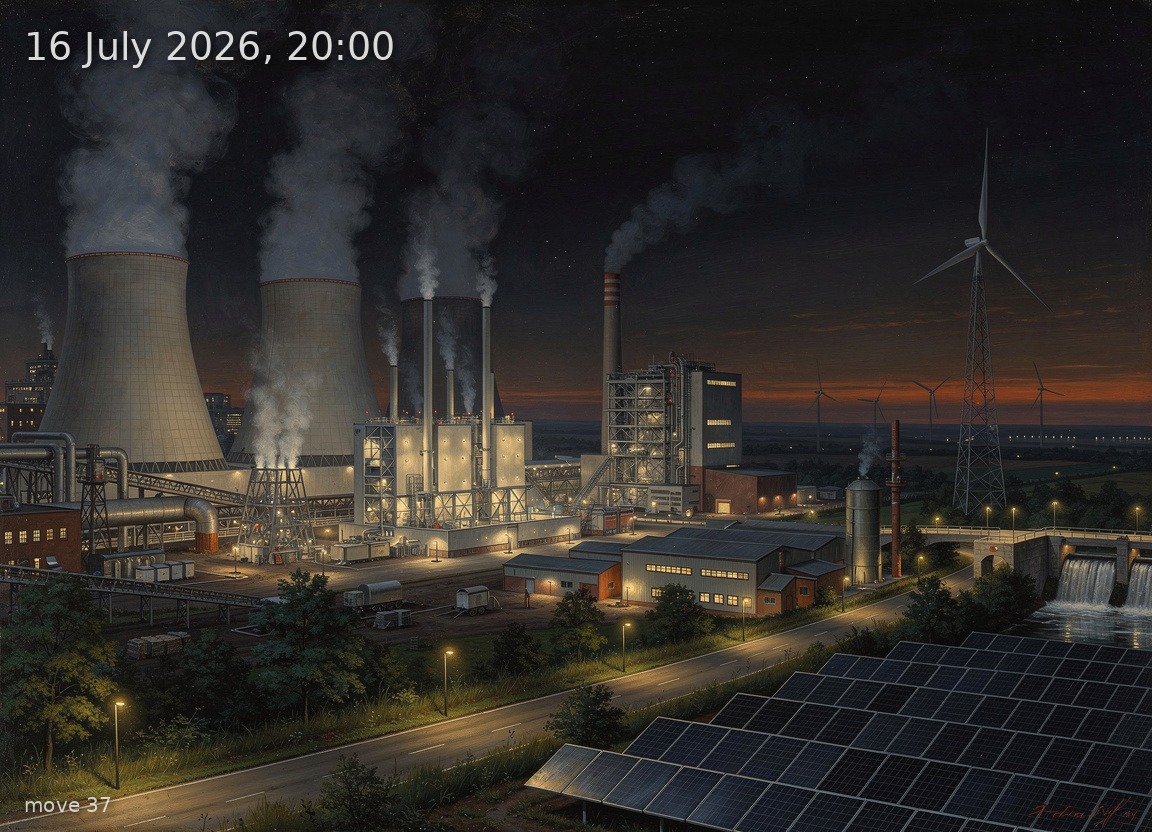
Brown coal and gas dominate as wind and solar fade at dusk, driving heavy imports and a 312 EUR/MWh price.
Generation mix
Wind onshore 10%
Wind offshore 1%
Solar 7%
Biomass 12%
Hydro 4%
Natural gas 21%
Hard coal 12%
Brown coal 32%
34%
Renewable share
3.7 GW
Wind (on + offshore)
2.2 GW
Solar
32.6 GW
Total generation
25.5 GW
Net import
311.7 EUR/MWh
Day-ahead price
25.0°C / 4 km/h
Temp / Wind speed
Open-Meteo, Kassel (51.3°N 9.5°E) · surface estimate from 100 m wind
9.0% / 44.0 W/m²
Cloud cover / Radiation
459
gCO₂/kWh
Image prompt
Brown coal 10.4 GW dominates the left third of the scene as a sprawling lignite complex with four massive hyperbolic cooling towers emitting thick white-grey steam plumes into the dark sky; natural gas 7.0 GW fills the centre-left as three compact CCGT plants with tall slender exhaust stacks venting shimmering heat haze; hard coal 4.0 GW appears centre-right as a single large conventional power station with a rectangular boiler house and a tall chimney trailing grey smoke; biomass 4.0 GW is rendered as a cluster of medium-sized industrial buildings with cylindrical wood-pellet silos and short stacks with faintly lit emissions; wind onshore 3.2 GW appears in the right background as a sparse row of three-blade turbines on lattice towers standing nearly motionless in still air; solar 2.2 GW is depicted as a field of aluminium-framed crystalline silicon panels in the far right foreground catching only the last faint residual glow near the horizon; wind offshore 0.5 GW is suggested by a distant cluster of tiny turbines on the far horizon line; hydro 1.4 GW appears as a small dam structure with illuminated spillway at the far right edge. The sky is a deep navy-to-black gradient — it is 20:00 in July so only the faintest burnt-orange band lingers at the very lowest western horizon, the rest fully dark, with no twilight overhead. The atmosphere feels heavy and oppressive, hazy and thick, reflecting the extreme electricity price. Sodium-yellow streetlights and industrial floodlights illuminate the foreground infrastructure, casting warm pools of light on concrete and steel. Summer vegetation — lush green deciduous trees, tall grasses — is visible in the warm 25°C air but rendered in muted tones under artificial light. The landscape is flat central German terrain. Painted in the style of a highly detailed 19th-century German Romantic oil painting — rich, deep colour palette dominated by amber industrial glow against dark indigo sky, visible impasto brushwork, dramatic chiaroscuro, atmospheric depth with haze softening distant elements, meticulous engineering detail on every structure. No text, no labels.