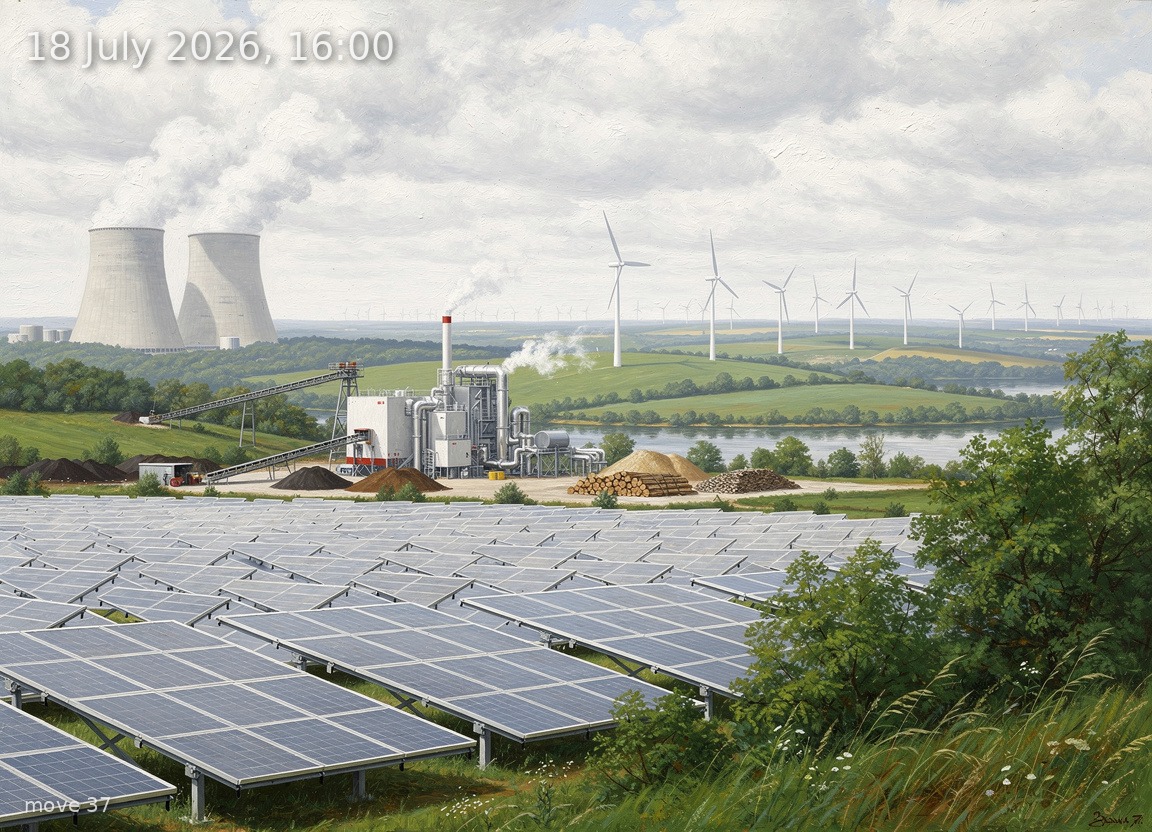
Solar (31.3 GW) and wind (19.6 GW) dominate, creating 12.6 GW net exports and a slightly negative price.
Generation mix
Wind onshore 28%
Wind offshore 5%
Solar 52%
Biomass 6%
Hydro 2%
Natural gas 3%
Hard coal 1%
Brown coal 4%
92%
Renewable share
19.5 GW
Wind (on + offshore)
31.3 GW
Solar
60.5 GW
Total generation
+12.6 GW
Net export
-1.8 EUR/MWh
Day-ahead price
23.4°C / 16 km/h
Temp / Wind speed
Open-Meteo, Kassel (51.3°N 9.5°E) · surface estimate from 100 m wind
100.0% / 324.0 W/m²
Cloud cover / Radiation
54
gCO₂/kWh
Image prompt
Solar 31.3 GW dominates the scene as vast fields of aluminium-framed crystalline silicon photovoltaic panels stretching across more than half the canvas, angled south, their glass surfaces reflecting a bright but fully overcast white sky; wind onshore 16.7 GW appears as dozens of tall three-blade turbines with white nacelles and lattice-free tubular towers arrayed across rolling green summer hills in the middle distance, blades turning at moderate speed in the steady breeze; wind offshore 2.9 GW is suggested by a handful of turbines barely visible on the far horizon beyond a river; biomass 3.7 GW is rendered as a mid-sized industrial plant with a wood-chip storage yard and a single modest steam stack in the left-centre; brown coal 2.6 GW occupies the far left as two hyperbolic concrete cooling towers emitting thin white steam plumes, with conveyor belts carrying dark lignite visible at their base; natural gas 1.5 GW appears as a compact combined-cycle gas turbine facility with a single sleek exhaust stack and minimal emissions next to the cooling towers; hydro 1.4 GW is depicted as a small concrete dam with water flowing over spillways in the foreground right; hard coal 0.5 GW is a single smaller smokestack barely visible behind the brown coal plant. The time is 16:00 on a July afternoon — full diffuse daylight under a uniformly white overcast sky at 100% cloud cover, yet strangely bright with 324 W/m² direct radiation filtering through thin high cloud, giving the landscape a luminous silvery-white quality. The temperature is 23.4°C: lush green deciduous trees in full summer foliage, tall grass swaying gently. The negative electricity price is evoked by an open, calm, expansive atmosphere — wide sky, no oppressive weight, a serene almost weightless quality to the light. Style: highly detailed oil painting in the tradition of 19th-century German Romantic landscape painters such as Caspar David Friedrich and Carl Blechen — rich layered colour, visible impasto brushwork in the clouds, atmospheric depth with aerial perspective softening distant turbines and cooling towers, meticulous engineering detail on every facility rendered with the precision of a technical illustrator but the soul of a Romantic master. No text, no labels.