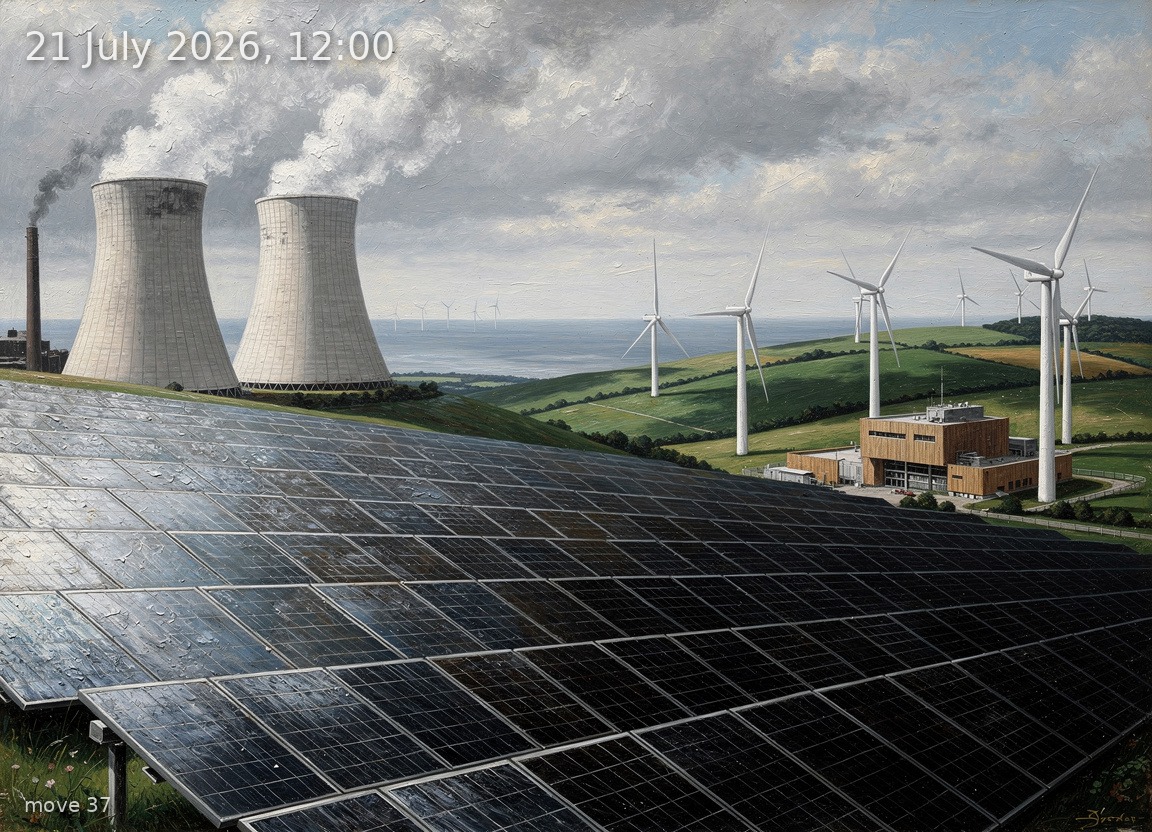
Solar at 47.8 GW overwhelms midday demand, driving 6.2 GW net export and near-zero prices.
Generation mix
Wind onshore 9%
Wind offshore 2%
Solar 73%
Biomass 6%
Hydro 2%
Natural gas 3%
Hard coal 1%
Brown coal 6%
90%
Renewable share
6.8 GW
Wind (on + offshore)
47.8 GW
Solar
65.9 GW
Total generation
+6.2 GW
Net export
7.1 EUR/MWh
Day-ahead price
18.6°C / 9 km/h
Temp / Wind speed
Open-Meteo, Kassel (51.3°N 9.5°E) · surface estimate from 100 m wind
74.0% / 301.0 W/m²
Cloud cover / Radiation
70
gCO₂/kWh
Image prompt
Solar 47.8 GW dominates the entire scene as a vast plain of crystalline silicon photovoltaic panels stretching across roughly three-quarters of the composition, their aluminium frames catching filtered midday light under a hazy, partly cloudy summer sky. Brown coal 4.1 GW appears at the far left as two massive hyperbolic cooling towers with lazy plumes of white steam rising into the overcast. Wind onshore 5.8 GW is represented by a scattered line of modern three-blade turbines with white tubular towers on gentle green hills in the middle distance, their rotors turning slowly in the light breeze. Wind offshore 1.0 GW shows as two or three distant turbines on a faint horizon line suggesting the North Sea. Biomass 3.8 GW sits as a modest timber-clad power station with a short stack and woodchip storage yard to the right of the cooling towers. Natural gas 1.8 GW is a small compact CCGT unit with a single slim exhaust stack producing a thin heat shimmer, tucked between the biomass plant and the solar field. Hydro 1.1 GW appears as a small concrete dam and penstock visible in a river valley on the far right. Hard coal 0.5 GW is a single dark industrial chimney barely smoking at the very left edge. The sky is a high summer midday sky at 12:00 noon in central Germany — bright overall but softened by 74% cloud cover, milky-white cirrus and altocumulus filtering the sun so that direct beams occasionally break through gaps, casting diffuse shadows across the solar arrays. Temperature is mild at 18.6°C; lush green deciduous trees, meadow grasses, and wildflowers line field edges, suggesting a temperate July. The low electricity price of 7.1 EUR/MWh is reflected in a calm, open, airy atmosphere with no oppressive haze. Style: highly detailed oil painting in the tradition of 19th-century German Romantic landscape painters such as Caspar David Friedrich and Carl Blechen — rich colour palette of greens, silvers, and soft greys, visible impasto brushwork, atmospheric aerial perspective fading into luminous distance — but every piece of energy infrastructure rendered with meticulous engineering accuracy: three-blade rotor hubs and nacelles, PV cell grid lines, cooling tower parabolic profiles, CCGT exhaust geometry. No text, no labels, no people in foreground.