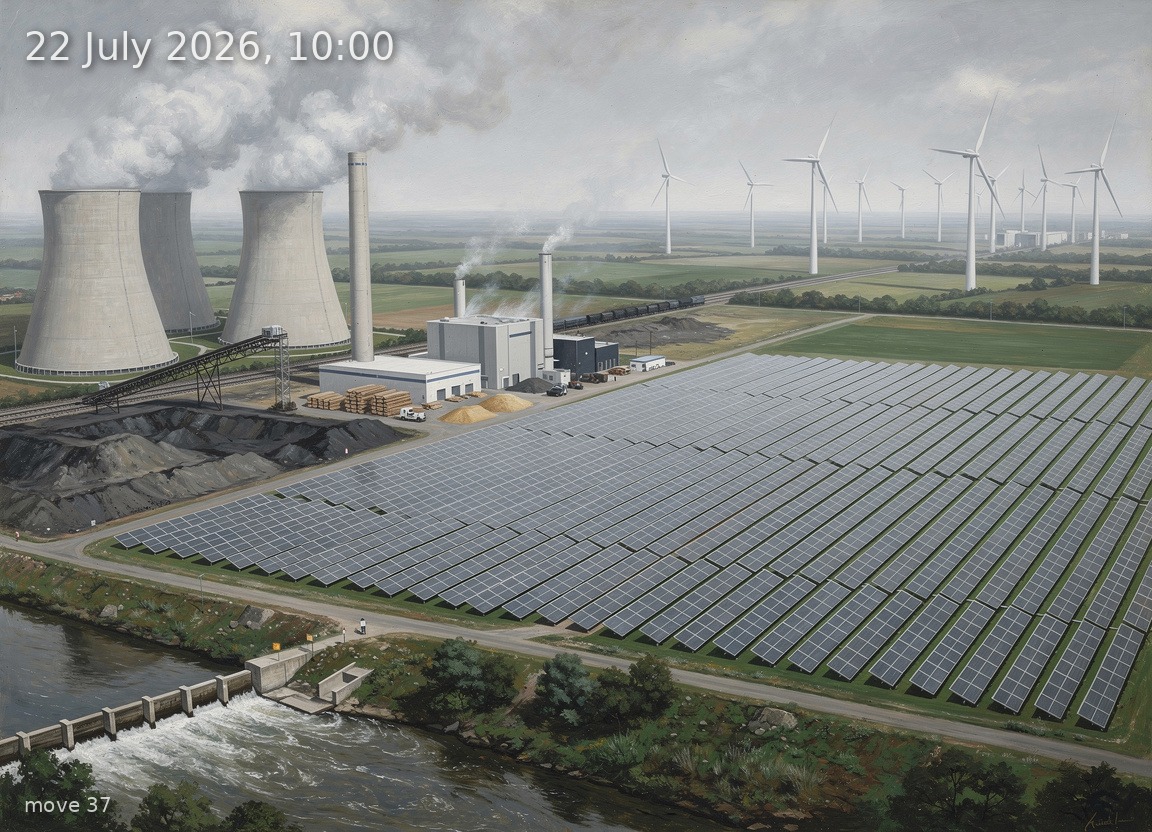
Solar dominates at 31.2 GW under overcast skies; strong wind and persistent coal drive 10.5 GW net exports.
Generation mix
Wind onshore 23%
Wind offshore 7%
Solar 43%
Biomass 5%
Hydro 2%
Natural gas 7%
Hard coal 3%
Brown coal 9%
81%
Renewable share
22.1 GW
Wind (on + offshore)
31.2 GW
Solar
72.4 GW
Total generation
+10.5 GW
Net export
66.2 EUR/MWh
Day-ahead price
15.9°C / 10 km/h
Temp / Wind speed
Open-Meteo, Kassel (51.3°N 9.5°E) · surface estimate from 100 m wind
99.0% / 53.0 W/m²
Cloud cover / Radiation
132
gCO₂/kWh
Image prompt
Solar 31.2 GW dominates the centre-right as an enormous field of aluminium-framed crystalline silicon PV panels stretching across flat agricultural land, their surfaces reflecting diffuse grey light; wind onshore 16.8 GW fills the far right as dozens of three-blade turbines on lattice and tubular towers receding into misty distance, blades turning slowly in moderate breeze; wind offshore 5.3 GW appears as a cluster of larger turbines visible on a hazy North Sea horizon at the far right edge; brown coal 6.8 GW occupies the left foreground as a group of massive hyperbolic cooling towers with thick white-grey steam plumes merging into the overcast sky, flanked by conveyor belts and lignite stockpiles; natural gas 5.0 GW sits centre-left as two compact CCGT power blocks with tall single exhaust stacks emitting thin transparent heat haze; biomass 3.9 GW appears as a modest wood-chip-fed plant with a low industrial chimney and stacked timber logs behind the gas units; hard coal 2.1 GW shows as a smaller coal-fired station with a single square cooling tower and coal rail cars, positioned behind the brown coal complex; hydro 1.3 GW is a small run-of-river weir with rushing water visible at the far left edge beside a wooded riverbank. Full mid-morning daylight but completely overcast: a uniform, heavy, pearl-grey sky with no visible sun, no shadows on the ground, flat diffuse illumination across the entire scene. Temperature 15.9°C in late July: lush green summer foliage on trees and meadows but with a cool damp atmosphere, grass slightly wet. The air feels dense and moderately oppressive, reflecting the 66.2 EUR/MWh price — haze hanging between the cooling towers and turbines, limited visibility toward the horizon. Style: highly detailed oil painting in the tradition of 19th-century German Romantic landscape painters — Caspar David Friedrich meets industrial modernity — rich layered colour in greens, greys, and muted browns, visible confident brushwork, deep atmospheric perspective, meticulous engineering accuracy on every turbine nacelle, PV panel frame, cooling tower hyperbolic curve, and CCGT stack. No text, no labels.