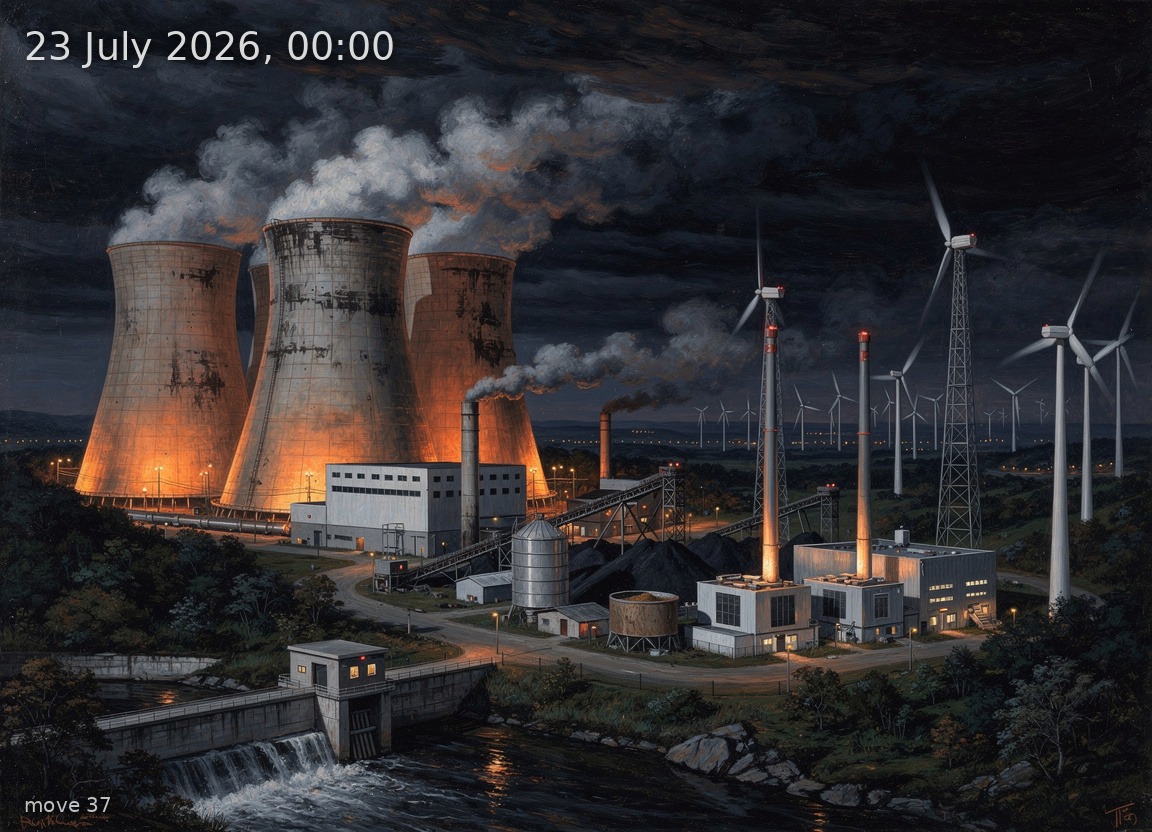
Strong overnight wind (26.3 GW) meets inflexible coal and gas baseload, driving 5.7 GW net export at an elevated price.
Generation mix
Wind onshore 41%
Wind offshore 12%
Biomass 8%
Hydro 2%
Natural gas 12%
Hard coal 9%
Brown coal 16%
64%
Renewable share
26.4 GW
Wind (on + offshore)
0.0 GW
Solar
49.7 GW
Total generation
+5.7 GW
Net export
142.8 EUR/MWh
Day-ahead price
14.7°C / 17 km/h
Temp / Wind speed
Open-Meteo, Kassel (51.3°N 9.5°E) · surface estimate from 100 m wind
97.0% / 0.0 W/m²
Cloud cover / Radiation
254
gCO₂/kWh
Image prompt
Brown coal 7.7 GW dominates the left quarter as a cluster of massive hyperbolic cooling towers emitting thick white steam plumes lit from below by orange sodium lamps; hard coal 4.5 GW sits just right of centre as a smaller coal plant with conveyor belts and a single squat stack trailing grey smoke; natural gas 5.9 GW appears as two compact CCGT units with tall slender exhaust stacks glowing faintly in the centre-right of the composition; wind onshore 20.2 GW fills the entire right half and extends into the deep background as dozens of tall three-blade turbines on lattice and tubular towers, their red aviation warning lights blinking against the black sky, rotors visibly spinning in the strong breeze; wind offshore 6.1 GW is suggested on the far-right horizon as a faint line of turbine lights reflected on a dark sea; biomass 4.1 GW appears as a modest industrial facility with a wood-chip silo and single chimney near the coal plants; hydro 1.1 GW is a small dam and powerhouse nestled in a hillside at the far left edge. The scene is set at midnight in central Germany in late July: the sky is completely black with no twilight glow, heavy 97% overcast blocking all stars, a deep oppressive ceiling of cloud faintly illuminated from below by industrial light. Temperature is mild at 14.7 °C with lush summer foliage on trees barely visible in the darkness. The atmosphere feels heavy and pressured, reflecting a high electricity price. Puddles on an asphalt road in the foreground reflect the orange and white industrial lights. Rendered as a highly detailed oil painting in the tradition of 19th-century German Romantic landscape painting — rich dark tones of indigo, umber, and ochre, visible impasto brushwork, dramatic chiaroscuro, atmospheric depth with steam and cloud merging, meticulous engineering detail on every turbine nacelle, cooling tower, and exhaust stack. No text, no labels.