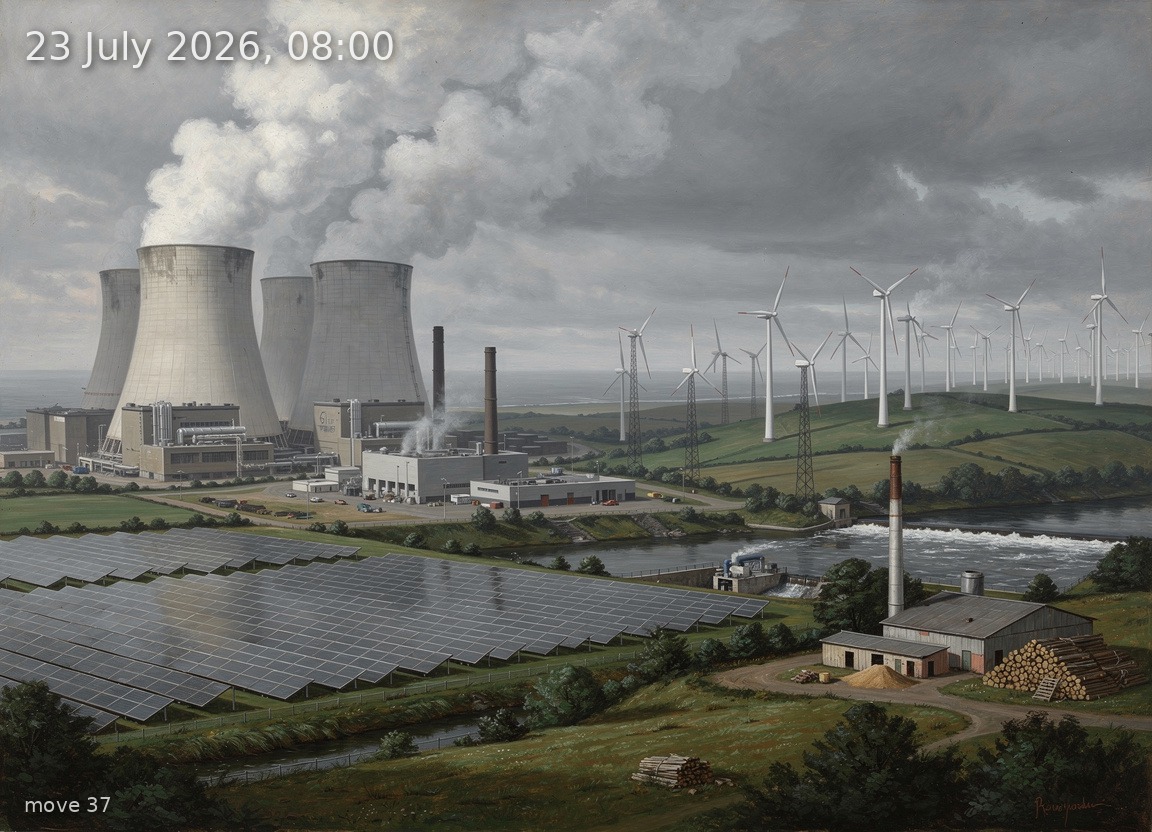
Wind and diffuse solar lead at 70% renewables, but full overcast and net imports push prices to 160 EUR/MWh.
Generation mix
Wind onshore 23%
Wind offshore 7%
Solar 30%
Biomass 7%
Hydro 2%
Natural gas 7%
Hard coal 7%
Brown coal 16%
70%
Renewable share
16.8 GW
Wind (on + offshore)
16.8 GW
Solar
55.6 GW
Total generation
3.7 GW
Net import
160.0 EUR/MWh
Day-ahead price
14.3°C / 13 km/h
Temp / Wind speed
Open-Meteo, Kassel (51.3°N 9.5°E) · surface estimate from 100 m wind
100.0% / 3.0 W/m²
Cloud cover / Radiation
218
gCO₂/kWh
Image prompt
Brown coal 8.8 GW dominates the left quarter as a massive lignite power complex with four hyperbolic cooling towers emitting thick white steam plumes into a heavy grey sky; solar 16.8 GW occupies the centre-left as vast fields of aluminium-framed crystalline silicon PV panels stretching across flat farmland, their surfaces dull and reflective-grey under the overcast — no sunshine, no glint; wind onshore 12.8 GW fills the centre-right as dozens of three-blade turbines on tall lattice and tubular towers marching across rolling green hills, blades turning in moderate breeze; wind offshore 4.0 GW appears in the far right background as a cluster of offshore turbines barely visible through coastal haze above a grey North Sea; natural gas 4.2 GW is rendered as two compact CCGT plants with slim exhaust stacks and modest heat shimmer, positioned between the coal complex and the solar fields; hard coal 3.8 GW sits adjacent to the lignite station as a smaller plant with rectangular boiler buildings and a single smokestack; biomass 4.1 GW appears as a wood-chip-fed combined heat and power facility with a modest chimney and stacked timber logs beside it; hydro 1.1 GW is a small run-of-river weir with turbine house visible along a river in the mid-ground. The sky is 100% overcast, a uniform blanket of low stratus in tones of pewter and slate, pressing down oppressively — no sun disk visible, diffuse flat light, 08:00 full daylight but dull and shadowless. Temperature 14°C, summer vegetation is lush deep green but damp, grasses bending slightly in 12.7 km/h wind. The atmosphere feels heavy and costly, a brooding pressure in the air. Highly detailed oil painting in the tradition of 19th-century German Romantic landscape painters — Caspar David Friedrich meets industrial sublime — rich muted colour palette of greys, sage greens, and warm coal-fire oranges, visible confident brushwork, atmospheric aerial perspective with misty depth, meticulous engineering detail on every turbine nacelle, every cooling tower rib, every PV cell grid. No text, no labels.