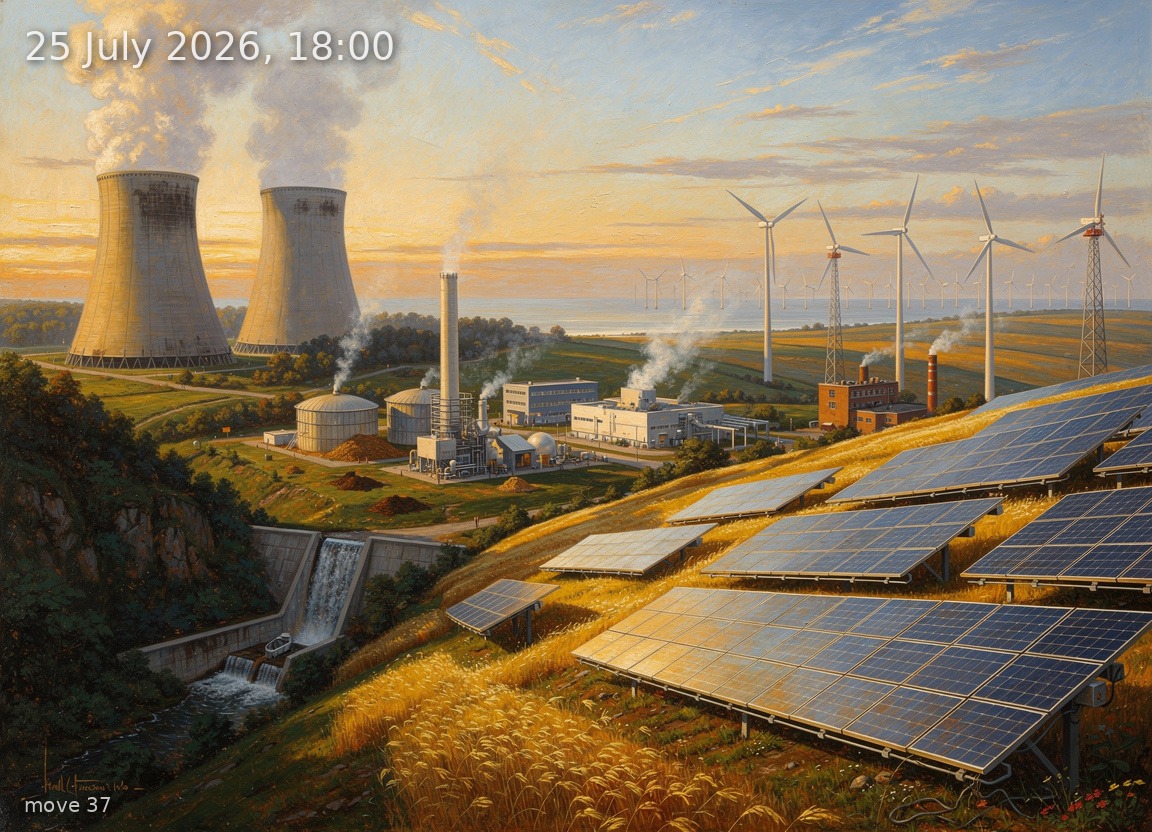
Solar at 17.8 GW and wind at 13.5 GW dominate, but 7.9 GW net imports bridge the summer evening demand gap.
Generation mix
Wind onshore 23%
Wind offshore 10%
Solar 43%
Biomass 9%
Hydro 3%
Natural gas 4%
Hard coal 2%
Brown coal 7%
88%
Renewable share
13.6 GW
Wind (on + offshore)
17.8 GW
Solar
41.4 GW
Total generation
7.9 GW
Net import
95.2 EUR/MWh
Day-ahead price
28.3°C / 15 km/h
Temp / Wind speed
Open-Meteo, Kassel (51.3°N 9.5°E) · surface estimate from 100 m wind
28.0% / 398.0 W/m²
Cloud cover / Radiation
88
gCO₂/kWh
Image prompt
Solar 17.8 GW dominates the right half of the scene as vast fields of aluminium-framed crystalline silicon photovoltaic panels stretching across rolling hills, angled to catch the low sun. Wind onshore 9.3 GW fills the centre-right as dozens of three-blade turbines on tall lattice and tubular towers, blades turning steadily in moderate wind. Wind offshore 4.2 GW appears in the far background as a row of offshore turbines visible across a distant hazy coastline. Biomass 3.7 GW occupies the centre-left as a cluster of modest industrial facilities with wood-chip storage domes and low exhaust stacks emitting thin white vapour. Brown coal 2.7 GW sits at the far left as two large hyperbolic cooling towers releasing thick steam plumes into the evening air. Natural gas 1.7 GW appears as a compact CCGT plant with a single tall exhaust stack and clean metallic enclosure, positioned just left of centre. Hydro 1.1 GW is rendered as a small concrete dam and penstock set into a forested valley in the left middle ground. Hard coal 0.7 GW is a smaller, older power station with a single square chimney beside the brown coal plant. The lighting is late summer dusk at 18:00 in July—the sun is low on the western horizon, casting long golden-orange light across the landscape, sky transitioning from warm amber near the horizon to pale blue overhead with only 28% wispy cloud cover. The atmosphere feels warm and slightly oppressive, with a hazy shimmer suggesting 28°C heat. Vegetation is lush, deep-green summer foliage on deciduous trees—lindens, oaks, beeches—with golden wheat fields between the solar arrays. The overall mood is grand but heavy, with the high electricity price conveyed through a dense, slightly sulphurous atmospheric haze. Style: highly detailed oil painting in the tradition of Caspar David Friedrich and Carl Blechen, rich saturated colour, visible impasto brushwork, atmospheric aerial perspective creating depth from foreground solar panels to distant offshore turbines. Meticulous engineering accuracy on all technology—correct nacelle shapes, three-blade rotors, panel wiring, cooling tower geometry, CCGT exhaust configurations. No text, no labels.