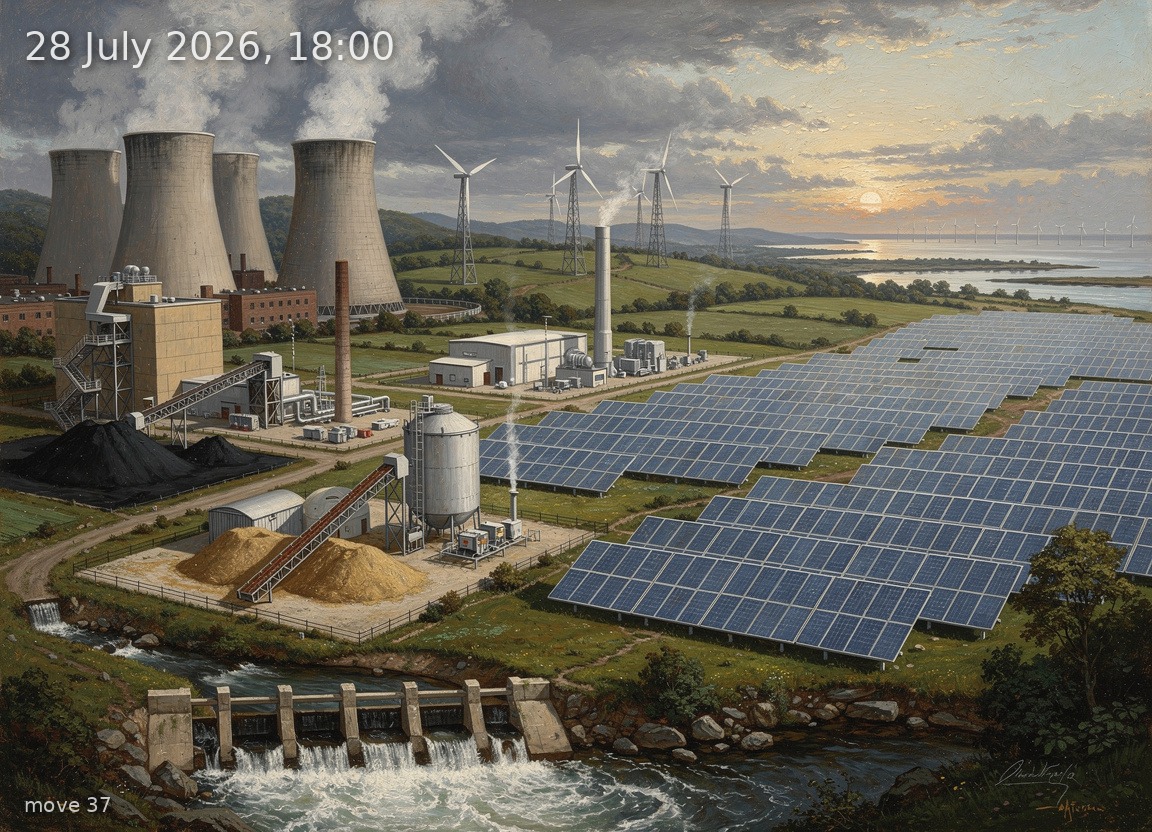
Solar leads at 18.7 GW but 15.3 GW net imports needed as light winds and high demand drive prices to 157 EUR/MWh.
Generation mix
Wind onshore 8%
Wind offshore 7%
Solar 45%
Biomass 9%
Hydro 3%
Natural gas 6%
Hard coal 6%
Brown coal 15%
73%
Renewable share
6.3 GW
Wind (on + offshore)
18.7 GW
Solar
41.1 GW
Total generation
15.3 GW
Net import
157.0 EUR/MWh
Day-ahead price
26.0°C / 4 km/h
Temp / Wind speed
Open-Meteo, Kassel (51.3°N 9.5°E) · surface estimate from 100 m wind
18.0% / 389.0 W/m²
Cloud cover / Radiation
200
gCO₂/kWh
Image prompt
Solar 18.7 GW dominates the right half and centre of the composition as vast fields of aluminium-framed crystalline silicon photovoltaic panels stretching across rolling green farmland, angled toward a low western sun; brown coal 6.2 GW occupies the left quarter as a cluster of massive hyperbolic cooling towers emitting tall white-grey steam plumes against the sky; wind onshore 3.4 GW appears as a modest row of three-blade turbines with lattice towers on distant hills, blades barely turning in still air; wind offshore 2.9 GW is suggested by a line of turbines on a hazy horizon beyond a river estuary; biomass 3.9 GW is depicted as a mid-ground industrial facility with a rounded silo, wood-chip conveyor, and a single low stack with thin white exhaust; hard coal 2.5 GW shows as a coal plant with a rectangular boiler house and conveyor belt feeding from a dark fuel pile, a single tall chimney with faint emissions; natural gas 2.4 GW appears as a compact CCGT unit with a sleek single exhaust stack and a small vapour trail beside the coal plant; hydro 1.0 GW is a small run-of-river weir with foaming white water in the foreground valley. The lighting is late-evening dusk at 18:00 in July — the sun is low in the west-northwest, casting long warm golden-orange light across the landscape, sky above transitioning from pale blue to deeper blue overhead, a few thin high cirrus clouds catching golden light, 18% cloud cover leaving most of the sky open. The air is heavy and hazy with summer warmth at 26°C, lush green deciduous trees in full leaf, meadow grasses tall and golden-tipped. The atmosphere feels oppressive and weighty, a faint amber-brown industrial haze hanging near the thermal plants, conveying the tension of high electricity prices. Style: highly detailed oil painting in the tradition of 19th-century German Romantic landscape painters such as Caspar David Friedrich and Carl Blechen — rich saturated colour, visible impasto brushwork, dramatic atmospheric depth and chiaroscuro, meticulous engineering accuracy on every turbine nacelle, panel frame, and cooling tower curve. No text, no labels.