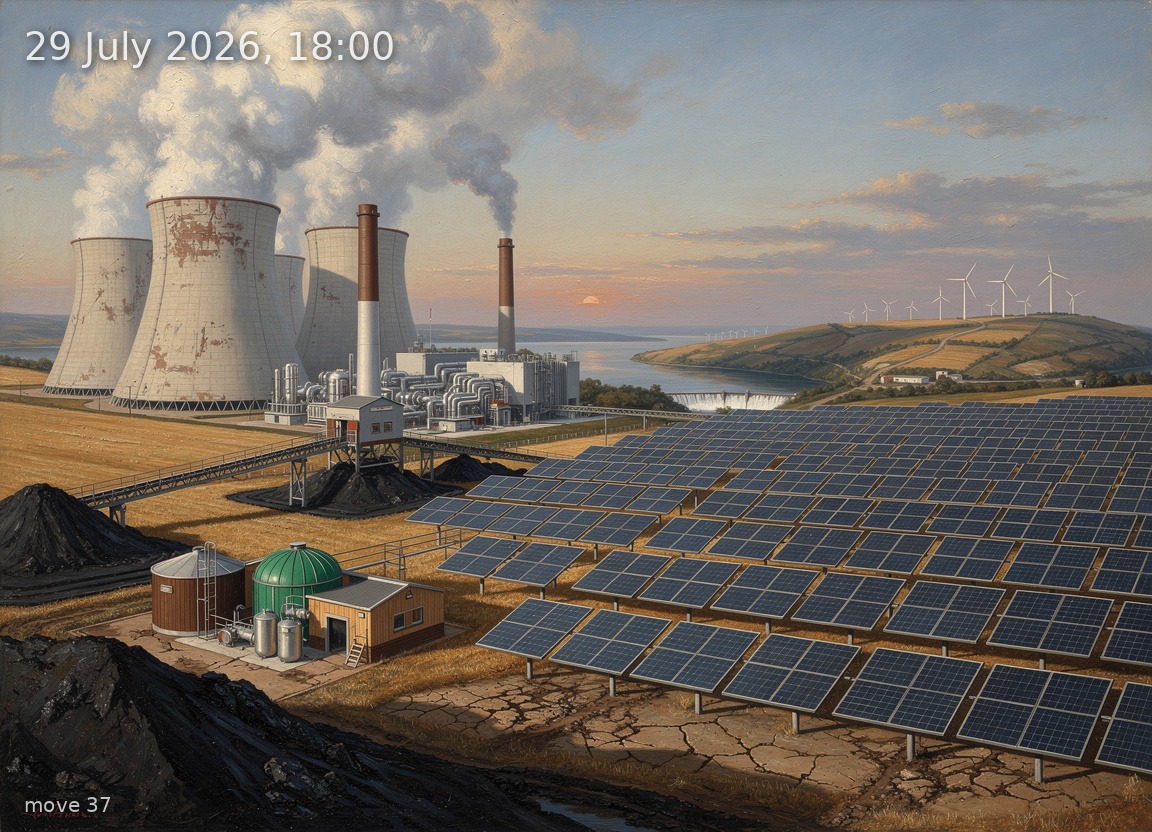
Solar leads at 19.2 GW but extreme heat drives 56 GW demand, requiring 14.6 GW net imports and heavy thermal dispatch.
Generation mix
Wind onshore 7%
Wind offshore 1%
Solar 46%
Biomass 9%
Hydro 3%
Natural gas 7%
Hard coal 7%
Brown coal 20%
67%
Renewable share
3.5 GW
Wind (on + offshore)
19.2 GW
Solar
41.5 GW
Total generation
14.7 GW
Net import
162.3 EUR/MWh
Day-ahead price
34.5°C / 9 km/h
Temp / Wind speed
Open-Meteo, Kassel (51.3°N 9.5°E) · surface estimate from 100 m wind
28.0% / 390.0 W/m²
Cloud cover / Radiation
245
gCO₂/kWh
Image prompt
Solar 19.2 GW dominates the right half of the scene as vast fields of aluminium-framed crystalline silicon photovoltaic panels stretching across parched golden farmland, angled toward a low western sun; brown coal 8.1 GW occupies the left quarter as a cluster of massive hyperbolic cooling towers with thick white-grey steam plumes rising into the hazy sky, beside conveyor belts of dark lignite; wind onshore 3.0 GW appears as a modest row of three-blade turbines on a distant ridge, rotors barely turning in the still air; natural gas 3.0 GW is rendered as two compact CCGT plants with slender exhaust stacks emitting thin heat shimmer, placed center-left; hard coal 2.7 GW appears as a single large stack-house with dark smoke just behind the gas units; biomass 3.8 GW is shown as a timber-clad biogas facility with a green domed digester near the center; hydro 1.1 GW is a small dam and spillway visible in a river valley in the far background; wind offshore 0.5 GW appears as tiny turbines on the hazy horizon line. The time is 18:00 in late July: the sun is descending in the west, casting intense orange-gold light at a low angle, long dramatic shadows stretching eastward across the drought-stressed landscape; the sky is mostly clear with scattered cumulus at 28% cover, but the atmosphere is thick, hazy, and oppressive with heat — a shimmering distortion near the ground conveys 34.5 °C temperatures. Vegetation is dry summer straw-yellow with stressed trees showing curled leaves. The overall atmosphere is heavy and brooding despite the golden light, suggesting high electricity prices and strained supply. Style: highly detailed oil painting in the tradition of 19th-century German Romantic landscape painters such as Caspar David Friedrich and Carl Blechen, with rich impasto brushwork, luminous glazes in the sky, meticulous engineering detail on every turbine nacelle, panel frame, and cooling tower, atmospheric perspective creating depth across the wide panoramic composition. No text, no labels.