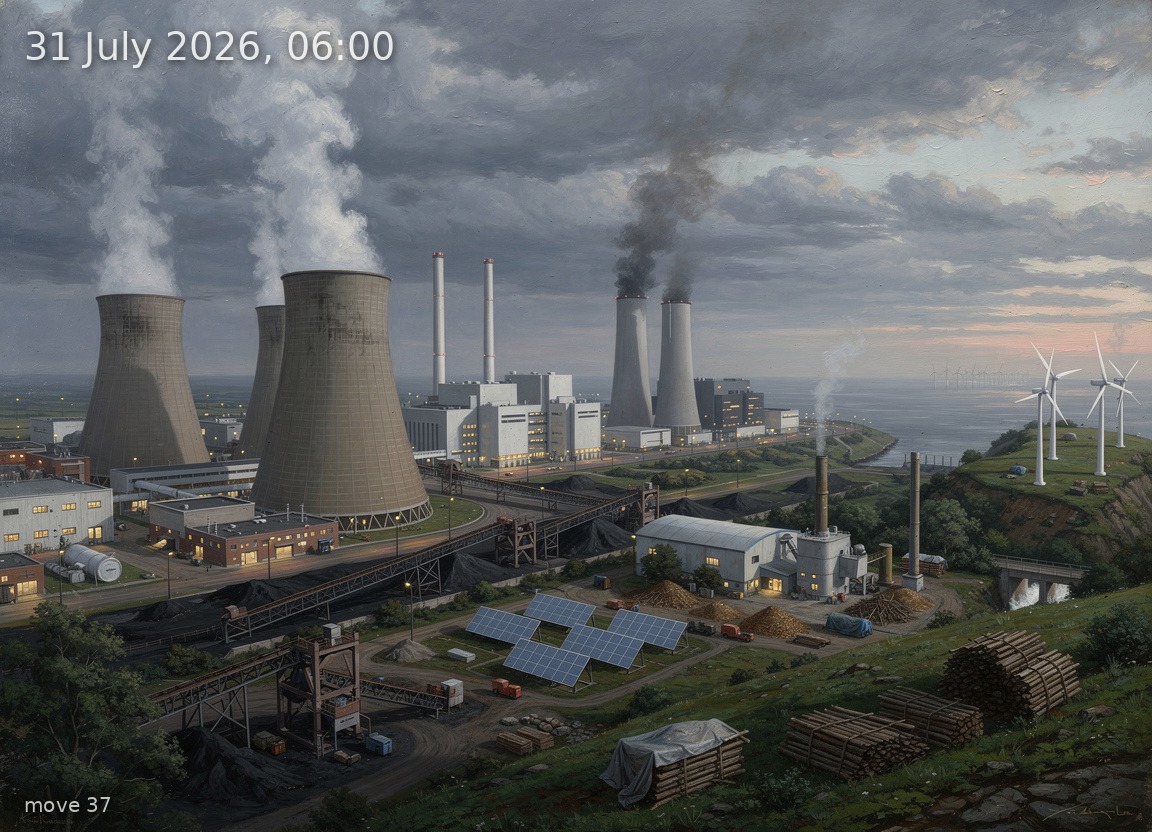
Brown coal dominates at 10.4 GW as overcast, windless dawn forces heavy thermal dispatch and large net imports.
Generation mix
Wind onshore 6%
Wind offshore 1%
Solar 7%
Biomass 13%
Hydro 4%
Natural gas 19%
Hard coal 14%
Brown coal 35%
31%
Renewable share
2.1 GW
Wind (on + offshore)
2.2 GW
Solar
29.3 GW
Total generation
23.2 GW
Net import
179.1 EUR/MWh
Day-ahead price
14.5°C / 4 km/h
Temp / Wind speed
Open-Meteo, Kassel (51.3°N 9.5°E) · surface estimate from 100 m wind
100.0% / 0.0 W/m²
Cloud cover / Radiation
490
gCO₂/kWh
Image prompt
Brown coal 10.4 GW dominates the left third of the scene as a massive lignite power station complex with four hyperbolic cooling towers emitting thick white steam plumes; natural gas 5.7 GW occupies the centre-left as two modern CCGT plants with tall slender exhaust stacks releasing thin heat shimmer; hard coal 4.1 GW appears centre-right as a traditional coal plant with a single large smokestack and conveyor belts carrying dark fuel; biomass 3.8 GW is rendered as a wood-chip-fed industrial facility with a modest chimney and stacked timber nearby; solar 2.2 GW appears as a small field of aluminium-framed crystalline silicon panels in the mid-ground, their surfaces dull and unreflective under thick clouds; wind onshore 1.8 GW is shown as a handful of three-blade turbines on a low ridge at the right, rotors barely turning in the still air; wind offshore 0.4 GW is suggested by a distant cluster of turbines on a grey sea glimpsed at the far right horizon; hydro 1.1 GW appears as a small dam and powerhouse nestled in a forested valley at right mid-ground. The sky is pre-dawn at 06:00 in late July — a deep blue-grey brightening faintly at the eastern horizon but with zero direct sunlight, completely overcast with low stratiform clouds pressing down oppressively. The atmosphere is heavy and humid at 14.5°C, with lush midsummer vegetation — full green deciduous trees, tall grass — but no warmth in the light. The air is utterly still, no motion in leaves or flags. High-voltage transmission lines cross the scene, cables sagging under load. The mood is tense and weighty, reflecting the 179 EUR/MWh price. Rendered as a highly detailed oil painting in the tradition of 19th-century German Romantic landscape masters — Caspar David Friedrich meets industrial sublime — with rich impasto brushwork, atmospheric aerial perspective, deep tonal contrasts between the glowing industrial facilities and the cold grey sky, meticulous engineering detail on every turbine nacelle, cooling tower, and panel frame. No text, no labels.