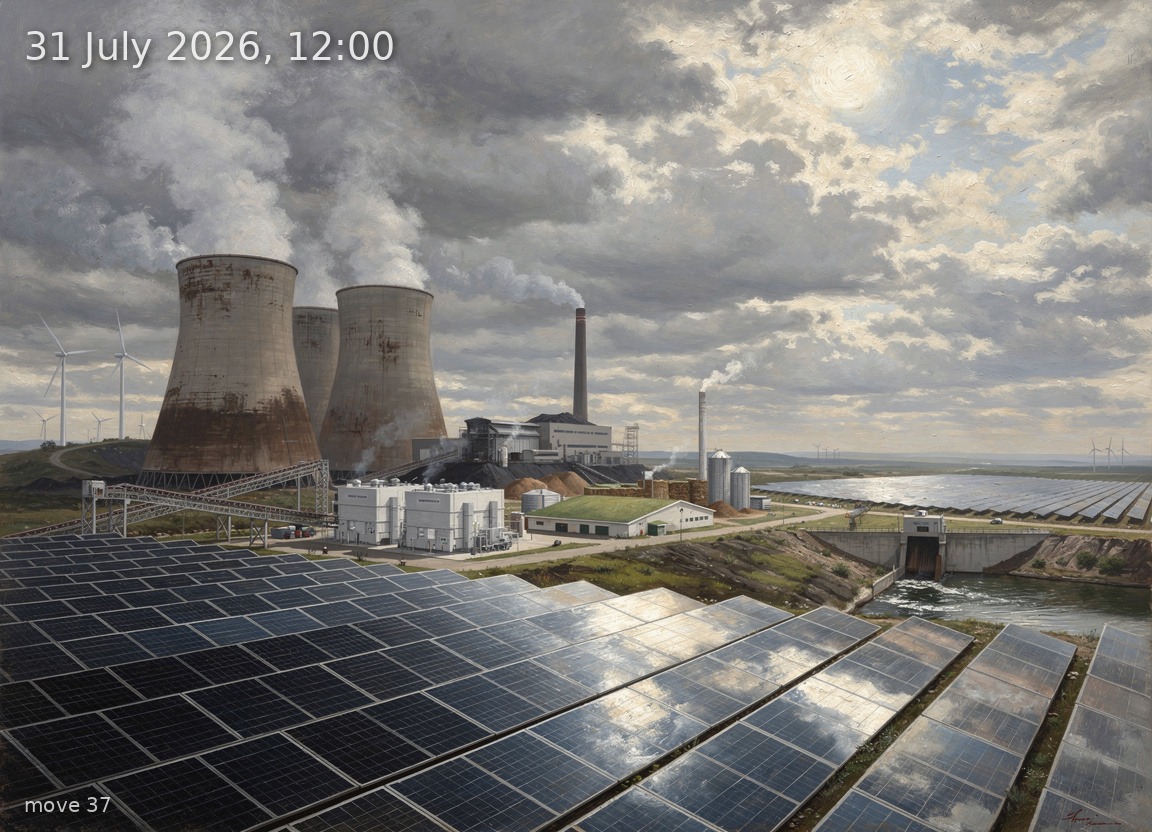
Solar at 46.7 GW drives 81.7% renewable share at noon; near-zero wind leaves brown coal and gas supporting the thermal base.
Generation mix
Wind onshore 3%
Wind offshore 1%
Solar 71%
Biomass 6%
Hydro 2%
Natural gas 4%
Hard coal 4%
Brown coal 11%
82%
Renewable share
2.2 GW
Wind (on + offshore)
46.7 GW
Solar
66.0 GW
Total generation
+6.8 GW
Net export
94.1 EUR/MWh
Day-ahead price
26.5°C / 2 km/h
Temp / Wind speed
Open-Meteo, Kassel (51.3°N 9.5°E) · surface estimate from 100 m wind
83.0% / 456.0 W/m²
Cloud cover / Radiation
135
gCO₂/kWh
Image prompt
Solar 46.7 GW dominates the scene as an immense plain of aluminium-framed crystalline silicon PV panels stretching across the entire right two-thirds of the composition, angled south, their blue-black surfaces reflecting a hazy, overcast midday sky. Brown coal 7.1 GW occupies the left background as a cluster of four massive hyperbolic cooling towers with thick white-grey steam plumes rising into the muggy air, beside a conveyor-fed lignite bunker. Hard coal 2.4 GW appears as a single smaller smokestack facility just left of centre, dark exhaust barely visible. Natural gas 2.7 GW is rendered as two compact CCGT units with slender exhaust stacks and faint heat shimmer, positioned centre-left. Biomass 3.8 GW is a mid-sized wood-chip plant with a green-roofed building and a modest steam vent, situated between the coal and gas facilities. Wind onshore 1.7 GW shows as three tall three-blade turbines on a distant ridge at the far left, their rotors barely turning in the still air. Wind offshore 0.5 GW is suggested by two tiny turbines on the extreme left horizon above a faint line of sea. Hydro 1.2 GW appears as a small concrete dam and powerhouse nestled in a valley in the middle distance. The sky is 83% covered by a thick, oppressive blanket of cumulus and altostratus clouds — hazy white-grey, heavy, humid — yet strong noon sun punches through scattered gaps, casting bright patches across the solar field and creating dramatic chiaroscuro. Temperature is 26.5 °C: lush midsummer vegetation — dark green deciduous trees, tall grass, wildflowers along field edges — everything slightly wilted and dusty in the summer heat. The atmosphere feels heavy and sultry, matching the high electricity price. Rendered as a highly detailed oil painting in the tradition of 19th-century German Romantic landscape painters — rich, layered colour with visible confident brushwork, atmospheric depth and aerial perspective, golden-grey tonal palette reminiscent of Caspar David Friedrich and Carl Blechen but depicting industrial infrastructure with meticulous engineering accuracy. No text, no labels.