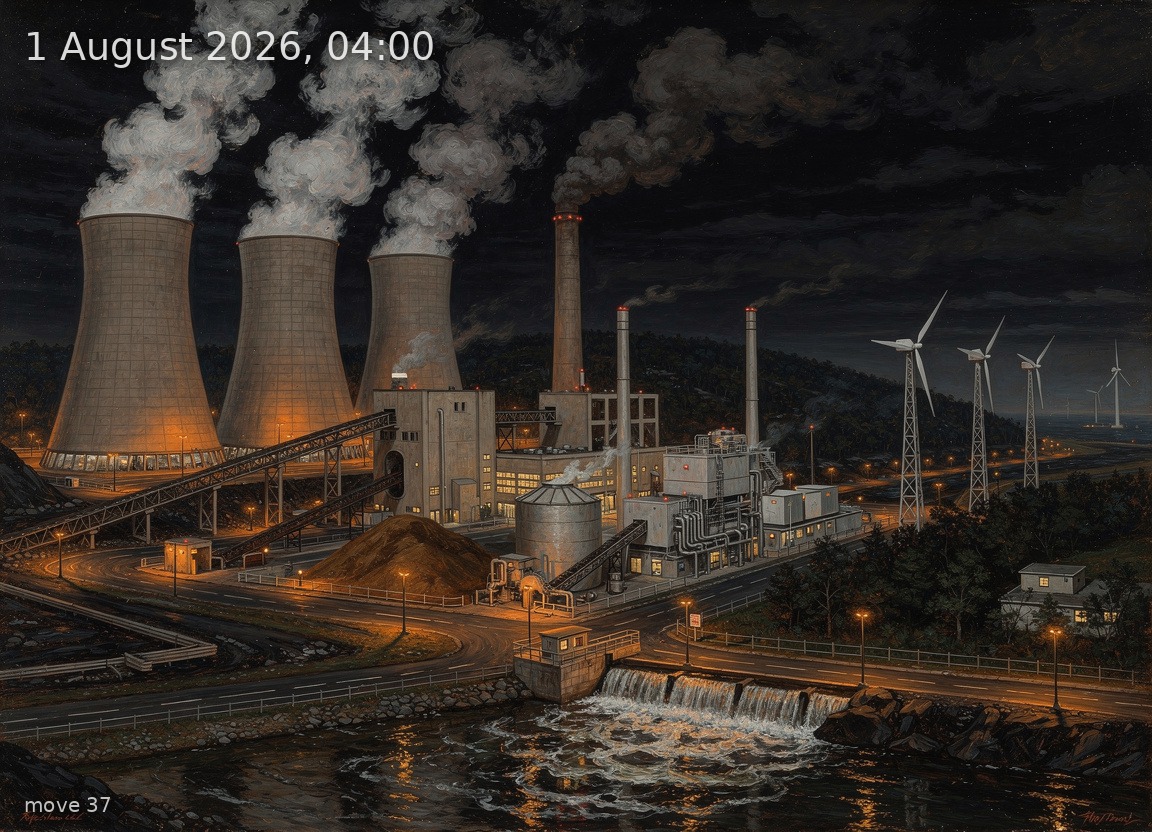
Brown coal dominates overnight generation as wind contributes modestly and net imports bridge a 9.5 GW gap.
Generation mix
Wind onshore 20%
Wind offshore 2%
Biomass 12%
Hydro 4%
Natural gas 16%
Hard coal 14%
Brown coal 33%
37%
Renewable share
6.4 GW
Wind (on + offshore)
0.0 GW
Solar
30.2 GW
Total generation
9.5 GW
Net import
154.5 EUR/MWh
Day-ahead price
18.5°C / 18 km/h
Temp / Wind speed
Open-Meteo, Kassel (51.3°N 9.5°E) · surface estimate from 100 m wind
98.0% / 0.0 W/m²
Cloud cover / Radiation
454
gCO₂/kWh
Image prompt
Brown coal 10.0 GW dominates the left third of the scene as a massive lignite power station with four hyperbolic cooling towers emitting thick white steam plumes into the black sky; hard coal 4.3 GW appears just right of centre as a coal-fired plant with tall rectangular boiler houses, conveyor belts, and a single large chimney trailing grey smoke; natural gas 4.7 GW sits at centre-right as a pair of compact CCGT units with slender exhaust stacks venting translucent heat haze; wind onshore 5.9 GW stretches across the right quarter as a row of modern three-blade turbines on lattice towers, rotors turning at moderate speed; wind offshore 0.5 GW is suggested by a single distant turbine silhouette near the far-right horizon; biomass 3.7 GW appears as a medium-sized industrial facility with a rounded wood-chip silo and a modestly smoking stack in the mid-ground between the coal and gas plants; hydro 1.1 GW is a small dam with water cascading in the far background at the foot of a dark hillside. The time is 4:00 AM in August: the sky is completely black, no twilight, no sky glow, deep navy-to-black overhead, stars barely visible through 98% cloud cover creating a heavy, oppressive overcast blanket. All structures are lit by sodium-orange industrial floodlights and glowing windows, casting warm pools of amber light onto wet-looking pavement and surrounding summer foliage — full-leafed deciduous trees, tall grass. The atmosphere feels heavy and humid at 18.5°C; a faint mist clings to the ground near the cooling towers. The elevated electricity price is conveyed through a dense, pressing atmosphere — low clouds seem to weigh on the landscape. Painted as a highly detailed oil painting in the tradition of 19th-century German Romantic landscape painters such as Caspar David Friedrich and Carl Blechen: rich impasto brushwork, dramatic chiaroscuro between the industrial light sources and the surrounding darkness, atmospheric depth with receding layers of infrastructure fading into the murky night. Meticulous engineering detail on every turbine nacelle, cooling tower shell, conveyor gantry, and exhaust stack. No text, no labels, no human figures prominent.